Physical Address
304 North Cardinal St.
Dorchester Center, MA 02124
Physical Address
304 North Cardinal St.
Dorchester Center, MA 02124
Giving your paver patio the right care involves surprising seasonal secrets and maintenance cycles that most homeowners completely overlook.
Paver patios in Romeoville’s freeze-thaw climate require calcium chloride or potassium acetate de-icers, prompt snow removal, and seasonal polymeric sand inspection to remain structurally sound through winter. Will County’s 42-inch frost line and Group B through D glacial soils make base preparation the decisive factor in how well a patio withstands repeated freeze-thaw cycling. Winter paver maintenance is the seasonal practice of protecting surface joints, material integrity, and drainage function against freeze-thaw stress, ice-melt chemical exposure, and frost heave.
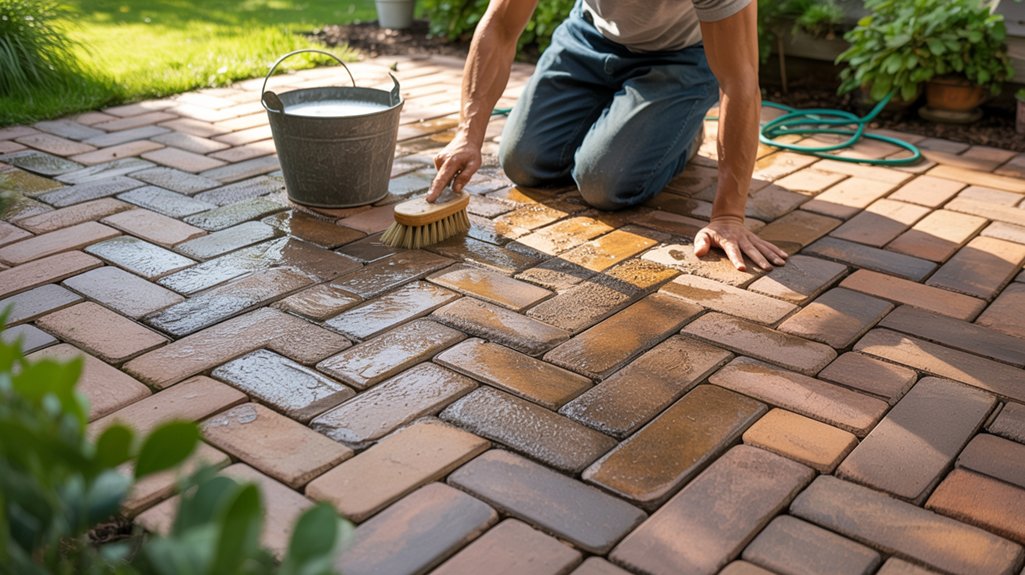
Consistent seasonal maintenance — sweeping debris before it decomposes into joint sand, rinsing surface accumulations before they bond — keeps ASTM C936 pavers performing well within their rated compressive capacity rather than degrading prematurely from surface neglect. Stain response is time-sensitive; oil, organic matter, and mineral deposits become increasingly resistant to removal once they’ve penetrated the paver’s surface texture, particularly on unsealed installations exposed to Romeoville’s wet spring and summer storm cycles. De-icing product selection carries equal consequence, since chloride-based compounds accelerate surface scaling on concrete pavers and compromise the cured polymeric sand matrix that stabilizes the entire field.
Northeastern Illinois receives approximately 41 inches of annual precipitation, with late-spring and summer convective thunderstorms delivering concentrated surface loads that accelerate organic debris accumulation and staining in paver joints. Left unaddressed, organic material—leaf tannins, algae, and windborne sediment—degrades polymeric sand integrity and creates surface conditions where freeze-thaw cycling drives contaminants deeper into joint cavities. Romeoville’s climate, characterized by roughly 29 inches of seasonal snowfall and aggressive freeze-thaw oscillation, compounds this effect across the full calendar year rather than isolating damage to a single season. Routine dry sweeping followed by low-pressure rinsing removes surface deposits before they bond, while prompt stain response prevents penetration into paver faces—a functional outcome that directly extends re-sealing and polymeric sand replacement intervals.
Calcium chloride and magnesium chloride are the de-icing compounds least likely to compromise ASTM C936-compliant concrete pavers, as both operate at lower application rates than sodium chloride and avoid the aggressive chloride concentrations that accelerate surface scaling under freeze-thaw cycling. Romeoville’s frost line of 42 inches and its sustained winter oscillation between freezing and thawing temperatures create repeated mechanical stress at the paver face, a condition that sodium chloride intensifies by drawing moisture into surface pores before refreezing. Coarse sand applied as a traction aid eliminates chemical exposure entirely on pedestrian surfaces where ice management—rather than melt acceleration—is the primary objective. Avoiding urea-based and fertilizer-grade compounds further protects joint polymeric sand from nitrogen-driven degradation and prevents runoff concerns near Gateway Wetlands and Des Plaines River corridor drainage paths.
Polymeric sand and surface sealers aren’t permanent—both degrade under the mechanical stress of freeze-thaw cycling, UV exposure, and the abrasion that accumulates in high-traffic corridors like those along Weber Road. Joint sand warrants re-application on a five-to-eight-year cycle, with the actual interval determined by visible erosion, weed infiltration, or joint loosening that signals the binding agents have broken down. Sealing schedules vary by material: concrete pavers tolerate longer intervals between applications, while natural stone—more porous and more reactive to moisture infiltration—typically requires a shorter cycle to prevent staining, spalling, and surface degradation from water that freezes within the material itself.
Polymeric sand — the jointing compound that locks segmental paver systems against lateral displacement, weed intrusion, and insect infiltration — reaches functional exhaustion within five to eight years under the freeze-thaw cycling documented across northeastern Illinois’s USDA Hardiness Zones 5b–6a. At the 42-inch frost line governing Will County installations, repeated freeze-thaw cycles exert sustained hydrostatic and expansive pressure against joint material, progressively fracturing the polymer binder that holds sand particles in cohesion. Once that binder fails, joints open to moisture infiltration, accelerating the very base saturation that compromises the compacted aggregate layer below. Because most visible surface problems — rocking units, joint erosion, edge displacement — trace to compromised jointing rather than paver-face wear, re-application on a disciplined cycle addresses failure at its origin rather than at its symptom.
Concrete pavers manufactured to ASTM C936‘s minimum 8,000 psi compressive strength require sealer reapplication on a three-to-five-year cycle under the aggressive freeze-thaw conditions documented across Will County’s USDA Hardiness Zones 5b–6a, while natural stone installations demand shorter intervals of two to three years due to the higher porosity and dimensional variability inherent to natural materials. The distinction matters because sealer functions differently across material types: on dense concrete pavers, it primarily repels surface moisture and de-icing chemical penetration, while on natural stone it additionally stabilizes the material against spalling and efflorescence driven by subsurface moisture migration. Romeoville’s approximately 41 inches of annual precipitation, combined with a 42-inch frost line, sustains the hydrostatic pressure that shortens effective sealer life regardless of material. Clay pavers conforming to ASTM C902 or C1272 occupy a middle interval, requiring reapplication every four to six years depending on surface texture and joint exposure.
Routine maintenance addresses surface degradation, but it can’t correct structural failures rooted in base preparation — and in Romeoville’s freeze-thaw environment, the distinction matters. When pavers heave seasonally or settle unevenly, the cause is almost always inadequate base depth, improper compaction, or unresolved drainage conditions beneath the installation rather than surface wear. Properties near the Des Plaines River floodplain face compounding risk, where seasonally high water tables and hydric soils can destabilize even well-compacted aggregate bases if surface drainage wasn’t engineered to redirect water away from the subgrade at the outset.
Heaving and settlement that displace individual pavers trace directly to base preparation failures, not surface wear, because compaction standards under ASTM D1557 Modified Proctor require base aggregate to reach 95 percent density before any paver course is set. When that threshold goes unmet, freeze-thaw cycling in Will County’s soil profile — where the frost line reaches 42 inches below finished grade — drives moisture-laden subbase material through repeated expansion and contraction cycles that no surface maintenance protocol can counteract. Polymeric sand, sealing, and re-screeding address the joint and surface plane; none restores subbase density lost at installation. Patios exhibiting chronic rocking units, persistent low spots, or recurring edge separation after frost seasons are exhibiting structural failure at the aggregate layer, a condition that requires base excavation and recompaction rather than any maintenance intervention.
Will County stormwater ordinances require detention, release-rate controls, and water-quality measures for any project that materially alters drainage patterns or adds significant impervious surface near the Des Plaines River floodplain. Hydrologic Soil Groups C and D — the predominant classifications across floodplain-adjacent subdivisions and hydric depressions in Romeoville’s service area — exhibit infiltration rates low enough that surface water cannot disperse through the subgrade at the rate convective storm events deliver it. When a patio’s 1- to 2-percent drainage slope directs runoff toward saturated Group D soils, no maintenance protocol redirects that water; the drainage path itself is a site engineering condition established at design. Chronic ponding at patio edges in these corridors reflects a drainage design failure, one that requires regrading, subsurface conveyance, or regulatory review rather than any routine upkeep measure.
A few questions surface repeatedly among paver patio owners managing Romeoville’s climate conditions, and the answers tend to clarify misconceptions that, left unaddressed, accelerate deterioration. Rock salt, annual sealing, and post-winter heave are distinct issues, each governed by different variables. Polymeric sand replacement intervals, sealer scheduling, and winter chemical selection all follow material-specific logic rather than a single universal schedule.
Polymeric sand in Romeoville-area paver patios typically requires replacement every five to eight years under normal service conditions. Patios installed near the Des Plaines River floodplain or Gateway Wetlands-adjacent subdivisions experience accelerated joint erosion due to seasonal high water tables and the region’s aggressive freeze-thaw cycling. Sustained joint integrity is the single most reliable indicator that replacement intervals should be shortened rather than extended.
Rock salt is not recommended for use on paver patios, as sodium chloride accelerates freeze-thaw spalling, degrades polymeric sand joints, and contaminates adjacent soils and stormwater drainage. Romeoville’s 42-inch frost line and Zone 5b-6a temperature swings amplify these effects considerably. Sand, fine grit, or chloride-free deicers preserve surface integrity while remaining compatible with Will County stormwater and drainage standards.
Pavers heave after winter in Illinois primarily because water infiltrates the base, freezes, expands, and lifts the surface unevenly during the aggressive freeze-thaw cycling characteristic of the southwest Chicago corridor. Romeoville’s frost line reaches approximately 42 inches, the deepest in the regional market, meaning inadequately prepared bases are especially vulnerable. Most heaving traces to insufficient compaction or base depth rather than surface-layer failure.
Paver patios do not require annual sealing; most concrete and clay paver installations in Romeoville’s freeze-thaw climate follow resealing cycles of two to five years depending on material porosity, sun exposure, and traffic load. Permeable systems designed to meet Will County stormwater requirements should be evaluated before any sealer application, as certain film-forming products reduce infiltration rates. Observing color fade and surface sheen loss provides reliable timing indicators between scheduled cycles.
Romeoville’s 42-inch frost line — the deepest threshold across the southwest Chicago corridor — combined with Will County stormwater ordinance requirements, ASTM C936 compressive minimums, and ICC-adopted base compaction standards at 95 percent of Modified Proctor density, creates a maintenance environment where long-term paver performance is determined almost entirely at the installation stage. Backyard Paradiso brings direct command of those technical requirements to paver patio installation and maintenance across Romeoville and its surrounding estate corridors, where base preparation failures account for the majority of surface-level problems that routine upkeep cannot resolve. Consultations are available by appointment from the firm’s Romeoville office, serving the Weber Road corridor, Gateway Wetlands subdivisions, the Des Plaines River edge, and the Bolingbrook and Forest Preserve District of Will County boundary. Well-executed paver patios in these markets consistently demonstrate strong resale recovery and expand functional outdoor square footage through seasons that marginal installations cannot reliably sustain.