Physical Address
304 North Cardinal St.
Dorchester Center, MA 02124
Physical Address
304 North Cardinal St.
Dorchester Center, MA 02124
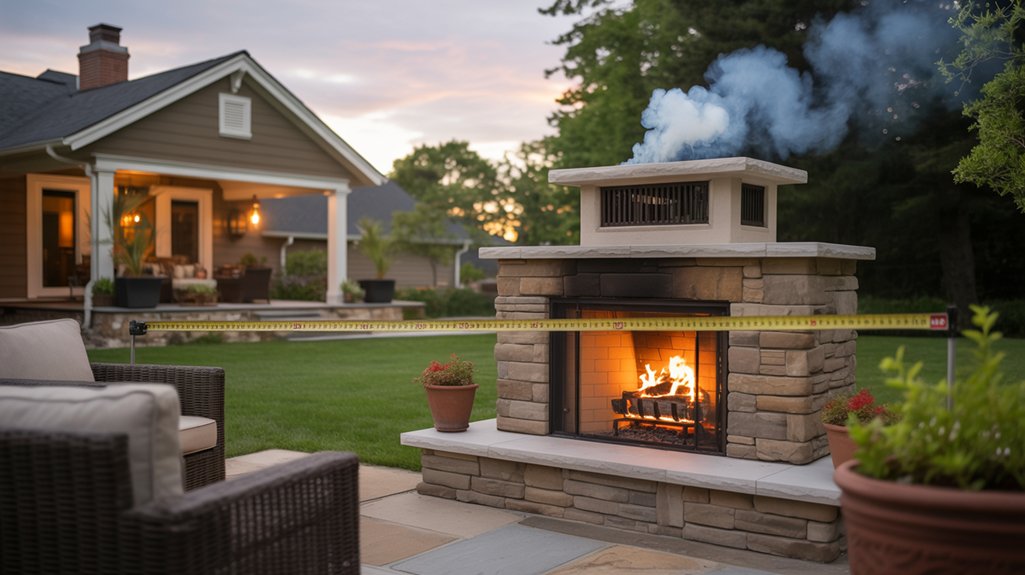
Just how far your outdoor fireplace must sit from your house depends on factors most homeowners never consider.
No single distance governs all outdoor fireplaces — the required clearance depends entirely on appliance type and its governing regulatory path. Factory-built units listed to UL 127 follow their own listing documentation, while site-built masonry fireplaces follow IRC prescriptive framing clearances, and portable units fall under IFC open-burning setbacks. An outdoor fireplace is a permanently or temporarily installed combustion appliance designed for open-air residential use.
Factory-built fireplaces listed to ANSI/UL 127 carry clearance requirements established exclusively within each appliance’s own listing documentation, not within a universally prescribed code dimension. The International Residential Code directs installers to comply with those listing documents, explicitly displacing any prescriptive masonry rules from the compliance path for factory-built units. Because the listing is product-specific, the approved clearance distance between the appliance and combustible construction varies from one manufacturer’s model to the next. Confirming the installation instructions for the specific listed unit is consequently the only method that establishes a code-compliant setback — no substitution of a generic figure satisfies the IRC’s listing-compliance requirement.
IRC Section R1001.11 prescribes a minimum 2-inch clearance on the front and sides of a site-built masonry fireplace and a 4-inch clearance behind the back face — dimensions that govern the masonry structure’s relationship to adjacent combustible framing, not the appliance’s distance from the house as a whole. This distinction is consequential: the provision addresses combustible construction built into or immediately surrounding the fireplace assembly, making it a structural clearance requirement rather than a siting setback. No IRC prescriptive section establishes a universal house-distance figure for permanently installed masonry fireplaces. Because the masonry prescriptive path does not extend to factory-built or listed appliances, R1001.11’s figures cannot be imported into those compliance paths either, reinforcing that the governing dimension is always installation- and appliance-type-specific.
The International Fire Code’s open-burning provisions establish a 25-foot separation for recreational fires and a 15-foot separation for portable or gas-fired outdoor fireplaces — figures that apply exclusively to portable units and open burning, not to permanently installed listed appliances. A permanently installed factory-built fireplace listed under ANSI/UL 127, or a listed gas appliance governed by ANSI Z21.97/CSA 2.41 and NFPA 54, follows a compliance path rooted in the appliance’s own installation documentation rather than the IFC open-burning setback table. The fire code official also retains authority to reduce the IFC distances, which further undermines their treatment as fixed universal thresholds. Because no single prescriptive number governs all installation types, the controlling clearance for any permanently installed appliance is determined by the listing documentation and the local authority having jurisdiction.
Wood and composite decking beneath a fireplace hearth extension requires a non-combustible buffer zone before any listed outdoor fireplace can be installed above it. This requirement reflects the listing-specific radiant-heat and ember-emission thresholds that govern factory-built appliances under ANSI/UL 127, which assign overhead and adjacent clearances through the appliance’s own installation documentation rather than through a universal prescriptive dimension. Pergola rafters and awning fabric fall under the same logic: the governing clearance to those combustible overhead structures is determined by the specific listed product’s instructions, not by a fixed code table. Because those dimensions vary by appliance and are enforced by the local authority having jurisdiction, no single setback figure applies across installation types.
Enclosing a fireplace listed for open outdoor use under ANSI/UL 127 can invalidate the appliance’s listing by altering the ventilation and carbon-monoxide dispersal conditions that the original certification assumed. Factory-built outdoor fireplaces earn their listings under specific installation configurations, and any structural modification — including the addition of a roof, enclosing walls, or a pergola cover — constitutes a change of conditions that the listing documentation did not authorize. When a listing is invalidated, the clearances specified in the installation instructions no longer govern with regulatory force, exposing the installation to rejection by the authority having jurisdiction. The safe distance for such a project must then be renegotiated through the AHJ before any enclosure construction proceeds.
The International Fire Code grants the authority having jurisdiction explicit discretion to reduce or modify open-burning setback distances, which means no single published figure governs every outdoor fireplace installation. For factory-built appliances listed under ANSI/UL 127, the clearance to combustible construction is established solely by the appliance’s listing documentation and installation instructions, not by a prescriptive code dimension. For site-built masonry fireplaces, IRC Section R1001.11 specifies clearances to adjacent combustible framing but does not define how far the overall structure must sit from the house. Because the governing distance shifts depending on appliance type, listing path, and local amendment, confirming both the manufacturer’s installation instructions and the AHJ’s interpretation before finalizing placement is the only method that produces a defensible, code-compliant setback.
Factory-built gas fireplaces and site-built masonry fireplaces don’t share a clearance standard — each follows its own regulatory path, with listed appliances governed by manufacturer installation documents and masonry units subject to IRC prescriptive dimensions that address adjacent combustible framing rather than setback from the house. The 15- and 25-foot figures drawn from IFC open-burning provisions apply to portable units and recreational fires, not to permanently installed appliances, and applying them to a built-in fireplace conflates two distinct regulatory frameworks. Overhead structures like pergola rafters introduce additional clearance obligations tied to the appliance’s listing, and the authority having jurisdiction holds final approval over any site-specific distance determination.
Factory-built gas fireplaces use different clearances than masonry ones. Listed gas appliances follow ANSI Z21.97/CSA 2.41, meaning clearances derive from the product’s own installation instructions rather than any prescriptive code dimension. Masonry fireplaces instead follow IRC R1001.11 prescriptive rules, which do not apply to listed factory-built units.
The 15- and 25-foot open-burning distances do not apply to permanently installed, listed outdoor fireplaces. Those figures come from IFC open-burning provisions governing portable units and recreational fires, not fixed appliances. Governing clearances for built-in fireplaces run through listing documentation and building-code compliance paths instead.
Yes, a pergola or covered patio can change the required clearance. Overhead combustible structures like rafters or awning fabric must clear the radiant-heat and ember-emission zone specified in the appliance’s listing documentation. Enclosing a listed outdoor fireplace can also invalidate its original carbon-monoxide and venting assumptions.
The local authority having jurisdiction holds final approval over any outdoor fireplace distance from the house. Listing documents and IRC provisions establish baseline clearances, but the fire code official is authorized to reduce or modify applicable setbacks for specific installations. Confirming requirements with the local jurisdiction before siting is finalized remains the only reliable path to an approved distance.
Jurisdictions across the greater service region apply overlapping regulatory frameworks to permanent outdoor fireplace installations — including IFC open-burning setbacks, listing-specific clearances under ANSI/UL 127 or ANSI Z21.97, and locally variable authority-having-jurisdiction determinations that can modify prescribed distances before a permit is issued. Backyard Paradiso works within this layered code environment regularly, with direct experience steering the distinction between factory-built listed appliances, site-built masonry construction, and the separate compliance path each requires for outdoor fireplace installations. Consultations are available by appointment for clients in the Dallas–Fort Worth area, Houston, San Antonio, Austin, and surrounding markets. Properly sited and permitted outdoor fireplaces return measurable value in functional outdoor living area, and projects that establish compliant clearances from combustible construction and overhead structures from the outset avoid costly repositioning or retrofitting that can erode that return. Confirming appliance listing documentation and local AHJ requirements before siting is finalized is where that value is protected.