Physical Address
304 North Cardinal St.
Dorchester Center, MA 02124
Physical Address
304 North Cardinal St.
Dorchester Center, MA 02124
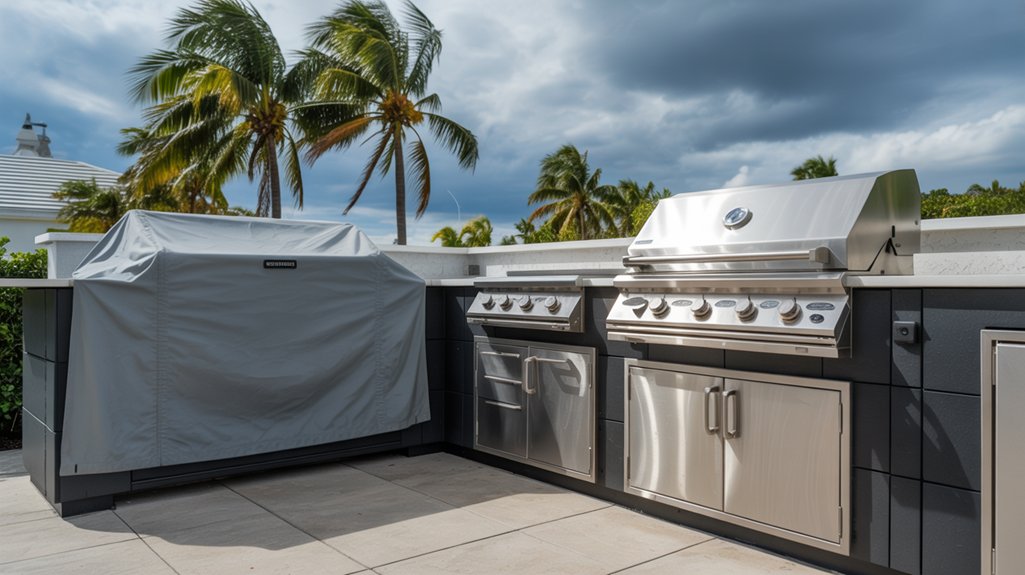
Follow these essential hurricane prep steps to safeguard your Naples outdoor kitchen—your gas lines and cabinetry depend on what you do next.
A Naples outdoor kitchen hurricane preparedness protocol requires shutting off gas at the service valve, removing or anchoring portable appliances, securing cabinetry to structural framing, and staging post-storm saltwater decontamination before the next named storm makes landfall. Southwest Florida’s subtropical salt-air exposure and HVHZ wind ratings demand 316 marine-grade stainless throughout. An outdoor kitchen hurricane preparedness protocol is a sequenced set of pre-storm and post-storm procedures designed to protect fixed appliances, gas infrastructure, and structural cabinetry from wind, surge, and corrosive contamination during named-storm events.
When the National Hurricane Center issues a named-storm watch for Southwest Florida, the preparation window typically spans 48 hours — enough time to execute a sequenced shutdown that begins at the gas supply and works outward through each connected appliance. The gas-line shutoff comes first, closing the manual ball valve at the dedicated outdoor kitchen stub-out before any appliance is touched, because residual pressure in downstream lines creates ignition risk during disconnection. From there, the distinction between removable appliances and anchored installations determines whether a unit goes into interior storage or stays in place under storm-rated cover.
A named-storm watch issued by the National Hurricane Center indicates that hurricane conditions are possible within 48 hours, establishing the watch as the correct threshold for initiating gas-line shutoff and appliance disconnection at outdoor kitchen installations along the Southwest Florida Gulf Coast. That 48-hour window is the operative planning margin recognized by NOAA’s National Hurricane Center, and it distinguishes a watch from a warning, which compresses the action window to 36 hours. For propane and natural gas service, the shutoff sequence begins at the appliance isolation valves, proceeds to the branch supply valve, and terminates at the meter or tank service valve. Disconnecting flexible gas connectors before high-wind arrival prevents connector fatigue failure caused by wind-induced appliance movement, a consequence that can compromise line integrity even when the primary shutoff has been closed.
The Florida Building Code‘s High-Velocity Hurricane Zone provisions require that permanently installed outdoor kitchen appliances meet anchoring specifications capable of resisting design wind speeds exceeding 180 mph for Risk Category II structures in Collier County. That anchoring standard draws a functional line between two categories of equipment that demand different pre-storm protocols when a named-storm watch is issued: appliances that can be physically removed and sheltered indoors, and appliances that must remain in place and depend entirely on structural anchorage to survive the event. Freestanding grills, portable refrigeration units, and countertop appliances fall into the first category and should be relocated to an enclosed garage or interior room before wind conditions deteriorate. Built-in grills, drop-in burners, and undercounter appliances welded or bolted into cabinetry assemblies anchored to a concrete substrate represent the second category, where pre-storm action shifts from relocation to verification of fastener integrity and protective covering.
Outdoor kitchens built to withstand HVHZ conditions aren’t assembled — they’re engineered, with Florida Building Code provisions dictating how cabinetry, countertops, and appliance housings anchor to the substrate beneath them. Where sandy coastal soils undermine conventional footing assumptions, those anchoring requirements carry compounding consequence, since a structure that shifts under sustained 180-mph loads becomes projectile mass rather than fixed architecture. Material selection operates under the same logic: 316 marine-grade stainless resists the chloride-accelerated corrosion that degrades 304 alloy within years on a Gulf Coast site, and hardware that corrodes loses clamping force long before a storm arrives to test it.
Florida’s High-Velocity Hurricane Zone designation, codified under Section 1609 of the Florida Building Code, requires outdoor kitchen cabinetry and countertop assemblies in Naples to withstand design wind speeds exceeding 180 mph for Risk Category II structures. These provisions go substantially beyond standard IRC requirements, mandating positive anchorage to the structural slab rather than surface-fastened attachment alone. Cabinetry frames must transfer lateral and uplift loads directly into substrate-level connections, a critical distinction on sandy coastal soils where unanchored mass can become airborne debris. Countertop materials face parallel scrutiny, as the code’s missile-impact testing standards apply to exposed horizontal surfaces that could fracture and generate secondary projectiles during a named storm.
316-grade stainless steel contains a minimum 2 percent molybdenum content, a compositional requirement that distinguishes it from 304-grade alloys and directly governs its resistance to chloride-induced pitting corrosion in coastal salt-air environments. In Naples, where NOAA climate data for Southwest Florida document year-round salt deposition rates that accelerate oxidation of ferrous and lower-alloy materials, 304-grade hardware used in structural fasteners, anchor bolts, and cabinet framing connections can exhibit visible corrosion within a single hurricane season. That corrosion undermines the load-path integrity that HVHZ anchorage depends on, since a compromised fastener cannot transfer the lateral and uplift forces mandated under Florida Building Code Section 1609. Specifying 316-grade material throughout the anchorage assembly — fasteners, straps, and embedded connections alike — preserves the structural capacity the code requires across the full service life of the installation.
After a named storm passes, the sequence in which an outdoor kitchen’s systems are inspected directly affects both safety and the accuracy of damage assessment. Gas lines and electrical components demand priority attention before any cleaning begins, because saltwater infiltration into conduit, junction boxes, or flex connectors can mask damage that only becomes apparent under load. Once those systems are cleared, saltwater contamination on 316 stainless steel surfaces, stone countertops, and cabinetry hardware requires thorough freshwater flushing followed by appropriate marine-grade cleaning agents, since chloride residue accelerates corrosion at a rate that cosmetically intact surfaces won’t reveal until the damage is irreversible.
Saltwater intrusion from storm surge deposits chloride ions directly onto stainless steel surfaces, initiating crevice corrosion in 304-grade alloy within hours of prolonged exposure. Southwest Florida Gulf Coast storm surges — documented by NOAA tide gauge stations at Naples Pier — can deposit saline residue across appliance interiors, burner ports, and cabinetry joints, compounding damage well beyond visible surface staining. Post-storm recovery requires immediate freshwater flushing of all exposed surfaces before chloride ions penetrate protective oxide layers, particularly on 304-grade components that lack the molybdenum content present in 316 marine-grade stainless steel. ASTM A240 compositional standards distinguish these alloys; 316 carries approximately 2–3 percent molybdenum by weight, which measurably slows chloride-driven pitting under coastal conditions. Burner valves, ignition assemblies, and electrical conduit entries demand individual inspection before any attempt at system restart.
NFPA 54 (National Fuel Gas Code) requires that gas supply systems be pressure-tested and inspected for leakage before restoration of service following any event that may have caused damage to the installation. Hurricane-force winds and storm surge present compound failure mechanisms for outdoor gas infrastructure: lateral loading can shear threaded fittings at underground risers, while saltwater infiltration accelerates corrosion at valve stems and flexible connector joints that may not exhibit visible external damage. Electrical conduit entries into outdoor kitchen cabinetry require inspection for water intrusion before any circuit is re-energized, as the National Electrical Code Article 680 provisions governing wet-location installations establish minimum standards that storm conditions routinely challenge. On Naples Gulf Coast properties where sandy substrate shifts during surge events, underground gas line alignment warrants physical verification before the pressure-test sequence begins.
Naples homeowners managing outdoor kitchens through hurricane season face a consistent cluster of recurring questions — when to act relative to watch versus warning declarations, which material grades hold up under sustained salt-air exposure, how long gas service should remain isolated after a storm passes, and whether standard homeowners policies actually cover the structural and appliance losses that result. These questions aren’t peripheral; they bear directly on both the physical integrity of the installation and the financial recovery that follows. What the answers share is a dependence on specific conditions — storm classification, utility provider protocols, alloy designation, and policy language — rather than general rules that apply uniformly across every situation.
Removing a freestanding grill before a hurricane watch is advisable, as watches carry a 48-hour potential landfall window — sufficient time for staged disassembly and indoor storage. Built-in grills anchored under Florida Building Code HVHZ provisions are designed to remain in place, though removable components like grates and drip trays should still be stowed. Backyard Paradiso advises Naples clients on which components qualify for removal versus permanent anchorage.
Grade 316 stainless steel, not 304, is the minimum acceptable specification for outdoor kitchen components in Naples and along the Southwest Florida Gulf Coast. The molybdenum content in 316 alloy provides measurably superior resistance to chloride-induced pitting corrosion that accelerates in salt-air coastal environments. Backyard Paradiso specifies 316 marine-grade stainless for cabinetry, grates, and hardware on all estate installations in Port Royal and Aqualane Shores.
Gas service should remain off until a licensed gas contractor or utility technician has physically inspected supply lines, fittings, and appliance connections for storm-induced displacement or corrosion. Sandy coastal substrates common to Naples can shift during hurricane-force wind events, stressing buried supply lines at connection points. Florida Building Code requires permitted gas systems be re-inspected before restoration of service following structural disturbance.
Homeowners insurance typically covers outdoor kitchen hurricane damage when the structure is permanently attached and listed as a scheduled improvement under the dwelling extension or other structures provision. Coverage limits, exclusions for detached structures, and named-storm deductibles — often 2–5% of dwelling value in HVHZ-rated Florida markets — greatly affect net recovery. Naples estate owners should review policy language with an insurance professional before hurricane season to confirm outdoor kitchen valuation and anchoring documentation requirements.
Sandy coastal substrate, sustained salt air exposure, and Florida Building Code HVHZ wind-load requirements reaching 180-plus mph collectively define the engineering baseline against which every outdoor kitchen component in Naples must be evaluated before a named storm makes landfall. Backyard Paradiso works within these conditions regularly, applying that familiarity to outdoor kitchen installation and storm preparedness across Southwest Florida’s Gulf Coast estate market. Consultations are available by appointment, giving property owners in Port Royal, Old Naples, Aqualane Shores, and Pelican Bay structured access to guidance on anchoring specifications, 316 marine-grade material selection, and pre-storm protocols calibrated to actual HVHZ requirements. The investment in a properly engineered outdoor kitchen — one built to withstand watch-to-warning timelines without requiring emergency disassembly — returns measurable value in functional square footage and long-term structural integrity that standard construction cannot replicate in this coastal environment.