Physical Address
304 North Cardinal St.
Dorchester Center, MA 02124
Physical Address
304 North Cardinal St.
Dorchester Center, MA 02124
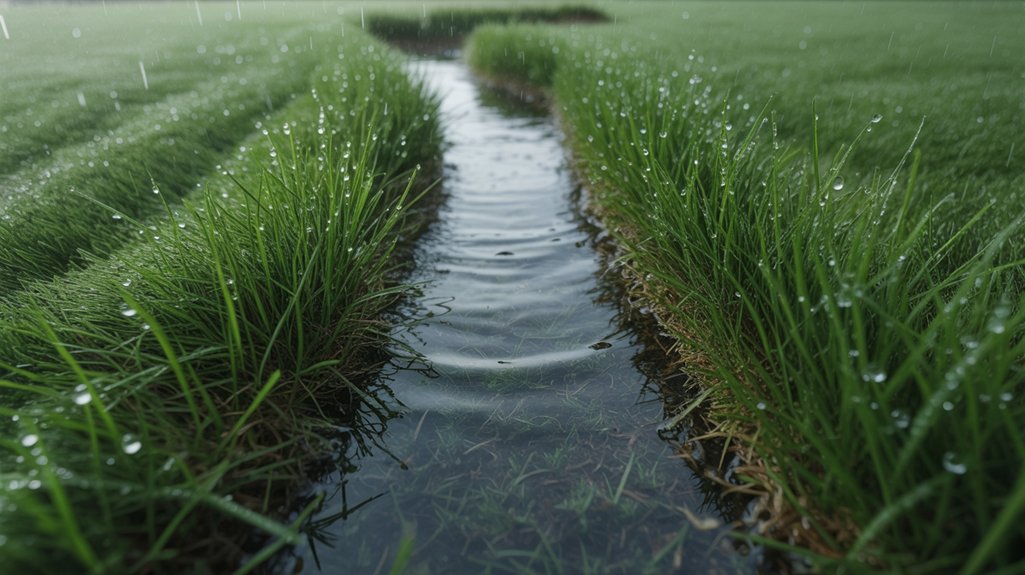
When it rains, artificial grass drainage depends on factors most homeowners overlook, and the results may surprise you.
Artificial grass drains effectively after Denver rain and snowmelt when the system beneath the surface is engineered to match local soil conditions. Denver’s Hydrologic Soil Group B and C clays limit natural infiltration, making a properly compacted aggregate base — not the turf surface itself — the true determinant of drainage performance. Artificial grass is a synthetic surface system combining UV-stabilized polyethylene fibers, perforated backing, and a compacted aggregate base designed to manage stormwater while eliminating irrigation demand.
Perforated backing moves water through the fiber layer quickly, often exceeding the infiltration rates of established natural turf, yet that advantage means little if the material beneath it can’t accept and redirect the volume. Over Denver’s Hydrologic Soil Group B and C clays, the compacted aggregate base functions as the system’s actual hydraulic mechanism—managing lateral dispersion and controlling how efficiently water clears the installation zone. How that base is specified, graded, and compacted ultimately determines whether the turf system performs under the convective storm loads and concentrated snowmelt events that characterize Front Range conditions.
Perforated backing in synthetic turf systems is engineered to pass water vertically at rates that exceed the infiltration capacity of compacted natural lawn soils under sustained rainfall. The backing layer, however, functions only as the entry point of a two-stage drainage path; the compacted aggregate base beneath it determines whether that water exits the system or pools at the turf-soil interface. In Denver’s Hydrologic Soil Group B and C soils — characterized by significant clay fractions and the shrink-swell behavior common across Front Range expansive clay formations — native subgrade infiltration rates can fall sharply during saturation, making base depth and compaction specification the controlling design variable. Convective storm events and spring snowmelt, not steady rainfall, represent the critical drainage design cases for installations across the Denver metro.
A compacted aggregate base specified at 90 to 95 percent of ASTM D1557 Modified Proctor density functions as the primary drainage reservoir in a synthetic turf system, holding and releasing storm volume that perforated backing alone cannot manage. In Denver’s Hydrologic Soil Group B and C subgrades, native clay infiltration rates drop considerably during saturation, leaving the 3-to-4-inch aggregate layer as the only available buffer between surface runoff and standing water at the turf-soil interface. Convective storm events deliver precipitation intensity that exceeds subgrade recovery rates, making base depth and gradation the governing design variables rather than backing flow rate. Site grading held to a minimum 2 percent slope away from foundations, as required under IRC site-drainage provisions, works in combination with base storage capacity to move that volume laterally before subgrade infiltration resumes.
Front Range convective storms don’t distribute rainfall gradually — they concentrate significant volume within compressed timeframes, creating surface-loading conditions that expose any weakness in base compaction or lateral drainage geometry. Hail compounds this by momentarily sealing the turf surface, delaying vertical infiltration precisely when runoff volume peaks. Snowmelt introduces a separate but related stress: freeze-thaw cycling at the base layer tests whether aggregate density, held at 90 to 95 percent of Modified Proctor, can resist the heave and settlement that destabilize drainage gradients over successive winters.
Denver sits within the central U.S. hail corridor, where convective storm cells deliver intense short-duration precipitation events that can overwhelm drainage systems engineered for gentler regional climates. These storms concentrate runoff into narrow windows, testing whether a synthetic turf installation’s aggregate base can transmit water fast enough to prevent pooling at the surface. Compacted aggregate placed over Hydrologic Soil Group B and C clays — the predominant soil condition across Denver’s estate corridors — presents the binding constraint, as the clay fraction beneath the base limits the rate at which water ultimately escapes the profile. Snowmelt events compound the challenge, introducing sustained low-intensity infiltration demand during freeze-thaw cycles that are characteristic of Denver’s shoulder seasons at elevation.
Denver’s frost-line depth is commonly taken at 30 to 36 inches under Denver Building Code structural provisions, a threshold that directly governs how aggregate base layers must be specified to resist heave during the freeze-thaw cycles that recur across the Front Range through late autumn and early spring. Compacted aggregate placed at 90 to 95 percent of ASTM D1557 Modified Proctor density resists the volumetric displacement that expansive Front Range clays exert as moisture content shifts with freezing and thawing. Snowmelt introduces sustained low-intensity infiltration demand distinct from the short-duration convective events that define the warm season, and the combination of both event types means the base must maintain structural integrity across a wide range of saturation states. Where base compaction falls below specification, differential settlement at the surface becomes a functional consequence measurable in pile-height inconsistency and localized ponding.
Surface geometry and structural compliance aren’t separable concerns in a Denver artificial grass installation. Site grading must direct runoff away from foundations at a minimum two percent slope, a threshold the IRC establishes not as a suggestion but as the baseline condition for protecting below-grade building envelope components through Denver’s freeze-thaw cycles and convective storm events. Under the city’s MS4 stormwater framework, permeable synthetic turf surfaces can qualify as managed pervious cover, which carries real consequences for how the Department of Transportation & Infrastructure evaluates a site’s runoff contribution during permit review.
The International Residential Code requires finish grades to slope a minimum of 2 percent away from foundations for a distance of at least 10 feet, a threshold that synthetic turf installations in Denver must meet or exceed to maintain code compliance. In clay-heavy Front Range soils classified under Hydrologic Soil Groups B and C, this grading requirement carries amplified consequence: the shrink-swell behavior of expansive clays means that surface drainage failures translate directly into hydrostatic pressure cycles against foundation walls. Artificial grass edge detailing and bender-board connections must preserve, not interrupt, the designed slope across the full turf footprint. Denver’s Department of Transportation and Infrastructure further enforces MS4 stormwater compliance, meaning that any regrading associated with a turf installation that alters site runoff patterns may require review under municipal stormwater approvals.
Denver’s Department of Transportation and Infrastructure administers MS4 stormwater permits that govern how surface drainage from residential properties—including turf installations—discharges into the municipal separate storm sewer system. Permeable synthetic turf surfaces, when properly constructed over a compacted aggregate base with perforated backing, reduce peak runoff volumes relative to impervious hardscape, a characteristic that aligns with the city’s broader demand-management framework favoring infiltration-friendly surfaces. However, MS4 compliance scrutiny applies at the edges: bender-board transitions, concrete mow strips, and adjacent hardscape elements can create localized impervious connections that redirect sheet flow in ways that alter the site’s pre-installation drainage signature. Any regrading that materially changes runoff patterns triggers review under Denver’s stormwater approval process, making edge detailing and perimeter grading as consequential to regulatory compliance as the turf field itself.
Drainage performance in Denver’s climate raises predictable questions, and the answers hinge less on the turf surface itself than on what’s engineered beneath it. Pooling, drain rates under convective rainfall, snow interaction, and the role of supplemental drainage over expansive clay soils each reflect distinct variables in a system where backing permeability and base design do most of the work. Understanding how those components respond under Front Range conditions clarifies what a well-installed system can reasonably deliver.
Pooling does not occur on properly installed artificial grass when both the perforated backing and the compacted aggregate base beneath it function as an integrated drainage system. Denver’s expansive clay soils in Hydrologic Soil Group B and C classifications slow vertical percolation, making base preparation the critical variable. Sites graded to a minimum two percent slope away from foundations address residual surface flow during the convective storm events common across Denver’s estate corridors.
Well-designed artificial turf systems drain at rates far exceeding natural turfgrass, with perforated backing capable of passing substantial volumes per hour under ideal conditions. Performance is ultimately governed by the compacted aggregate base and the infiltration capacity of underlying soils — a critical qualification in Denver’s Hydrologic Soil Group B and C clay-heavy terrain. Convective storm events across Cherry Hills Village and Greenwood Village represent the practical design benchmark.
Snow does not damage properly installed artificial grass under normal Denver winter conditions. Freeze-thaw cycling, which occurs frequently along the Front Range, is the more relevant stress factor, as repeated ground movement in expansive clay soils can affect base stability over time. Installations incorporating a well-compacted aggregate base engineered to Denver’s frost-line depth perform reliably through seasonal snowfall averaging 50–60 inches annually.
French drains are not universally required beneath artificial grass installed over clay soil, but expansive Front Range clay presenting Hydrologic Soil Group B or C conditions frequently warrants one. Where native soil infiltration rates fall below convective storm and snowmelt design volumes, lateral drainage infrastructure becomes the controlling factor. Denver’s Department of Transportation and Infrastructure administers MS4 stormwater approvals that shape these site-specific drainage determinations.
Denver’s Front Range clay-loam and expansive clay soil profiles, combined with convective storm drainage loads and MS4 stormwater permitting requirements, create installation conditions that routine synthetic turf specifications routinely underestimate. Backyard Paradiso works within these site-specific constraints, bringing direct familiarity with aggregate base engineering over Hydrologic Soil Group B and C soils to its artificial grass installations across the Denver metro. Consultations are available by appointment for properties throughout Cherry Hills Village, Greenwood Village, Hilltop, Crestmoor, Washington Park, Cherry Creek North, Lowry, and The Preserve at Greenwood Village. Investment in a properly engineered system is framed through functional square footage equivalence and long-term resale recovery — surfaces that drain reliably through snowmelt cycles and peak-season convective storms extend usable outdoor hours across more months of the year, a measurable return in a market where outdoor living space directly influences property value.