Physical Address
304 North Cardinal St.
Dorchester Center, MA 02124
Physical Address
304 North Cardinal St.
Dorchester Center, MA 02124
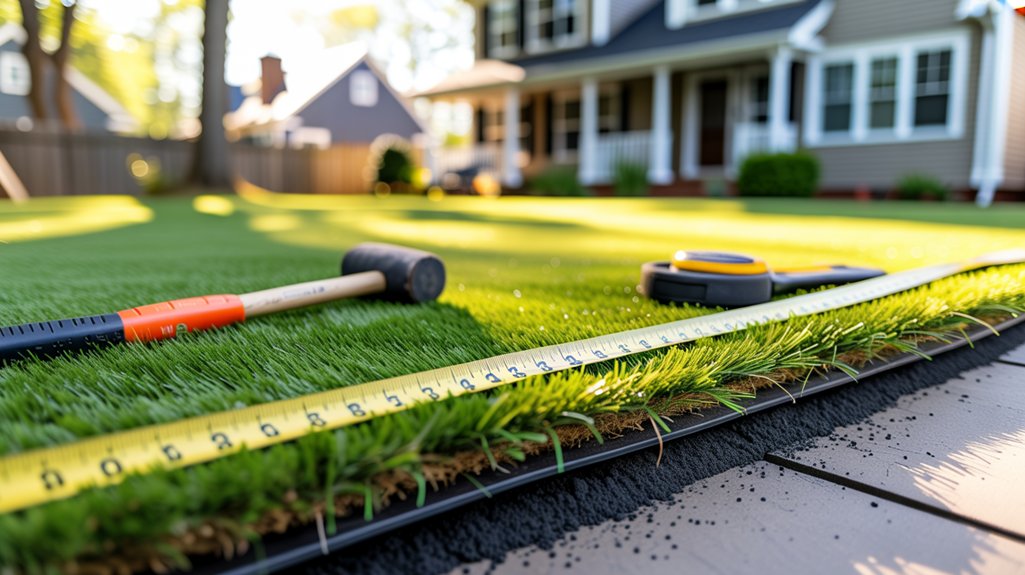
Outdoor artificial turf costs in New Jersey vary wildly depending on site conditions, materials, and permits—discover what truly drives your final price.
Three interlocking cost drivers — site conditions, specification tier, and total scope — determine what artificial turf installation carries as a final investment in New Jersey. Meadowlands-area soils, shallow groundwater corridors near the Hackensack River, and North Jersey freeze-thaw cycling introduce site variables absent in more forgiving markets. Artificial turf installation is the engineered replacement of natural lawn surface with a multi-layer synthetic system designed to deliver consistent performance across drainage, load, and climate demands throughout its service life.
Nowhere in the project budget does the site itself assert more influence than in the base preparation phase. The Secaucus soil series — very deep, human-transported fill with high coarse-fragment content — exhibits bearing and compaction behavior that varies meaningfully from lot to lot, and proximity to the Hackensack River or adjacent wetlands can place groundwater close enough to the surface that drainage engineering carries a disproportionate share of the total scope. Tight inner-ring lots compound this further, as restricted machine access, constrained staging areas, and disposal logistics for unsuitable fill material each add labor hours that an incomplete proposal won’t surface until the work is underway.
The USDA Natural Resources Conservation Service formally recognizes the Secaucus soil series as very deep, moderately well drained soils formed in thick human-transported fill with high coarse-fragment content — a classification that signals heterogeneous bearing conditions from lot to lot across the Meadowlands. Where groundwater elevation rises near the Hackensack River and adjacent wetland margins, subgrade saturation can compromise aggregate base compaction and accelerate edge restraint movement if drainage provisions are underdesigned. North Jersey freeze-thaw cycling drives frost depth considerations that the local construction official, operating under the New Jersey Uniform Construction Code, should confirm for any footing or edge-restraint detail. On these soils, base preparation — excavation depth, aggregate specification, compaction verification, and drainage outlet design — carries a larger share of total project scope than it would on free-draining upland sites elsewhere in the region.
The New Jersey Uniform Construction Code adopts frost depth requirements that direct contractors working in Hudson and Bergen counties to design edge restraints and any load-bearing details against freeze-thaw cycling characteristic of the North Jersey climate zone. On the tight urban and inner-ring lots common to Secaucus and surrounding Meadowlands communities, that cycling compounds existing site challenges: grading corrections must direct surface runoff away from structures and toward compliant outlets, and drainage provisions embedded within the aggregate base must account for shallow groundwater near the Hackensack River. Machine access on constrained lots forces sequential equipment staging, increases hand-labor content, and complicates material removal logistics — all conditions that distinguish a site-specific scope from a generalized estimate and explain why drainage design carries a disproportionate share of the installed budget on Meadowlands parcels.
Once site conditions establish the structural budget, material specification sets the performance tier — and the two together determine whether an installation delivers a decade of service or requires remediation within a few years. Face weight and tuft density govern how the surface holds up under foot traffic and UV exposure; backing chemistry, specifically polyurethane versus SBR latex, determines how the system responds to the moisture and freeze-thaw cycles characteristic of North Jersey conditions. Infill selection carries its own set of tradeoffs, with silica sand representing the baseline and zeolite-based pet packages addressing ammonia ion-exchange and drainage demands that standard infill doesn’t resolve.
ASTM D7032 governs the performance specifications for synthetic turf, including face weight measurement, which establishes the standardized basis on which residential and commercial turf products are compared across tiers. Face weight — expressed in ounces per square yard — directly correlates with pile density and fiber volume, both of which influence how the surface recovers from compressive loading over time. The fiber system compounds this relationship: monofilament polyethylene face yarns paired with texturized thatch layers represent the predominant residential construction, while backing chemistry — polyurethane versus SBR latex — affects dimensional stability and moisture resistance under the saturated subgrade conditions common across Meadowlands-adjacent lots. Polyurethane secondary backing is associated with longer service life where groundwater is shallow and heavy use is continuous.
Zeolite, a naturally occurring aluminosilicate mineral, functions as an ion-exchange medium that captures ammonium ions — the primary odor-producing compound in pet urine — at the infill layer rather than allowing them to migrate into the aggregate base. This mechanism distinguishes pet-package systems from silica sand baseline infill, which provides structural support and ballast but carries no chemical remediation capacity. The distinction is consequential for Meadowlands-adjacent installations, where shallow groundwater tables and low-permeability fill soils can slow the flushing that free-draining sites rely on to manage residual contamination. Infill selection thus determines both the functional tier of the installation and the maintenance protocol the surface will require across its service life.
A complete proposal itemizes every phase of the project as a discrete line: excavation and fill export, aggregate base construction, drainage provisions, field material with specified face weight and backing type, infill volume, seaming, and edge restraint. Warranty scope deserves equal scrutiny — a manufacturer’s fiber warranty and a contractor’s installation warranty address different failure modes, and the absence of either exposes the owner to full replacement liability when problems emerge at the seams or base rather than the surface. The total value proposition rests on what the turf replaces over its service life, and a thin quote that omits base or drainage work doesn’t lower that cost; it defers it.
A complete artificial turf installation proposal functions as a binding scope document, and the New Jersey Uniform Construction Code requires that permitted site work be performed in accordance with an approved set of project specifications that define materials, methods, and drainage provisions.
When a proposal omits line items, the omitted work does not disappear — it either surfaces as a change order or is simply not performed, leaving the installation structurally incomplete. A reviewable quote for a Meadowlands-area property addresses excavation depth and export volume, aggregate base specification and compaction standard, drainage design relative to groundwater proximity, seaming and edge-restraint method, infill type, and any municipality-required permits across Hudson and Bergen counties. The difference between a thorough proposal and a thin one is accountability at every phase of the installation.
ASTM D7032 establishes the standard specification for synthetic turf playing surfaces, providing a defined framework against which fiber retention, drainage rate, and infill displacement are evaluated over a product’s service life.
Warranty scope — covering the face fiber, backing system, and drainage performance separately — determines whether a long-term value claim carries enforceability. In the Meadowlands region, where shallow groundwater and freeze-thaw cycling place recurring mechanical stress on the backing layer and base, a polyurethane secondary backing carries different warranty language than an SBR latex construction, and that distinction belongs in the proposal documentation. A quote that bundles all warranty terms into a single undifferentiated statement obscures material differences in coverage. Reading the line items of a proposal against the warranty schedule confirms whether the installed specification matches the performance commitment.
Quotes vary because site conditions, specification tier, and full scope disclosure differ materially from proposal to proposal. Secaucus and surrounding Meadowlands parcels introduce soil, drainage, and access variables that free-draining markets rarely price at comparable depth. A complete proposal itemizes base construction, drainage provisions, edging, and any municipality-required permits separately rather than absorbing those costs into a single line.
Permit requirements for artificial turf installations vary by municipality across Hudson and Bergen counties, with no single statewide threshold governing all residential projects. Drainage alterations, impervious surface calculations, and proximity to wetland buffers can each independently trigger review under local ordinance. Homeowners should confirm applicable requirements directly with the local construction official before work commences.
North Jersey installations commonly reference a frost depth of approximately 36 inches when engineering footing-adjacent edge restraints, though base aggregate depth for the turf field itself is governed by drainage performance and compaction standards rather than frost penetration alone. Shallow groundwater conditions common near the Hackensack River and Meadowlands wetlands can further influence base design. Confirming the applicable depth standard with the local construction official under the NJ Uniform Construction Code remains the authoritative step before specification.
Budget-tier turf carries measurable trade-offs in fiber resilience, backing integrity, and infill performance that compress service life relative to specification-grade systems. In Secaucus and the surrounding Meadowlands, shallow groundwater and freeze-thaw cycling place additional mechanical stress on lower-density constructions. A site-specific consultation remains the appropriate venue for matching product tier to actual site conditions and projected use intensity.
The Hackensack River corridor, the tight inner-ring lots of Secaucus, and the interim parcels edging the Meadowlands share a common installation reality: filled tidal marsh soils, variable groundwater proximity, and frost-depth requirements that make base construction and drainage design consequential rather than incidental. Backyard Paradiso brings artificial turf installation to these corridors with direct working knowledge of the soil, drainage, and regulatory conditions that separate a durable installation from a failing one. Consultations are available by appointment and encompass site-specific base assessment, specification selection, and complete scope definition — the elements that distinguish a detailed proposal from a thin one. Functional square footage recovered from a high-maintenance lawn represents a measurable shift in how a property performs and holds value over time. Backyard Paradiso also serves Hudson County, Bergen County, and surrounding North Jersey municipalities where Meadowlands-adjacent and urban-infill conditions present comparable installation requirements.