Physical Address
304 North Cardinal St.
Dorchester Center, MA 02124
Physical Address
304 North Cardinal St.
Dorchester Center, MA 02124
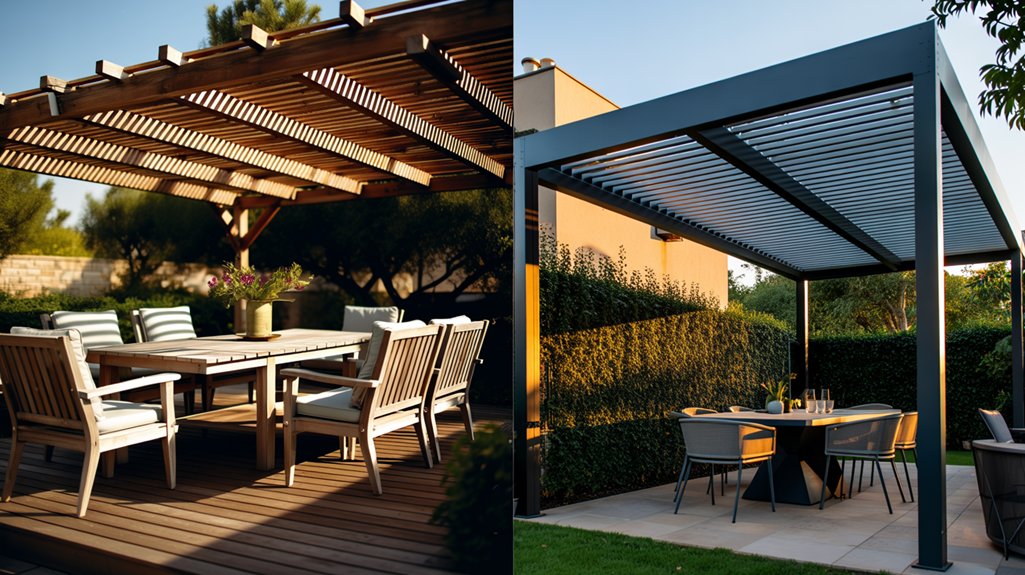
Comparing louvered and traditional pergolas reveals surprising cost, maintenance, and performance tradeoffs that could change everything about your outdoor investment decision.
Both louvered and fixed-roof aluminum pergolas serve Naples outdoor living, but the louvered system delivers measurably greater functional range across the wet season’s daily rain-and-reopen cycle. That advantage is conditional on a site where shade variability, ventilation control, and rain exclusion are simultaneously required rather than just one. A motorized louvered aluminum pergola is an extruded aluminum structure whose adjustable blades rotate to modulate sunlight, airflow, and precipitation shedding through integrated drainage routed internally through the posts.
Blade angle is the operative variable — it governs how much direct solar radiation reaches the deck surface, how freely air moves through the overhead plane, and whether the structure functions as a weather barrier or an open framework. When Naples’ wet-season thunderstorms arrive in the afternoon, closed blades shed rain through integrated gutters and internal post drainage, allowing the space to reopen within the hour without surface flooding or foundation drainage compromise. That single capability — moving between full exposure and a substantially weathertight roof on demand — defines the functional distance between a louvered system and every fixed alternative.
| Consideration | Fixed-Roof Aluminum Pergola | Motorized Louvered Pergola |
|---|---|---|
| Shade and light | Set at design; constant coverage | Blade angle adjusts through the day |
| Rain response | Sheds rain continuously by design | Closes on demand; integrated gutter and post drainage |
| Ventilation | Fixed airflow through lattice or panel gaps | Tunable airflow with blade position |
| Wind and snow design | Single structural classification | Engineered for the worst-case closed position |
| Moving parts | None | Motor, pivots, sensors, and controls to maintain |
Aluminum pergola louvers rotate on a horizontal axis to modulate blade angle continuously between fully open and fully closed, producing a measurable shift in both shading depth and cross-ventilation at the occupant level. When blades are pitched toward the sun, direct solar gain is interrupted while airflow passes through the remaining gap — a functional condition distinct from either a solid fixed roof or an open lattice. As blades close, the roof plane shifts to a substantially solid surface capable of shedding rain through integrated gutters that route drainage internally through the posts to grade, maintaining the surface-drainage gradient that IRC 2021 Section R401.3 requires at the foundation perimeter. In Naples, where NOAA climate data records rainfall concentrated in June-through-September afternoon thunderstorms, that shift from closed to open can occur within a single afternoon — the defining operational rhythm of a covered outdoor room in this climate.
When aluminum pergola louvers close to form a substantially solid roof plane, integrated gutters capture precipitation and route it through post-internal channels to grade — a drainage path that preserves the surface-drainage gradient IRC 2021 Section R401.3 requires at the foundation perimeter. This closed-roof condition is functionally distinct from an open-lattice system, which allows rainfall to pass through the plane entirely, and from a fixed solid roof, which lacks the reciprocal ability to reopen. In Naples, where NOAA climate normals document rainfall concentrated in June-through-September afternoon thunderstorms, a louvered system can shift from closed and draining to fully open within the span of a single afternoon. That operational range — rain-shedding roof to open-air structure within minutes — represents the mechanical capability that distinguishes the louvered aluminum pergola from both alternatives.
The louvered roof’s premium isn’t arbitrary — it reflects the structural consequences of a roof that changes its aerodynamic classification depending on blade position. Under ASCE 7-22, open blades present an open free-roof condition, while closed blades constitute a substantially solid surface, so the entire structure must be engineered for the worst-case scenario across both states. Motorization compounds that complexity, introducing drive motors, pivot assemblies, and sensor-integrated controls — each a functional asset and, in equal measure, a long-term maintenance variable.
Under ASCE 7-22, a motorized louvered aluminum pergola must be designed for two distinct structural classifications depending on blade position: open blades place the system within the open free-roof category, while closed blades present a substantially solid surface subject to the pressure demands of an enclosed or partially enclosed structure. Engineers resolve this dual classification by designing for the governing worst-case condition, typically the fully closed position. Blade assemblies themselves are evaluated as components and cladding, where net pressure coefficients rise sharply at roof edges and corners — loading conditions that a fixed-roof or open-lattice aluminum system, carrying a single static classification, does not face. That layered design obligation is the structural source of the cost differential.
A motorized louvered aluminum pergola integrates drive motors, blade pivot assemblies, rain sensors, wind sensors, and a control interface — each a functional component and a potential maintenance point over the system’s service life. This componentry is what separates the motorized system from a fixed-roof or open-lattice aluminum pergola at the engineering level, not simply the addition of convenience. Rain and wind sensors automate blade closure in response to real-time conditions — a meaningful capability in a coastal climate where Gulf-driven afternoon thunderstorms can develop with little warning during the June-through-September wet season. That automation, however, depends on sensor calibration, power continuity, and mechanical pivots remaining serviceable — conditions that elevate long-term ownership responsibility beyond what a structurally equivalent fixed-roof aluminum system requires.
Naples doesn’t offer mild conditions against which a pergola performs at its best; it offers salt-laden Gulf air, concentrated wet-season rainfall, intense UV exposure, and hurricane-season wind loads that collectively define what any aluminum overhead structure must resolve. A motorized louvered system earns its premium precisely where those variables collide — where an outdoor room closes against a midday thunderstorm and reopens within the hour, sustaining the lanai rhythm that characterizes Port Royal, Old Naples, and the surrounding golf-club communities. Where coverage requirements are constant and the budget favors mechanical simplicity, a fixed-roof aluminum pergola addresses the same climate without the moving parts.
Naples, Florida receives approximately 54 inches of annual rainfall, the majority concentrated in June through September afternoon thunderstorm activity. This seasonal pattern creates a specific performance demand that a fixed-roof or open-lattice aluminum pergola cannot fully address: the outdoor space must shed an intense midday storm and return to full sun exposure within the same afternoon. Salt-laden Gulf air compounds the calculus, accelerating corrosion on any exposed mechanical componentry — a condition that informs both material selection and maintenance expectations for louvered aluminum systems. The combination of UV intensity, thermal load, and hurricane exposure places this market in a distinct engineering category, one where adjustability carries functional weight beyond convenience.
A fixed-roof aluminum pergola is the structurally simpler of the two systems because it carries a single load classification under ASCE 7-22, with no blade-position variable altering the design envelope. Where an outdoor space requires constant, uninterrupted coverage — a covered walkway, a permanent dining enclosure, a lanai attachment with consistent shading demands — the motorized louvered system introduces mechanical complexity that the application does not require. Aluminum dead loads for fixed-roof systems fall within the same 3 to 8 psf range common to all architectural aluminum patio covers, and the absence of drive motors, pivot assemblies, and sensor controls reduces both initial cost and long-term maintenance exposure. For Naples homeowners whose outdoor room serves a defined, unchanging purpose, the fixed-roof aluminum pergola remains the structurally sound and operationally appropriate choice.
Properly engineered louvered aluminum pergola systems shed rain when closed through integrated blade channels, perimeter gutters, and internal post drainage routed to grade. Performance depends on installation precision and ongoing maintenance of seals and drainage pathways. Any drainage routing must preserve the surface-grade slope required at the foundation under IRC 2021 R401.3.
Motorized louvered aluminum pergolas are engineered for high-wind conditions by designing to the worst-case blade position, typically fully closed, where the roof presents a substantially solid surface under ASCE 7-22 classifications. Integrated wind sensors can trigger automatic blade repositioning to reduce structural load during storm events. Homeowners should confirm specific wind-design ratings with Collier County’s building authority before installation.
Pergolas in Naples require a building permit. Coverage area, attachment method, and roof classification—open lattice versus substantially solid louvered—affect how a structure is reviewed under applicable codes. Collier County’s building authority is the definitive source for current permit thresholds, submittal requirements, and wind-design standards applicable to any specific installation.
Motorized louvered aluminum pergolas require periodic blade pivot lubrication, motor and sensor inspection, gutter-channel clearing, and rinsing of salt-air deposits from framing and drive components. Salt-laden Gulf air accelerates corrosion at pivot points and electrical connections, making coastal maintenance intervals shorter than inland installations. Collier County’s building authority can clarify any inspection obligations attached to permitted structures.
Naples’ convergence of hurricane wind exposure, salt-laden Gulf air, concentrated wet-season rainfall, and the foundation surface-drainage gradient requirements under IRC 2021 R401.3 shapes every aluminum pergola specification before a single component is selected. Backyard Paradiso works within these conditions routinely, and that familiarity informs how the firm approaches louvered and fixed-roof aluminum pergola installation across the region. Consultations are available by appointment for homeowners evaluating which system aligns with their site constraints and coverage requirements. Whether the project is a motorized louvered system designed for the lanai rhythm of Port Royal and Old Naples or a fixed-roof aluminum structure serving a golf-club community where constant coverage is the priority, the investment is best measured against functional outdoor square footage gained and the contribution a properly engineered outdoor room makes to long-term property value in this market.