Physical Address
304 North Cardinal St.
Dorchester Center, MA 02124
Physical Address
304 North Cardinal St.
Dorchester Center, MA 02124
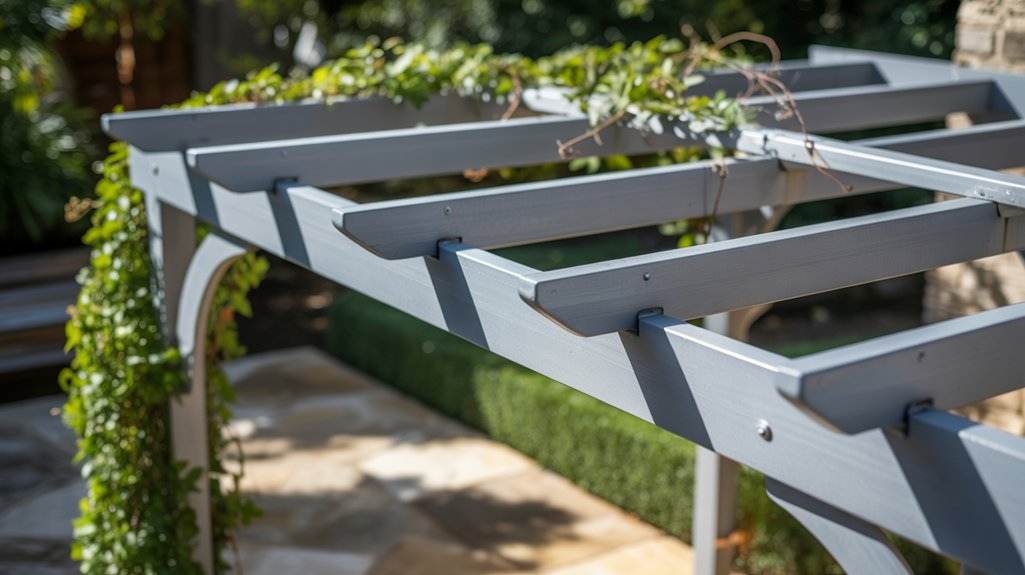
Beyond decades of durability, aluminum pergolas hide surprising vulnerabilities that could determine whether yours lasts a lifetime or fails prematurely.
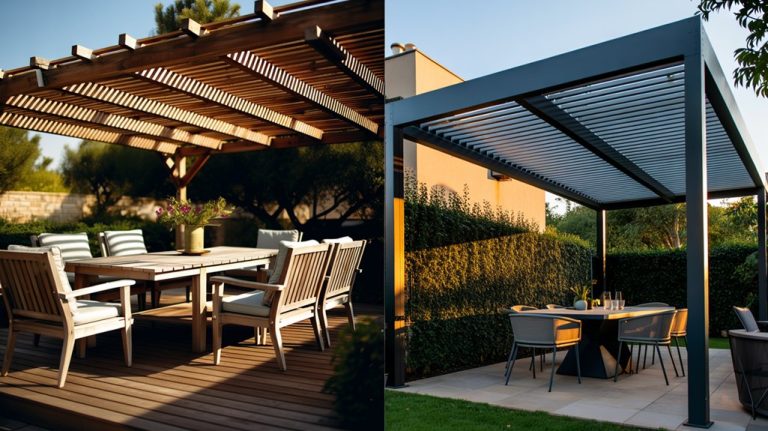
Aluminum pergolas installed in South Texas routinely deliver structural service lives measured in multiple decades, with framing integrity extending well beyond thirty years under typical residential conditions. Performance within that range depends on alloy selection, powder-coat finish grade, footing integrity in expansive caliche soils, and cumulative UV and thermal stress across San Antonio’s roughly 250 annual sunshine days. An aluminum pergola is a freestanding or structure-attached overhead framework engineered to define and shade outdoor living space while supporting optional motorized louvers, integrated lighting, and weatherproof electrical systems.
The structural case for aluminum pergolas in South Texas begins with alloy selection, where 6063-series extrusions produced under ASTM B221 carry an inherent corrosion resistance that doesn’t degrade meaningfully across decades of humid subtropical exposure. Powder-coat finishes rated to AAMA 2604 or 2605 standards extend that durability to the surface layer, maintaining color and chalk resistance through roughly 250 days of annual UV exposure without the adhesion failures or substrate oxidation that compromise lesser finish systems. Under those conditions, the framing assembly’s structural life isn’t measured in product cycles but in the longer arc of the property itself.
Aluminum extrusions conforming to ASTM B221 in the 6063-T5 and 6063-T6 tempers carry an oxide layer that forms spontaneously on exposed surfaces, rendering the base alloy resistant to the atmospheric corrosion mechanisms that degrade steel or lower-grade aluminum profiles over time. In the humid subtropical to semi-arid climatic shift of San Antonio — where NOAA climate normals record roughly 250 annual sunshine days and August ambient temperatures approach 96°F — UV degradation and thermal cycling represent the dominant weathering stressors rather than salt-spray or freeze-thaw action. Powder-coat finishes meeting AAMA 2604 or 2605 performance standards provide a rated barrier against chalking and color loss, extending the cosmetic and protective surface life of the frame. Structural aluminum members sized and detailed under these specifications routinely achieve service lives measured in multiple decades before any load-carrying capacity is meaningfully diminished.
AAMA 2605 specifies a minimum of five years of Florida exposure testing for coating systems before certification, establishing a performance threshold that directly addresses high-UV, high-heat climatic conditions analogous to those across San Antonio’s estate corridors. San Antonio’s NOAA climate normals record approximately 250 annual sunshine days, with August ambient temperatures approaching 96°F — conditions that accelerate chalking, fading, and film degradation in coatings that fall below this certification tier. Finishes meeting AAMA 2604 or 2605 standards extend cosmetic integrity across the same multi-decade horizon as the underlying 6063 alloy structural frame, ensuring that surface degradation does not outpace the load-carrying service life of the extrusions. The result is a system whose structural and finish components age in alignment rather than diverging on separate replacement timelines.
The aluminum frame of a louvered pergola can reasonably outlast two or three generations of the electromechanical components it houses. Motors, actuators, and control boards operate within San Antonio’s thermal envelope — ambient summer temperatures near 96°F compounded by radiant heat from the structure itself — cycling repeatedly through expansion and contraction that degrades brushes, seals, and circuit-board solder joints on a roughly 10-to-15-year service horizon. Gaskets, perimeter seals, and LED modules follow a similar arc, with UV flux and thermal cycling accelerating elastomer hardening and phosphor degradation faster than any mechanical wear alone would predict.
Motorized louver actuators and control modules in louvered pergola roofs operate under a service horizon of roughly 10 to 15 years before components require inspection, recalibration, or replacement. This lifespan gap between mechanical systems and structural framing is the defining maintenance reality of louvered aluminum pergolas, because the 6063-T5/T6 and 6061-T6 alloy extrusions that form the frame carry a multi-decade structural life while the electromechanical components embedded within them do not. In San Antonio, where NOAA climate normals document approximately 250 annual sunshine days and August high temperatures averaging near 96°F, thermal cycling accelerates motor winding fatigue, degrades gaskets in actuator housings, and stresses low-voltage control wiring insulation. Electrical components serving motorized systems and integrated lighting also fall under NEC Article 411 and Section 210.8 GFCI requirements, meaning any service or replacement work must restore code-compliant protection, not simply swap hardware.
Silicone gaskets and thermoplastic seals used in aluminum pergola assemblies are rated to finite compression-set tolerances that thermal cycling progressively consumes, typically measured against ASTM D395 test methods for rubber and elastomeric materials. In San Antonio, where NOAA climate normals document August averages near 96°F and diurnal temperature swings routinely stress expansion joints, gasket materials lose elasticity faster than the surrounding 6063-T5/T6 extrusions lose structural integrity. LED modules integrated into pergola channels face a parallel degradation pathway: lumen depreciation accumulates with thermal load, and housings that trap heat accelerate the process independent of rated operating hours. Together, these components establish a service interval measurably shorter than the structural frame, making periodic inspection of seals and luminaires the practical maintenance priority for louvered pergola owners across San Antonio’s estate corridors.
The frame’s long-term structural integrity doesn’t end at grade—it extends into the ground, where Bexar County’s expansive clays and caliche profiles introduce conditions that no alloy selection can override. Footings set in reactive soils without accounting for differential heave and seasonal volume change will transfer movement directly into column bases, loosening anchorage and misaligning the roof plane over time. ASCE 7’s canopy wind provisions compound that challenge by requiring anchorage systems capable of resisting both downward bearing loads and the upward uplift forces that louvered roofs generate under the convective storm events common to San Antonio’s spring and early-fall seasons.
Expansive Vertisol and clay-loam soils classified in USDA Hydrologic Soil Groups C and D underlie significant portions of Bexar County, producing volumetric shrink-swell cycles that exert lateral and vertical pressure on embedded footings with each wetting and drying event. Where those soils overlie the shallow karst Edwards limestone of the Edwards Plateau shift, excavation for pergola posts encounters either highly calcareous material resistant to conventional auger equipment or bedrock at depths shallow enough to preclude standard pier sizing. Footing design in this region is consequently governed not by freeze-thaw depth — San Antonio’s frost penetration remains on the order of 12 inches or less — but by bearing capacity, uplift resistance, and soil movement. A footing engineered to those site-specific conditions becomes the buried determinant of whether a structurally sound aluminum frame remains plumb and load-bearing across multiple decades.
ASCE/SEI 7 Section 30.11 governs wind pressure calculations for canopy structures, treating louvered pergola roofs as components and cladding subject to both downward and net-uplift loading scenarios. In San Antonio’s position along the Edwards Plateau boundary, where open terrain and elevated Hill Country-adjacent topography in corridors such as The Dominion and Shavano Park reduce aerodynamic shielding, uplift forces on a pergola canopy can exceed the dead weight of the aluminum frame by a meaningful margin, transferring the entire load path to the footing-anchor interface. That interface — the mechanical connection between post base hardware, embedded anchor, and surrounding soil or rock — represents the buried half of pergola longevity, operating invisibly beneath a structure whose above-grade aluminum framing may otherwise perform for multiple decades without intervention. Footing engineering that accounts for site-specific uplift demand, rather than gravity bearing alone, determines whether the anchorage system holds geometry and load capacity across the full service life.
Four questions surface consistently among homeowners in San Antonio’s estate corridors: whether South Texas UV degrades powder-coat finishes, how frequently motorized louver components require attention, whether the structures hold under Hill Country wind events, and what inspection cadence sustains long-term performance. Each question addresses a distinct layer of the system — finish, mechanical, structural, and maintenance — and the answers depend on specified alloy grade, finish standard, footing condition, and installation quality rather than on product category alone. Understanding where each variable sits within the assembly clarifies both what to expect and what to monitor.
AAMA 2604- and 2605-rated powder-coat finishes are engineered to resist the ultraviolet intensity and heat accumulation characteristic of San Antonio’s roughly 250 annual sunshine days. Chalk and fade retention standards under those specifications define minimum performance thresholds that extend finish integrity across multiple decades of South Texas exposure. Estate corridors from Alamo Heights to The Dominion and the Hill Country edge represent the environments those ratings are most directly tested against.
Motorized louver systems in San Antonio’s climate typically require inspection annually and component service on a roughly ten-to-fifteen-year horizon, driven primarily by motor, drive, and control electronics rather than the aluminum framing itself. Sustained heat, UV cycling, and convective storm exposure accelerate wear on seals and electronic assemblies faster than in milder climates. Homeowners in The Dominion, Stone Oak, and Hill Country corridor properties benefit from scheduling service through the original installing contractor familiar with system-specific parts sourcing.
Aluminum pergolas engineered to ASCE/SEI 7 canopy wind provisions handle the convective storm events and sustained gusts characteristic of San Antonio’s Hill Country corridor. Structural performance depends heavily on footing integrity in the region’s expansive clays and shallow Edwards limestone, where uplift resistance governs design. Properties along Shavano Park, The Dominion, and the Camp Bullis corridor warrant site-specific geotechnical consideration during permit review through Bexar County or City of San Antonio Development Services.
Annual inspection of fastener torque, powder-coat integrity, louver blade alignment, and footing perimeter conditions represents the appropriate baseline cadence for San Antonio aluminum pergolas. Expansive clay soils in Hydrologic Soil Groups C and D can shift seasonally, making footing-perimeter checks particularly consequential between wet and dry cycles. City of San Antonio Development Services records can confirm original permitted footing specifications as an inspection reference point.
Aluminum pergola installation in San Antonio requires structural compliance with ASCE/SEI 7 Section 30.11 canopy wind provisions, AAMA 2604 or 2605 finish performance standards, NEC GFCI requirements under Section 210.8, and footing design calibrated to expansive Hydrologic Soil Group C and D clays over Edwards limestone bedrock. Backyard Paradiso brings command of those overlapping engineering and code demands to aluminum pergola longevity work across San Antonio’s estate corridors, where shallow caliche, heritage tree setbacks under the City’s Unified Development Code, and sustained UV exposure compound the technical stakes. Consultations are available by appointment from the firm’s San Antonio office. Investment in a properly engineered aluminum pergola represents a durable functional square footage gain with documented resale recovery potential, particularly in established neighborhoods such as Alamo Heights, Terrell Hills, The Dominion, Stone Oak, and the Hill Country corridor extending toward Boerne.