Physical Address
304 North Cardinal St.
Dorchester Center, MA 02124
Physical Address
304 North Cardinal St.
Dorchester Center, MA 02124
Here's what every pet owner needs to know about artificial turf before making a decision that could affect their yard forever.
Artificial turf performs well for pet households when the drainage system beneath it is properly engineered. In humid continental climates like Romeoville’s, glacial till soils and a 42-inch frost line require a compacted crushed-stone base with adequate slope to prevent urine pooling and freeze-thaw heave. Artificial turf for pets is a multi-layer synthetic surface designed to drain liquid waste through perforated backing into a permeable aggregate base, eliminating mud and supporting routine hygienic maintenance.
Synthetic turf’s suitability for pets depends less on pile composition than on how the full assembly manages liquid. Perforations in the secondary backing pass urine directly into a permeable aggregate base, and where that base is properly compacted and graded, the liquid clears the system before it can concentrate. Infill selection works alongside drainage to govern odor, with sand-free and enzymatic-compatible systems reducing the microbial activity that a saturated base would otherwise accelerate.
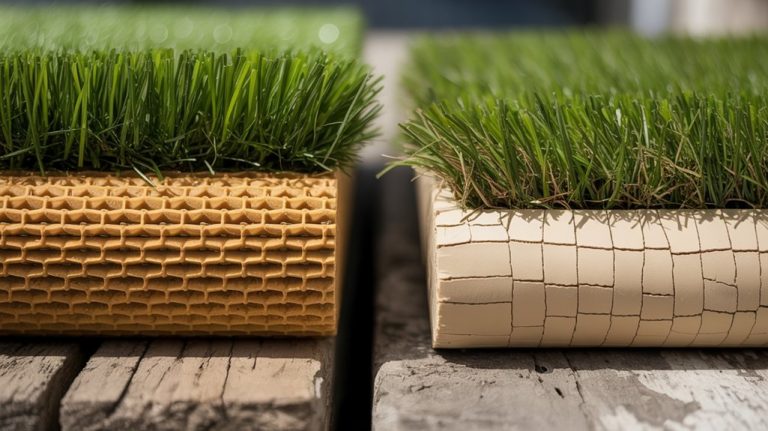
Perforations punched through the secondary backing of synthetic turf allow liquid to pass directly into the drainage base beneath, bypassing the fiber layer entirely. This design means the pile material itself does not bear responsibility for managing urine or rinse water; the burden falls instead on the sub-base assembly, typically 3 to 4 inches of compacted crushed stone or decomposed granite brought to 90 to 95 percent of modified Proctor density per ASTM D1557. A 1 to 2 percent site slope works alongside backing permeability to move liquid away from the surface before pooling occurs. When the base becomes clogged or compacted beyond its drainage capacity, liquid backs up into the aggregate layer, creating the anaerobic conditions that produce persistent odor—the most common failure mode in pet installations.
Sand-free and enzymatic infill systems are recognized by the Synthetic Turf Council as primary design solutions for managing waste and odor in pet installations. Standard silica sand infill retains urine salts and organic residue within the pile, creating conditions favorable to microbial growth that conventional rinsing does not fully resolve. Sand-free alternatives—including zeolite-based and acrylic-coated crumb rubber blends—reduce that retention by limiting the surface area available for organic material to bind. Enzymatic cleaners, applied periodically and compatible with polyethylene and polypropylene pile, break down ammonia compounds at the molecular level rather than masking odor. When infill selection is matched to a properly draining base and a 1 to 2 percent slope, the system addresses odor at its source rather than through remediation after the fact.
Maintenance on a pet lawn follows a straightforward sequence: solids come off promptly, residuals rinse through the pile and into the base, and periodic application of enzymatic cleaners keeps microbial activity from establishing at the surface. Where that sequence breaks down, the problem typically isn’t the fibers—it’s a base that’s draining too slowly to flush accumulated liquid through before it stagnates. Compacted aggregate, insufficient slope, or a clogged geotextile layer will back waste into the system, and the odor and microbial growth that follow are consequences of a structural condition, not a cleaning deficiency.
Enzymatic cleaners compatible with synthetic turf backing materials break down urine compounds at the molecular level, preventing the ammonia and mercaptan accumulation that causes persistent odor in pet installations. Solid waste is removed promptly, and residuals are rinsed through the pile and into the permeable base below. The Synthetic Turf Council identifies drainage performance and waste management as primary design criteria for pet areas, a designation that reflects how quickly organic material migrates into the aggregate layer if rinsing is delayed. In Romeoville’s humid continental climate, where NOAA climate normals record approximately 41 inches of annual precipitation, regular rinsing integrates naturally with rainfall cycles, though snowmelt periods in late winter require deliberate flushing to clear concentrated waste that has accumulated beneath frozen pile during the preceding months.
The most common failure mode in pet turf installations is a clogged or under-draining base, which backs liquid into the aggregate layer and creates the anaerobic conditions that accelerate microbial growth and persistent odor. Proper base construction per ASTM D1557 specifies compaction to 90 to 95 percent of modified Proctor density using 3 to 4 inches of crushed stone or decomposed granite, creating a permeable substrate that flushes waste downward rather than allowing it to pool. In Romeoville, Will County’s humid continental climate delivers approximately 41 inches of annual precipitation according to NOAA climate normals, and the region’s 42-inch frost line means freeze-thaw cycling can compromise base integrity over time if initial compaction is insufficient. A 1 to 2 percent finished slope reinforces drainage performance by directing urine and rinse water away from the installation perimeter consistently.
Romeoville’s humid continental climate delivers roughly 41 inches of annual precipitation alongside 29 inches of snowfall, conditions that concentrate drainage stress on any outdoor surface during spring melt and repeated freeze-thaw cycles. A properly graded pet turf installation—built over compacted crushed stone with a 1 to 2 percent slope—sheds that snowmelt and rinse water before it can back up into the aggregate and generate odor. The same system that manages liquid waste also eliminates the mud, pesticides, and fertilizers that a conventional lawn introduces into a dog’s daily environment.
Romeoville, Illinois sits within USDA Hardiness Zone 5b, where the design frost depth reaches 42 inches and freeze-thaw cycling recurs throughout the late fall and early spring months. These conditions place direct mechanical stress on any permeable base system, as repeated expansion and contraction within saturated aggregate can displace compaction and reduce drainage capacity over time. For pet turf installations, the base layer — typically 3 to 4 inches of crushed stone or decomposed granite compacted to 90 to 95 percent of modified Proctor density per ASTM D1557 — must maintain that density through seasonal cycling to continue shedding snowmelt and rinse water without backing liquid into the pile. Will County stormwater ordinances govern how that drainage integrates with the broader site, making proper base slope and outfall planning a design requirement rather than an optional refinement.
Synthetic turf installations eliminate direct dog contact with lawn pesticides, herbicides, and fertilizers by replacing the biological turf system that requires those inputs. Romeoville’s humid continental climate, with approximately 41 inches of annual precipitation based on NOAA climate normals for the southwest Chicago corridor, sustains conditions favorable to flea and tick populations throughout the warm season — pests that organic turf harbors in thatch and soil layers. Artificial turf removes that harborage environment without chemical intervention. The system also eliminates the mud transfer cycle common to clay-heavy glacial till soils prevalent across Will County, where precipitation events saturate topsoil rapidly and dogs track contaminants indoors, compounding sanitation demands that synthetic surfaces avoid by design.
Artificial turf is safe for dogs when the system is properly designed and maintained. The critical conditioning factor is adequate drainage, as a clogged or under-draining base encourages microbial growth and odor rather than any issue with the polyethylene or polypropylene pile itself. Enzymatic cleaners and prompt solid waste removal keep the surface hygienic.
Solid waste is removed promptly, and residual liquid waste rinses through the perforated backing and permeable base below. Periodic treatment with enzymatic or compatible cleaners controls odor buildup, particularly in humid continental climates where warm seasons accelerate microbial activity. A properly constructed crushed-stone base at adequate slope remains the critical factor preventing waste accumulation and the odor problems that follow drainage failure.
Artificial turf can accumulate urine odor over time when drainage is inadequate and waste is not regularly flushed through the system. A clogged or under-draining base is the most common failure point, allowing microbial growth to concentrate odor in the aggregate layer. Periodic rinsing with enzymatic cleaners and a properly constructed permeable base prevent this outcome.
Dogs can dig at artificial turf, though the reinforced polyethylene or polypropylene backing and secured perimeter edge systems markedly resist penetration compared to natural soil. Persistent digging breeds may still fray pile fibers over time at edges or seams. Proper perimeter anchoring and infill density are the primary installation factors that determine long-term resistance to digging behavior.
Romeoville’s glacial till profile, 42-inch frost line, humid continental precipitation averaging 41 inches annually, and Will County stormwater requirements collectively define the drainage engineering standard that any pet turf installation must satisfy to perform reliably over time. Backyard Paradiso’s artificial grass installation work in the southwest Chicago suburbs is built around that baseline, with base construction, backing permeability, and site slope treated as primary design variables rather than afterthoughts. Consultations are available by appointment for property owners evaluating pet surfacing across Romeoville, Bolingbrook, Plainfield, and surrounding Will County communities. Investment in a properly engineered pet lawn is most accurately measured against reduced maintenance burden, eliminated mud remediation, and the functional outdoor square footage returned to consistent daily use — a calculation that reflects long-term value rather than upfront material cost alone.