Physical Address
304 North Cardinal St.
Dorchester Center, MA 02124
Physical Address
304 North Cardinal St.
Dorchester Center, MA 02124
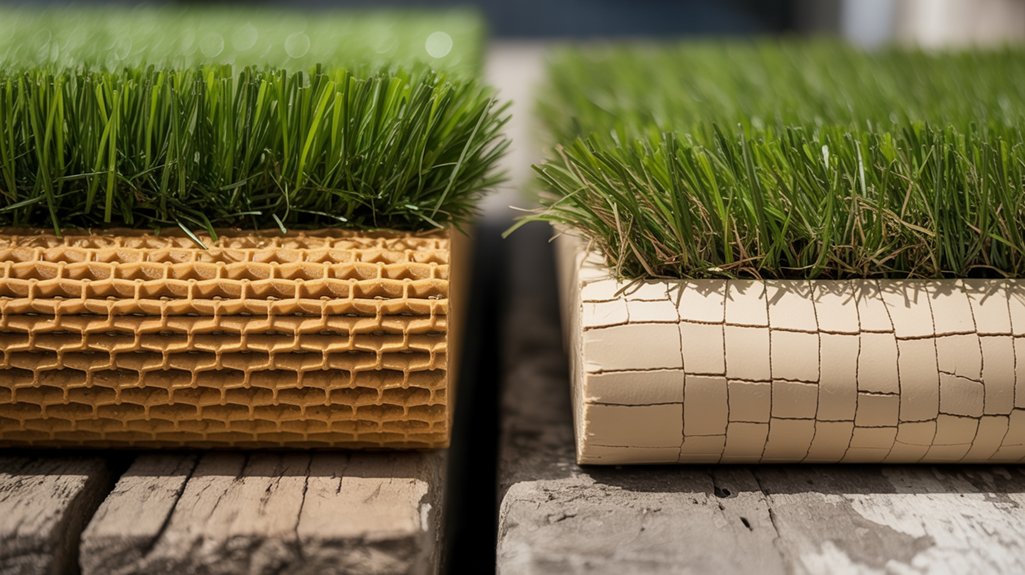
Uncover which artificial grass backing—polyurethane or latex—truly withstands moisture, freeze-thaw cycles, and pet zones without failing prematurely.
Polyurethane backing outperforms latex in long-term durability, particularly under freeze-thaw cycling and prolonged moisture exposure where latex becomes prone to stiffening, cracking, and crumbling. Climate stress and pet-area moisture loads amplify these differences meaningfully. Artificial grass backing is the layered foundation system that locks tufted fibers into a primary carrier and stabilizes them through a secondary polyurethane or latex coating, determining dimensional stability, tuft bind strength, and overall lawn longevity.
Artificial grass backing operates as a two-layer structural system: a primary layer of woven or non-woven polypropylene carries the tufted pile fibers, while a secondary coating—either polyurethane or latex—locks those tufts in place and governs how the installation holds its shape over time. Tuft bind, measured as the extraction force required to pull a fiber from the backing, directly determines whether the surface remains intact under foot traffic and infill pressure. Dimensional stability, the backing’s resistance to expansion, contraction, and edge curl, depends on how well that secondary coating maintains its bond through moisture cycling and mechanical load.
Artificial grass backing consists of a primary layer and a secondary coating, each serving a distinct structural role in holding the turf system together. The primary layer, most commonly a woven or non-woven polypropylene fabric, carries the tufted pile fibers and establishes the dimensional foundation of the product. A secondary coating—either polyurethane or latex—is then applied over the primary layer to lock the tufts in place, resist delamination, and provide long-term dimensional stability. Engineers evaluate this system through tuft bind testing, which measures the extraction force required to pull a single fiber from the backing, along with water permeability through backing perforations and resistance to mechanical stress over the product’s service life.
Tuft bind, measured as the extraction force required to pull a single pile fiber from the backing matrix, is a primary engineering metric for evaluating artificial grass backing integrity. A backing system that fails to achieve adequate tuft bind allows fibers to shed under foot traffic and infill displacement, accelerating surface degradation independent of fiber quality. Dimensional stability works in parallel: a backing that stretches, contracts, or warps under thermal cycling or moisture stress causes visible seam separation and surface irregularity over time. Polyurethane secondary coatings absorb little moisture and maintain flexibility under freeze-thaw stress, characteristics that directly preserve both tuft bind retention and dimensional stability across the product’s service life.
Polyurethane and latex coatings serve the same structural function—locking tufted fibers against pullout and maintaining dimensional stability—but they age under field conditions in fundamentally different ways. Polyurethane resists moisture absorption, retains flexibility through freeze-thaw cycling, and doesn’t crumble as service years accumulate, which is why it carries longer warranties and performs more predictably in wet or cold climates. Latex, typically styrene-butadiene rubber, has decades of established field history and performs adequately when new, but it’s more susceptible to stiffening, cracking, and moisture-driven degradation over its service life.
Polyurethane backing absorbs minimal moisture and maintains flexibility at low temperatures, two properties that directly determine backing integrity under freeze-thaw cycling. Where latex-backed products are susceptible to stiffening, cracking, and crumbling as thermal stress accumulates across seasonal cycles, polyurethane resists that degradation pattern and retains dimensional stability over its service life. The reduced moisture absorption also makes polyurethane the preferred backing material for pet installations, where prolonged exposure to liquid saturation accelerates the breakdown that latex-backed products experience. These durability characteristics are reflected in warranty terms, which for polyurethane-backed products extend longer than those offered on comparable latex constructions.
Styrene-butadiene rubber, the compound most commonly used in latex artificial grass backing, carries a longer field history in sports turf installations than polyurethane does. That track record reflects genuine performance capability under moderate conditions, where latex backing delivers adequate flexibility and water resistance across its early service life. The degradation pattern changes under sustained mechanical stress and moisture exposure, however, as latex is more prone to stiffening, cracking, and crumbling over time than polyurethane-backed constructions. Latex backing is also heavier, which affects handling and installation logistics, and its sensitivity to prolonged liquid saturation makes it a less suitable choice where pet use or high-moisture conditions define the operating environment.
Durability decisions center on how a backing performs under sustained moisture exposure and repeated freeze-thaw cycling, conditions that accelerate cracking and delamination in less stable secondary coatings. Polyurethane’s low moisture absorption and maintained flexibility at low temperatures give it a measurable advantage over latex in climates where those stresses compound over time. Dual-backed products address this by layering latex’s flexibility beneath a polyurethane finish coat, and that construction typically supports the longer warranty terms manufacturers extend to installations in higher-stress environments.
Polyurethane-backed artificial grass maintains flexibility at low temperatures where styrene-butadiene rubber latex backing becomes brittle and susceptible to cracking under freeze-thaw cycling. This distinction matters in climates where ground temperatures cycle repeatedly across the freezing threshold, a condition that imposes mechanical stress on any coating bonded to a dimensionally shifting substrate. Latex backing, though water-resistant when new, absorbs more moisture over its service life, accelerating degradation when that retained moisture expands during freezing. Polyurethane resists moisture absorption and does not crumble as it ages, which is why it carries longer warranties and performs more reliably under prolonged mechanical and thermal stress — making backing selection a durability decision rather than a purely budgetary one.
Dual-backed artificial grass applies a styrene-butadiene rubber latex layer for flexibility followed by a polyurethane layer for dimensional stability, combining the established field history of latex with the crumble resistance and moisture performance of polyurethane. This construction addresses the primary failure modes of each material used independently: latex alone is prone to stiffening and cracking over time, while polyurethane alone lacks the compliance that latex contributes at the primary backing interface. Warranty length reflects this hierarchy — polyurethane-backed and dual-backed products carry longer manufacturer warranties than latex-only systems, a direct expression of expected service life under freeze-thaw and moisture stress. Backing selection, evaluated against climate conditions and intended use, determines long-term structural integrity more than fiber specification alone.
Backing material questions tend to surface around the same practical concerns: longevity, moisture exposure, and suitability for high-demand use like pet areas. Polyurethane generally holds a durability advantage over latex, particularly under freeze-thaw cycling and sustained moisture, where latex is more prone to stiffening, cracking, and crumbling over time. Dual-backed products address this by layering latex for flexibility beneath polyurethane for dimensional stability, though base preparation remains the controlling variable regardless of which backing system is specified.
Polyurethane backing outperforms latex in long-term durability, resisting cracking, crumbling, and moisture degradation while remaining flexible under freeze-thaw stress. Latex remains a viable budget option with decades of field history, though it stiffens and deteriorates more readily over time. Backyard Paradiso treats backing selection as a durability decision, available through appointment consultation.
Latex turf backing does break down over time, becoming prone to stiffening, cracking, and crumbling as it ages. Prolonged moisture exposure and freeze-thaw cycling accelerate this degradation, particularly in climates with significant temperature variation. Installations prioritizing longevity under such conditions often benefit from polyurethane or dual-backed alternatives, a distinction Backyard Paradiso addresses as part of its backing consultation process.
Polyurethane backing is the preferred choice for pet areas due to its moisture resistance, dimensional stability, and resistance to crumbling over time. Latex backing is more susceptible to degradation under prolonged moisture exposure, which pet use reliably introduces. Backyard Paradiso treats backing selection as a durability decision, available by appointment for site-specific guidance.
Dual-backed artificial grass combines a latex layer applied first for flexibility with a polyurethane layer added over it for long-term durability. This construction attempts to capture the cost and performance advantages of both materials within a single product. Backyard Paradiso treats backing selection as a durability decision, available by appointment for site-specific guidance.
Artificial grass backing performance depends on tuft bind integrity, secondary coating durability under freeze-thaw cycling, dimensional stability, and drainage compliance with compacted aggregate base density meeting ASTM D1557 at 90 to 95 percent modified Proctor — specifications that directly determine whether a backing system holds its structural integrity over a full service life. Backyard Paradiso applies that technical framework to backing specification decisions, treating the choice between polyurethane, latex, and dual-backed constructions as an engineering consideration rather than a product selection. Consultations are available by appointment, giving property owners in the region access to specification-level guidance on backing systems matched to their site conditions, use patterns, and drainage requirements. Backing decisions made at installation carry long-term implications for maintenance costs and functional longevity, making early specification work among the higher-return investments in any artificial grass project across the markets Backyard Paradiso serves.