Physical Address
304 North Cardinal St.
Dorchester Center, MA 02124
Physical Address
304 North Cardinal St.
Dorchester Center, MA 02124
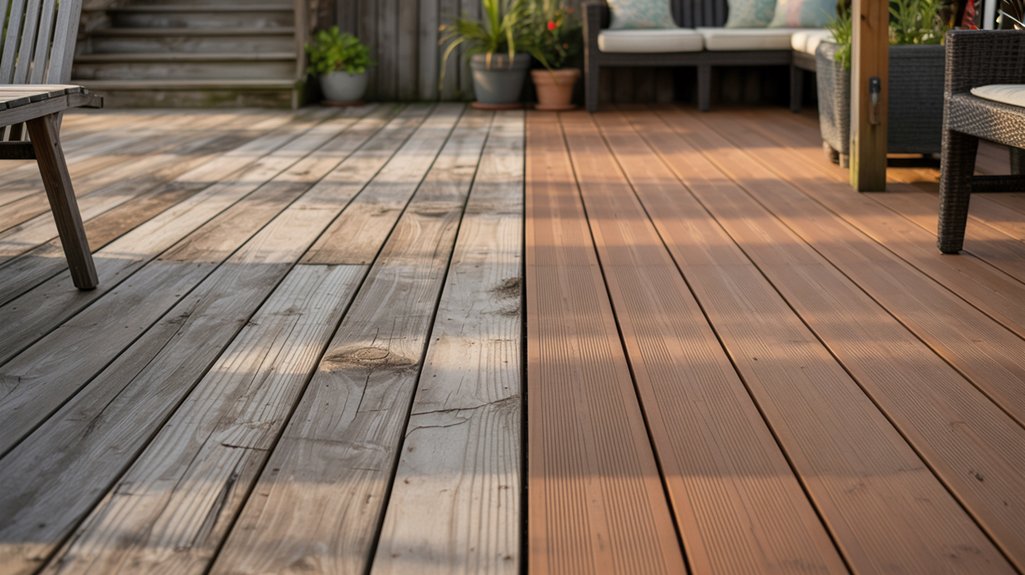
Outlasting wood in durability and termite resistance, composite decking may be the smarter choice—but the full comparison reveals surprising trade-offs.
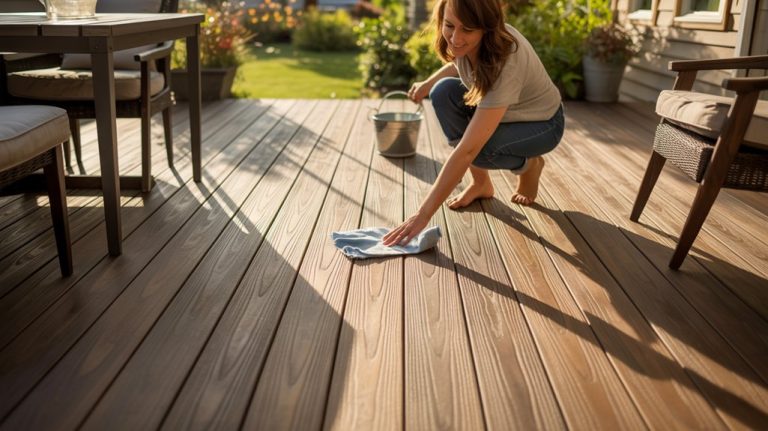
Composite decking outperforms wood on rot resistance, termite resistance, and long-term maintenance burden, making it the stronger fit for estate-grade builds intended for extended service life. That advantage is most decisive in high-termite-probability climates like South Texas, where year-round biological pressure accelerates the degradation of untreated dimensional lumber. Composite decking is a performance-rated board product engineered to resist moisture, decay, and insect damage while delivering consistent color stability across its service life.
| Factor | Composite decking | Wood decking |
|---|---|---|
| Regulatory basis | Performance-rated to ASTM D7032; no structural grade | Structural grade; governed by IRC R507 span tables |
| Decay and rot | Decay-resistant per ASTM D7032 (IRC R507.2.2.3) | Susceptible unless preservative-treated or naturally durable |
| Termite resistance | Termite-resistant per D7032 where required (R507.2.2.4 / R318 zones) | Vulnerable in termite zones unless treated |
| Routine maintenance | Periodic cleaning; no sealing or staining | Recurring sealing or staining to resist moisture and checking |
| Behavior under sustained load | Viscoelastic; span ratings include a creep adjustment (ASTM D7341) | Higher stiffness at equal section; graded for span |
The regulatory frameworks governing composite and wood decking don’t share the same foundation, and that distinction carries real consequences for how each material performs over time. Dimension lumber carries a structural grade tied to IRC R507 span tables, while composite boards earn a performance rating under ASTM D7032 — a standard that quantifies decay resistance, termite resistance, flame spread, and long-term deflection rather than raw structural capacity. In South Texas, where termite pressure is a year-round design factor, IRC R507.2.2.3 and R507.2.2.4 require that composite products containing biodegradable content demonstrate verified resistance under those protocols — a requirement that wood, paradoxically, isn’t held to in the same explicit, documented way.
Composite decking boards carry no inherent structural grade and are instead governed by IRC 2021 Section R507.2.2 and a performance rating established under ASTM D7032, while dimension lumber decking is classified by structural grade and governed by IRC R507 span tables. These are fundamentally different regulatory frameworks: lumber grading evaluates stiffness, load capacity, and defect limits, whereas ASTM D7032 evaluates decay resistance, termite resistance, flame spread, slip resistance, and long-term creep deflection. Because composite boards are viscoelastic, ASTM D7032 span ratings incorporate a creep adjustment per ASTM D7341, accounting for deflection under sustained load that exceeds what same-dimension lumber would exhibit. Understanding which framework governs a given material is the prerequisite for accurate specification on any deck project.
IRC 2021 Section R507.2.2.3 requires that composite decking products containing wood or other biodegradable content demonstrate decay resistance under ASTM D7032 protocols before those products may be specified in exposed exterior applications. Where termite probability zones apply — defined under IRC Section R318 and encompassing virtually the entire South Texas region, including San Antonio — Section R507.2.2.4 further mandates demonstrated termite resistance under the same ASTM D7032 framework. Dimension lumber meeting those same exposures carries no equivalent performance certification; instead, code directs wood decking toward pressure-treatment or naturally durable species classifications. For projects in high-termite-pressure zones, the composite path produces a labeled, documented resistance record that the lumber grading system was never structured to provide.
Where composite and wood decking diverge most consequentially is in how each material responds to sustained exposure — moisture, biological pressure, and the surface conditions that determine long-term usability. Capped co-extruded composite and cellular PVC boards shed water and resist rot and termite infiltration by design, a performance advantage that’s especially material in South Texas, where termite pressure and humidity don’t relent seasonally the way they do in more forgiving climates. Both material categories also carry tested obligations for flame spread and slip resistance, and how a product performs against those benchmarks determines whether it’s suitable for estate-scale decks where occupancy loads and service life expectations are high.
Composite decking products containing wood or biodegradable content must demonstrate decay resistance under ASTM D7032, the performance standard governing rated composite boards under IRC 2021 R507.2.2.3. This requirement exists because moisture intrusion and biological attack represent the primary failure modes for organic decking materials in humid climates — conditions that characterize South Texas, where heat and rainfall sustain year-round fungal and termite pressure. Capped co-extruded composite boards address these mechanisms at the material level, shedding water rather than absorbing it and resisting biological colonization without periodic sealing or re-staining. Solid wood decking, by contrast, requires a recurring maintenance cycle — cleaning, sealing, and refinishing — to slow checking, graying, and rot that begin once a factory finish weathers away.
Composite decking products must not exceed a flame spread index of 200 under ASTM E84 or UL 723, as required by IRC 2021 R507.2.2.2. This threshold establishes a minimum fire performance benchmark that composite manufacturers must document through standardized testing, placing the burden of proof on the product rather than the installer. Slip resistance is evaluated under ASTM F2508 or F3445, providing measurable surface traction data relevant to wet conditions — a practical consideration in South Texas, where afternoon thunderstorms leave deck surfaces saturated. Solid wood decking carries no equivalent product-level performance rating for either property; compliance with surface safety and fire requirements depends instead on species selection, finish condition, and inspection interval, variables that shift across a wood deck’s service life as coatings degrade.
Material selection at this scale isn’t purely a durability question — it’s a structural one. Composite boards carry no inherent structural grade, so their span ratings derive from performance testing under ASTM D7032, which incorporates a creep adjustment accounting for the viscoelastic tendency of wood-plastic and polyolefin products to deflect progressively under sustained load — a behavior wood doesn’t exhibit to the same degree. That distinction matters when framing bays, specifying joist spacing, and choosing between capped co-extruded composite and cellular PVC, two material classes that share surface advantages but differ in substrate composition, moisture absorption characteristics, and long-term dimensional stability.
ASTM D7341 requires that composite decking span ratings incorporate a creep adjustment to account for the viscoelastic behavior of wood-plastic and polyolefin boards under sustained load. Unlike dimension lumber, which is assigned structural grades and governed by IRC R507 span tables based on stiffness properties that remain relatively stable over time, composite boards deflect incrementally under long-term loading — a phenomenon that dimension lumber of equal cross-section does not exhibit to the same degree. This distinction makes composite span ratings inherently more conservative than their lumber equivalents. Where stiffness across longer spans is the governing design concern, structural-grade lumber retains a measurable advantage; where rot resistance, termite resistance, and reduced maintenance burden outweigh span efficiency, the performance-rated composite path addresses those priorities more directly.
Capped co-extruded composite and cellular PVC boards represent two distinct material classes evaluated under ASTM D7032, each engineered to resist moisture intrusion and biological attack through different polymer compositions. Capped co-extruded composites bond a protective polymer shell directly to a wood-plastic core during manufacturing, limiting the surface exposure that drives decay and staining in uncapped boards. Cellular PVC products contain no wood fiber, eliminating biodegradable content entirely and removing the decay and termite resistance testing requirements that IRC R507.2.2.3 and R507.2.2.4 impose on composite products with organic content. Where South Texas termite pressure and sustained humidity are year-round design factors, both material classes address those conditions more directly than unprotected dimension lumber, while structural-grade lumber retains its span efficiency advantage where long-term deflection is the governing design constraint.
Homeowners comparing composite and wood decking tend to return to the same practical questions: how long each material holds up, whether composites genuinely resist termites, what ongoing maintenance looks like, and whether textured composite surfaces perform adequately in wet conditions. The answers aren’t uniform, because performance varies by product formulation, installation environment, and applicable code requirements — factors that matter considerably in a climate like South Texas, where termite pressure and moisture exposure are year-round design conditions. What the evidence does support is a consistent pattern of trade-offs, and understanding those trade-offs clarifies which material earns its keep over the service life of a given project.
Capped composite and cellular PVC decking typically outlasts untreated or minimally maintained wood by a significant margin under real service conditions. Longevity depends heavily on product quality, installation practice, and regional climate exposure, including the sustained termite pressure and moisture cycling common across South Texas. Backyard Paradiso specifies ICC-ES-evaluated composite systems in San Antonio precisely because documented performance ratings support longer, lower-maintenance service life than dimensional lumber alternatives.
Capped composite and cellular PVC decking products are engineered to resist termite damage in ways untreated wood cannot match. Under IRC R507.2.2.4, composite products containing biodegradable content must demonstrate termite resistance per ASTM D7032 protocols, a standard directly relevant in South Texas termite-probability zones. Backyard Paradiso specifies ICC-ES-evaluated composite systems across San Antonio projects where year-round termite pressure is a legitimate structural concern.
Capped co-extruded composite and cellular PVC decking do not require sealing or staining to maintain moisture or rot resistance. The protective polymer cap is engineered into the board at the manufacturing level, making topical sealants structurally redundant rather than optional maintenance. Backyard Paradiso specifies labeled, ICC-ES-evaluated composite systems precisely because that built-in performance eliminates the refinishing cycles wood demands.
Composite decking is not inherently more slippery than wood and is subject to standardized slip-resistance testing under ASTM F2508 or F3445. Surface texture, capping material, and wet conditions all affect traction performance meaningfully. Backyard Paradiso specifies composite systems evaluated under those protocols, ensuring slip resistance is a documented product characteristic rather than an assumption.
Composite decking installations in San Antonio must satisfy IRC 2021 R507.2.2, ASTM D7032 performance ratings, and — across the termite-probability zones that define much of South Texas — ASTM D7032 termite resistance protocols referenced under IRC R318, while every product specified must clear the flame spread index ceiling of 200 established under ASTM E84. Backyard Paradiso builds to those requirements across its composite decking work, specifying only labeled, ICC-ES-evaluated systems that carry documented span ratings, creep-adjustment compliance per ASTM D7341, and verified decay and termite resistance appropriate to the regional exposure condition. Consultations are available by appointment for property owners in San Antonio, Boerne, Helotes, and surrounding Hill Country communities. Investment in a performance-rated composite system is most accurately measured against the service life differential and maintenance burden reduction relative to pressure-treated lumber — factors that translate directly into recovered functional value over the deck’s usable life.