Physical Address
304 North Cardinal St.
Dorchester Center, MA 02124
Physical Address
304 North Cardinal St.
Dorchester Center, MA 02124
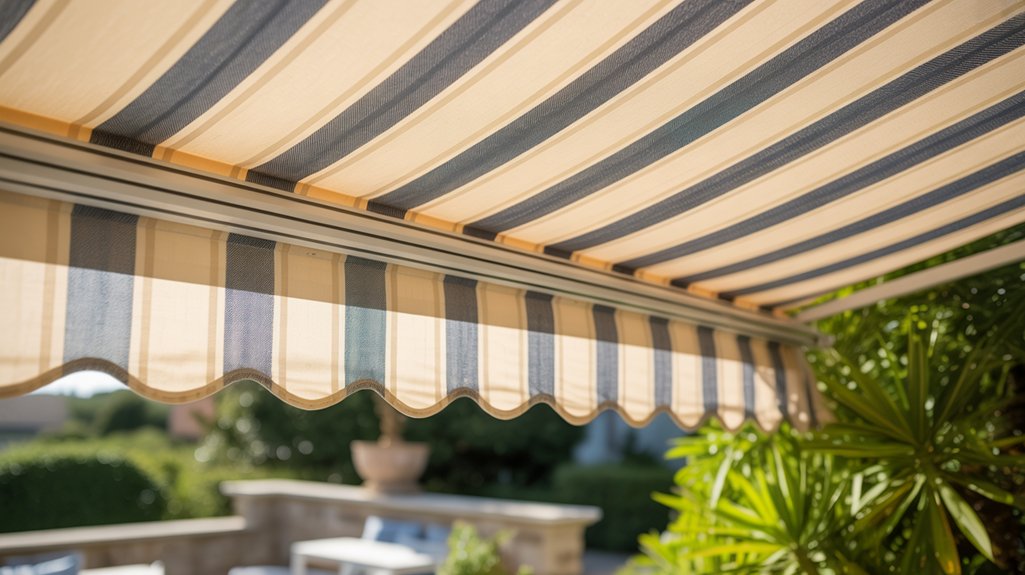
Discover which awning fabric truly stands the test of sun, rain, and time—the answer might surprise you.
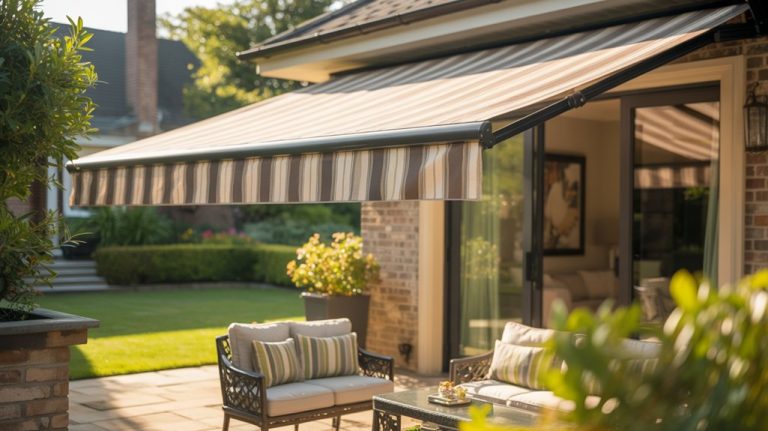
Solution-dyed acrylic is the strongest all-around fabric for outdoor awnings, particularly where fade resistance and breathability are the priority. In high-UV climates like Denver, ultraviolet intensity is the dominant degradation driver, making pigment-integral construction more durable than surface-coated alternatives. Outdoor awning fabric is a weather-resistant covering material stretched over a frame to shield exterior spaces from sun, rain, and heat.
Three fabric classes dominate residential retractable awnings: solution-dyed acrylic woven fabric, PVC-coated polyester, and vinyl-laminated polyester. Each class reflects a distinct manufacturing logic that determines how the material handles UV exposure, moisture, and structural load — not interchangeably, but according to specific trade-offs. Selecting among them requires identifying which performance property the installation actually prioritizes, because optimizing for fade resistance, waterproofing, and graphic capability point toward different materials.
| Property | Solution-dyed acrylic | PVC-coated polyester | Vinyl-laminated polyester |
|---|---|---|---|
| UV / fade resistance | Highest; pigment integral to the fiber | Coating-dependent | Laminate-dependent |
| Water resistance | Not inherently waterproof; needs drainage pitch (≈14° or more) or treatment | Waterproof; impermeable coating | Waterproof; laminate film |
| Opacity / view-through | Open or semi-open weave; some translucency | Largely opaque; higher shading coefficient | Opaque; supports printed graphics |
| Breathability | Vapor-permeable; surface dries | Non-breathable; needs ventilation detailing | Non-breathable; needs ventilation detailing |
| Typical residential weight | ≈250–310 g/m² | ≈400–650 g/m² | ≈350–500 g/m² |
Solution-dyed acrylic woven fabric achieves its UV resistance by incorporating pigment directly into the acrylic polymer before fiber formation, rather than applying colorant as a surface coating. This construction means degradation from ultraviolet exposure does not strip away a surface layer but must break down the fiber itself, a substantially slower process. The distinction carries practical weight in high-UV environments such as Denver, where ultraviolet intensity is the dominant weathering variable. Colorfastness performance for fabrics claiming this resistance is verified under accelerated weathering protocols per ASTM G154 or the broader-spectrum ASTM G155, and manufacturers offering long-term fade warranties back those claims with documented test results under one or both standards.
PVC-coated polyester achieves full water impermeability through a polyvinyl chloride coating applied over a high-tenacity polyester scrim, a construction that solution-dyed acrylic woven fabric cannot match without supplemental treatment. That impermeability comes with tradeoffs: the largely opaque surface blocks view-through and raises the shading coefficient, which increases heat buildup beneath the canopy unless ventilation detailing is incorporated into the installation design. Vinyl-laminated polyester follows a similar structural logic but substitutes a calendered film laminate for the coating layer, a method that accommodates printed graphics and yields a lighter fabric weight in residential grades. Tensile and tear strength for both fabric classes are verified under ASTM D751 and ASTM D5034, establishing the mechanical baseline that separates specification-grade material from commodity alternatives.
Fabric claims don’t hold weight until testing validates them. UV colorfastness is established through accelerated weathering protocols — ASTM G154 using fluorescent UV lamps, ASTM G155 using a broader-spectrum xenon arc source — and premium fabrics carry manufacturer warranties only when backed by documented results under one or both methods. Flame propagation follows NFPA 701 Test Method 2, the standard IBC 2021 Section 3105.3 references for awning covers, though jurisdictions may also require supplemental protocols such as CPAI-84 or California Title 19 depending on what the local authority having jurisdiction enforces.
ASTM G155, which uses a xenon arc light source to simulate the full solar spectrum, provides a broader-spectrum accelerated weathering evaluation than the fluorescent UV method specified under ASTM G154. Both standards are used to establish UV colorfastness for awning fabrics, but G155 more closely replicates the combined ultraviolet, visible, and infrared radiation that outdoor textiles encounter in service. Solution-dyed acrylic fabrics perform consistently under both protocols because pigment is locked into the fiber at the polymer stage rather than applied as a surface treatment, leaving no coating layer to degrade. Manufacturers offering colorfastness warranties on residential awning fabrics typically back those claims with accelerated weathering data generated under one or both of these standards.
IBC 2021 Section 3105.3 references NFPA 701 Test Method 2 as the flame propagation criterion for awning covers. That standard evaluates whether a fabric self-extinguishes after a controlled ignition source is removed, establishing a measurable threshold for fire resistance rather than relying on material classification alone. Supplemental protocols — including CPAI-84 and California Title 19 — may be imposed by a local authority having jurisdiction, making compliance requirements variable by region. Solution-dyed acrylic and PVC-coated polyester fabrics are both available in formulations that meet NFPA 701 Test Method 2, though the applicable protocol for a given installation depends on the jurisdiction’s adopted code cycle and any additional AHJ requirements in force.
No single fabric serves every condition equally well, and the decision typically pivots on two competing priorities: fade resistance and full waterproofing. Solution-dyed acrylic holds its color longer under sustained UV exposure because the pigment is integral to the fiber rather than surface-applied, but its woven structure depends on adequate drainage pitch — generally no less than 14 degrees — to shed water rather than repel it outright. Where standing water, opacity, or easier surface cleaning takes precedence, PVC-coated or vinyl-laminated polyester addresses those demands, though fabric weight, weave density, and ventilation detailing then become the variables that govern long-term performance.
Solution-dyed acrylic fabric achieves its fade resistance through pigment integration at the fiber-formation stage, a construction advantage that PVC-coated polyester and vinyl-laminated polyester cannot replicate through surface treatments alone. In high-UV environments such as Denver, where ultraviolet intensity is the dominant degradation driver, that structural difference determines long-term colorfastness performance verified under ASTM G154 or ASTM G155 accelerated weathering protocols. However, solution-dyed acrylic is not inherently waterproof and depends on a drainage pitch of approximately 14 degrees or greater to shed precipitation effectively. Where full water impermeability is the governing requirement, PVC-coated polyester delivers that property through its polyvinyl chloride coating layer, though its opacity and heat retention characteristics require ventilation detailing as a compensating design measure.
Solution-dyed acrylic woven fabric relies on a drainage pitch of approximately 14 degrees or greater to shed precipitation, because its vapor-permeable weave structure does not provide inherent waterproofing. That breathability is a functional advantage in applications where trapped moisture beneath an opaque cover would promote mildew or heat accumulation, but it transfers the water-management responsibility to installation geometry rather than the fabric itself. PVC-coated polyester eliminates that dependency through full impermeability, though its opacity requires ventilation detailing to offset heat buildup. Matching fabric class to project priorities consequently requires evaluating rainfall exposure, slope feasibility, and ventilation constraints together rather than treating fade resistance or waterproofing as independent variables.
A few questions surface consistently when homeowners evaluate awning fabric, and the answers depend less on product claims than on construction fundamentals. Solution-dyed acrylic holds the strongest case for fade resistance because pigment is locked into the fiber itself, making UV exposure a surface weathering issue rather than a colorant-loss problem — a meaningful distinction in high-altitude or sun-intensive climates. Whether acrylic or vinyl performs better, whether a fabric sheds water or merely repels it, and how long any cover realistically lasts all hinge on matching the fabric’s verified properties to the site’s dominant stressors.
Solution-dyed acrylic is the most fade-resistant awning fabric class available for residential retractable applications. Its colorfastness advantage stems from pigment being incorporated into the acrylic polymer before fiber formation, making it integral rather than surface-applied, a property verified through accelerated weathering under ASTM G154 or G155. Premium solution-dyed acrylic products typically carry manufacturer colorfastness warranties backed by that standardized testing.
Solution-dyed acrylic outperforms vinyl in UV colorfastness and breathability, while vinyl-based fabrics deliver full waterproofing and higher opacity. The stronger choice depends on whether fade resistance or water impermeability is the priority application requirement. High-UV markets like Denver favor acrylic, whereas installations requiring complete rain protection typically specify PVC-coated or vinyl-laminated polyester.
Awning fabric is not universally waterproof; water resistance varies by fabric class. PVC-coated polyester and vinyl-laminated polyester achieve full impermeability, while solution-dyed acrylic relies on a drainage pitch of roughly 14 degrees or a factory water-repellency treatment. Specifiers prioritizing breathability accept this trade-off, whereas applications demanding full waterproofing favor PVC or vinyl constructions.
Solution-dyed acrylic awning fabric typically lasts 10 to 15 years under normal residential conditions, while PVC-coated polyester and vinyl-laminated polyester generally range from 7 to 12 years depending on climate exposure. High-UV environments like Denver accelerate degradation, making pigment-integral fiber construction a meaningful durability advantage. Premium fabrics backed by ASTM G154 or G155 accelerated weathering testing carry manufacturer colorfastness warranties that serve as reliable lifespan benchmarks.
High UV intensity at Denver’s elevation, the corresponding accelerated degradation of surface-dyed materials, and the IBC 2021 Section 3105.3 flame propagation requirements that local authorities having jurisdiction enforce collectively shape which awning fabrics perform reliably in this market rather than merely passing a showroom inspection. Backyard Paradiso’s retractable awning installation work across the Denver region reflects direct familiarity with those conditions — particularly the case for solution-dyed acrylic where fade resistance and vapor permeability are the governing priorities, and for PVC-coated polyester where full waterproofing and opacity are required instead. Consultations are available by appointment for homeowners in Denver, Boulder, Littleton, and surrounding Front Range communities. Fabric selection and proper drainage pitch, when resolved at the specification stage, translate directly into functional outdoor square footage that extends the usable season and supports measurable resale recovery relative to untreated exterior space.