Physical Address
304 North Cardinal St.
Dorchester Center, MA 02124
Physical Address
304 North Cardinal St.
Dorchester Center, MA 02124
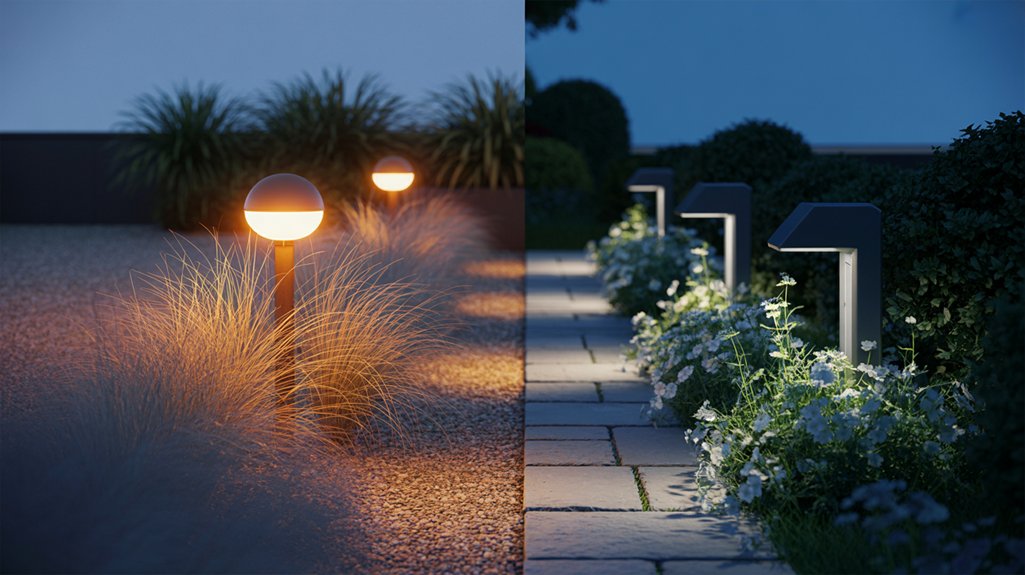
Gain insight into how LED landscape lights outperform halogen in efficiency, longevity, and compliance—but the real differences might surprise you.
LED landscape lighting outperforms halogen in energy efficiency, service life, heat management, and dark-sky compliance. In low-voltage systems governed by NEC Article 411, lower per-fixture LED wattage allows more luminaires per 25-ampere circuit before voltage drop limits are reached. LED landscape lighting is a permanently installed, low-voltage illumination category that delivers controlled light output through semiconductor junctions rather than heated filaments.
| Property | LED | Halogen |
|---|---|---|
| Efficiency (light per watt) | High — far less wattage for equal delivered light | Low — most input energy leaves as heat |
| Rated service life | Long; characterized by L70 via ANSI/IES LM-80 and TM-21 | Short by comparison |
| Heat output | Low ambient; junction temperature managed by a heat-sink body | High — filament radiates heat |
| Color temperature | Selectable CCT | Essentially fixed warm |
| Dimming and control | Dimmable; control- and sensor-friendly | Limited |
| Low-voltage circuit fit | More fixtures per 12 V / 25 A circuit (NEC Art. 411) | Fewer — higher wattage each |
LED’s fundamental advantage over halogen lies in efficacy — it delivers considerably more lumens per watt, which in a 12-volt low-voltage system translates directly into more fixtures per circuit before NEC Article 411’s 25-ampere limit constrains design. Halogen converts most of its input energy to heat at the lens, while LED concentrates thermal load at the semiconductor junction, where it must be actively managed through cast aluminum or copper housings with integral heat sinks. Junction temperature governs long-term output: lumen depreciation roughly doubles for every 10°C rise, making thermal management a structural decision rather than an afterthought.
Article 411 of the National Electrical Code limits each 12-volt low-voltage landscape circuit to 25 amperes, which at nominal voltage represents approximately 300 watts of total connected load. Because a halogen lamp converts most of its input energy to heat rather than visible light, a typical halogen landscape fixture demands considerably more wattage than an LED source producing equivalent delivered lumens. That efficiency gap has direct consequences for circuit capacity: fewer halogen fixtures can be connected to a single transformer circuit before the Article 411 threshold or voltage-drop limits are reached. LED’s lower per-fixture wattage allows more luminaires to run on the same circuit, reducing the number of transformer circuits and associated wiring required for a given installation.
Lumen depreciation in LED sources roughly doubles for every 10-degree Celsius rise in junction temperature, a relationship that IES TM-21 models explicitly using Arrhenius principles to project rated service life. Unlike halogen fixtures, which radiate waste heat outward from the lens and filament assembly, LED fixtures concentrate thermal load at the semiconductor junction itself, making conductive heat dissipation at that point the primary engineering constraint. Quality landscape fixtures address this through cast aluminum or copper bodies with integral fins, which function as passive heat sinks drawing heat away from the junction continuously during operation. Halogen’s comparatively unmanaged heat output also poses risks to surrounding materials and soil moisture near grade-mounted fixtures that LED’s lower surface temperatures reduce substantially.
Service life for LED landscape fixtures isn’t rated the way halogen bulbs are. Rather than a simple burn-out hour, LED longevity follows the L70 metric — the point at which output falls to 70 percent of initial lumens — measured per ANSI/IES LM-80 and projected under IES TM-21, which caps any extrapolation at six times the test duration to prevent inflated claims. Where halogen locks a system into a fixed warm color and no practical dimming, LED fixtures offer selectable correlated color temperature and compatible dimming controls, giving designers meaningful latitude to satisfy dark-sky ordinances and site-specific aesthetic requirements that halogen simply can’t address.
IES TM-21 governs how manufacturers project LED service life beyond the tested duration of LM-80 data, and it caps any such projection at six times the LM-80 test period. This constraint exists because lumen depreciation accelerates with heat: junction temperature rise of 10 degrees Celsius roughly doubles the rate of output loss, an Arrhenius relationship that TM-21 models explicitly. The industry benchmark for end-of-useful-life is L70 — the point at which luminous output falls to 70 percent of initial — measured under ANSI/IES LM-80 protocol. Halogen carries no equivalent metric; its rated hours describe catastrophic filament failure, not gradual depreciation, making direct life comparisons between the two source types methodologically distinct.
Correlated color temperature for residential LED landscape lighting is specified by IES model-ordinance guidance at 2700 to 3000 K, with a lower range of 2200 to 2700 K recommended near ecologically sensitive habitat. Halogen operates at a fixed color temperature near 2900 K determined by filament physics, offering no field-selectable adjustment; LED fixtures allow CCT selection at the time of specification, enabling a single product line to satisfy varied municipal light-pollution ordinances without hardware changes. Dimming extends that advantage: reducing drive current lowers junction temperature, which — given the Arrhenius relationship TM-21 models — slows lumen depreciation and extends the L70 service life beyond the rated figure established at full drive. Halogen carries no equivalent dimming benefit for longevity because filament degradation follows a different failure mechanism.
LED’s lower per-fixture wattage carries direct consequences for how many luminaires a single 12-volt transformer circuit can support before hitting the NEC Article 411 ceiling of 25 amperes per output circuit. More fixtures per circuit means fewer transformer runs, less wire, and a lower installed cost — practical advantages that compound across larger residential installations. Where Colorado communities enforce light-pollution ordinances, LED’s selectable correlated color temperature allows designers to hold the 2700–3000 K range that IES guidance and model dark-sky ordinances recognize as compliant, a specification halogen’s fixed output simply can’t meet.
Article 411 of the National Electrical Code limits each 12-volt output circuit to 25 amperes, which corresponds to approximately 300 watts at nominal voltage. A halogen fixture typically draws 20 to 50 watts per lamp, meaning a single circuit may support as few as six to fifteen luminaires before reaching that threshold. An LED fixture delivering equivalent illuminance draws a fraction of that wattage, allowing substantially more fixtures per circuit without triggering load or voltage-drop constraints. This per-circuit efficiency also supports dark-sky compliance in Colorado communities with light-pollution ordinances, where reduced wattage combines with dimming controls and warm correlated color temperatures — typically 2700 to 3000 K for residential installations — to meet IES model-ordinance guidance that halogen’s fixed output and color cannot practically accommodate.
IES model-ordinance guidance identifies 2700 K or below as the preferred correlated color temperature for residential landscape lighting in communities seeking to limit skyglow and protect dark-adapted wildlife. Halogen sources operate at a fixed color temperature near 2900 K with no adjustment possible, while LED fixtures allow selection of 2200 to 3000 K depending on proximity to sensitive habitat — a distinction that matters in Colorado municipalities where light-pollution ordinances adopt IES criteria by reference. Full-cutoff optics paired with dimming controls further reduce the artificial light at night that IES guidance targets, and LED accommodates both requirements simultaneously. Halogen’s fixed output provides no equivalent pathway to ordinance compliance without fixture replacement.
Four questions recur most often when homeowners consider switching to LED landscape lighting: whether LED fixtures outperform halogen in raw brightness, how their service lives compare, whether existing halogen sockets accept LED replacements, and what the actual reduction in electrical draw looks like. The answers aren’t uniform, because each depends on fixture design, system configuration, and the specific products involved. What the evidence does support consistently is that LED delivers more usable light per watt, maintains output longer before meaningful depreciation sets in, and draws substantially less current — conditions that matter in any low-voltage system operating under circuit and transformer constraints.
LED landscape lights are not inherently brighter than halogen, but they deliver equivalent or greater light output at considerably lower wattage. Lumens measure actual brightness, and an LED fixture routinely matches a halogen’s lumen output while drawing a fraction of the watts. This efficiency allows more fixtures per transformer circuit before NEC Article 411 limits are reached.
LED landscape lights last considerably longer than halogen, with service life measured by the L70 metric — the point at which output reaches 70 percent of initial lumens per IES TM-21 methodology. Halogen operates as an incandescent-class source with comparatively short rated hours. This longevity difference meaningfully reduces maintenance frequency in permanently installed low-voltage systems.
Halogen landscape bulbs can generally be replaced with LED equivalents in existing low-voltage fixtures. The retrofit must respect the listed system’s components, including transformer compatibility and fixture housing ratings, to maintain safe, compliant operation. Mismatched components risk performance degradation or code violations under NEC Article 411 governing low-voltage lighting circuits.
LED landscape lights consume considerably less electricity than halogen fixtures for equivalent delivered light output. In a 12-volt low-voltage system, this efficiency directly determines how many fixtures a single transformer circuit can support before reaching NEC Article 411‘s 25-ampere limit. Lower per-fixture wattage allows substantially more luminaires per circuit without voltage drop penalties.
Denver-area low-voltage landscape lighting installations operate under a specific convergence of engineering constraints: Article 411 circuit limits interact with high-altitude UV exposure and the region’s pronounced freeze-thaw cycles, while Colorado communities increasingly enforce light-pollution ordinances that require warm CCT sources and full-cutoff optics. Backyard Paradiso’s work in LED landscape lighting installation reflects direct familiarity with how those conditions shape fixture selection, transformer sizing, and dark-sky compliance decisions across the Front Range. Consultations are available by appointment for properties in Denver, Boulder, Fort Collins, and surrounding communities. Investment in a properly engineered LED low-voltage system is generally understood regarding functional outdoor area added, long-term operating cost reduction relative to halogen, and resale value recovery consistent with documented outdoor living improvements — framing that applies whether the project serves a modest residential yard or a larger estate parcel.