Physical Address
304 North Cardinal St.
Dorchester Center, MA 02124
Physical Address
304 North Cardinal St.
Dorchester Center, MA 02124
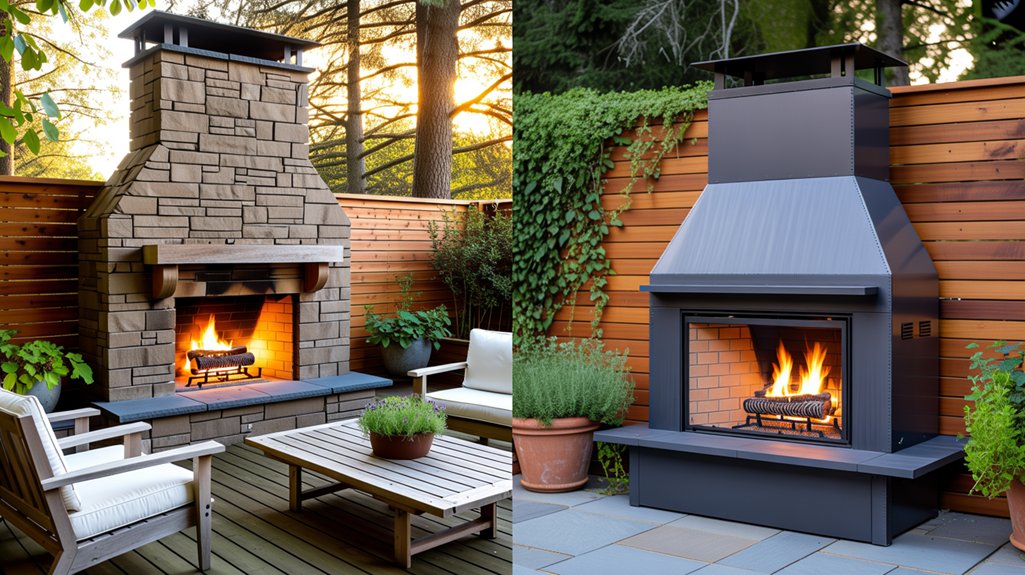
Uncover the critical differences between masonry and factory-built outdoor fireplaces that could determine your project's safety, cost, and longevity.
Wood-burning outdoor fireplaces fall into two construction types — site-built masonry and factory-built listed appliances — each governed by an entirely separate compliance framework that cannot be interchanged or combined. IRC 2021 R1001 prescriptive rules apply exclusively to masonry construction, while factory-built units are regulated solely by their ANSI/UL 127 listing. A wood-burning outdoor fireplace is a combustion appliance designed to produce open or enclosed flame within a dedicated firebox, exhausted through a matched chimney system engineered to manage sustained thermal output safely.
IRC R1001 governs site-built masonry fireplaces through a prescriptive dimensional framework that ties structural and thermal performance directly to specific construction thresholds — footing depth and projection, firebox depth, hearth slab thickness, and clearance to combustibles — each calibrated to consequence rather than convention. Refractory firebrick lining meeting ASTM C1261 and a clay flue liner compliant with ASTM C315, installed per ASTM C1283, aren’t interchangeable upgrades; they’re the thermal and structural baseline the code assumes is already in place. Where those dimensions and materials align, the assembly earns its longevity — where they don’t, the compliance gap carries structural and fire-safety exposure that no finish material conceals.
IRC Section R1001.2 requires site-built masonry fireplace footings to be no less than 12 inches thick, extend at least 6 inches beyond each face of the fireplace, and bear on soil below the established frost depth for the jurisdiction. These dimensional minimums are not advisory — they are prescriptive code requirements that apply uniformly to site-built construction, independent of the contractor’s preferred practice or local custom. The firebox depth minimum of 20 inches under R1001.6 and the 4-inch hearth slab with corresponding extension requirements under R1001.9 follow the same prescriptive logic, each threshold calibrated to a specific structural or fire-safety function. Jurisdictions in higher Seismic Design Categories impose additional reinforcing obligations under R1001.3, extending the compliance burden well beyond the dimensional checklist.
IRC R1001.6 requires site-built masonry fireboxes to be lined with refractory firebrick conforming to ASTM C1261, installed behind a clay flue liner meeting ASTM C315 and placed in accordance with ASTM C1283. These material designations are not interchangeable with standard brick or general-purpose mortar — each specification addresses thermal cycling, flue-gas exposure, and sustained combustion temperatures that common construction materials are not rated to withstand. The clay flue liner system channels combustion gases while the refractory firebox lining absorbs and dissipates radiant heat across repeated fire cycles. Taken together, these layered material obligations represent a compliance path entirely distinct from the listing-based framework that governs factory-built units — a distinction IRC R1004 makes explicit by routing prefabricated appliances away from R1001’s prescriptive dimensional and material requirements entirely.
Factory-built wood-burning fireplaces listed and labeled under ANSI/UL 127 operate under a fundamentally different compliance framework than site-built masonry — the listing governs clearances, hearth dimensions, and installation geometry, and R1001’s prescriptive masonry requirements don’t apply. The firebox assembly is constructed from high-temperature stainless steel — 304 in standard inland installations, 316 where coastal chloride exposure is a documented condition — and the chimney system must be a matched, listed Class A assembly under UL 103, because substituting unlisted components voids the listing and the legal basis for the installation. Where masonry demands field-verified dimensional compliance across dozens of prescriptive thresholds, the listed unit transfers that burden to the manufacturer’s tested and certified configuration, which carries its own consequence: any field deviation from the listing documentation isn’t a gray area — it’s a non-compliant installation.
Factory-built outdoor fireplaces listed under ANSI/UL 127 are governed exclusively by the terms of that listing — not by the prescriptive dimensional requirements of IRC 2021 Section R1001. This distinction carries direct compliance consequences: clearances to combustibles, hearth extension dimensions, and firebox construction specifications are all established through the manufacturer’s listing documentation and must be followed as written. IRC Section R1004 confirms that listed factory-built fireplaces are installed per their listing, rendering R1001’s masonry-specific requirements inapplicable to these units. The chimney system must be a matched, listed Class A assembly under UL 103 — substitution of unlisted components, even dimensionally compatible ones, voids the listing and reintroduces undefined clearance and performance risk.
Factory-built fireplaces listed under ANSI/UL 127 require a firebox constructed of high-temperature stainless steel — Grade 304 in standard inland installations, Grade 316 where coastal saline exposure is a documented service condition. This material specification is not a design preference; it is a performance requirement embedded in the listing itself, derived from the thermal cycling and corrosion resistance demands that distinguish an outdoor wood-burning appliance from its interior counterpart. The chimney system must be a matched, listed Class A assembly tested under UL 103 — no component substitution is permitted, because the listing is issued to the complete system as tested, not to individual parts. Service life for listed appliances is directionally shorter than site-built masonry, reflecting the nature of listed-appliance construction rather than any deficiency in compliance.
Where site-built masonry and listed factory-built units diverge most consequentially is on the question of temporal expectation — a properly executed masonry fireplace, built to IRC 2021 R1001’s dimensional and material requirements, carries a service horizon measured in generations because its refractory lining, clay flue system, and monolithic footing are field-assembled from durable mineral components with no scheduled obsolescence. A listed appliance under ANSI/UL 127, by contrast, carries a service life bounded by the conditions of its listing, the availability of matched listed components, and the performance thresholds its high-temperature stainless firebox sustains under site-specific thermal cycling — directionally shorter, though verifiable. On timeline, factory-built installation resolves faster and with predictable sequencing, while masonry construction demands phased curing, inspection holds, and material lead times that extend the schedule in exchange for permanence.
Site-built masonry fireplaces, constructed in compliance with the dimensional and material requirements of IRC 2021 Section R1001, are routinely appraised as multi-generational installations when firebrick lining, refractory mortar, and clay flue liners meeting ASTM C315 are properly executed. The structural depth of that compliance — footings bearing below frost depth, hearth slabs at minimum 4 inches thick, clearances maintained at 2 inches front and sides — produces an assembly whose degradation timeline is measured in decades rather than appliance cycles. Factory-built units listed under ANSI/UL 127 carry a directionally shorter service profile by design; the listing governs the installation and the listed components define the replacement horizon. The two construction types occupy fundamentally different positions on a longevity curve, and conflating their service expectations misrepresents the investment profile of either system.
Factory-built units listed under ANSI/UL 127 arrive as complete, pre-engineered assemblies whose clearances, hearth dimensions, and chimney specifications are established by the listing rather than by the prescriptive dimensional requirements of IRC 2021 Section R1001. That pre-qualification eliminates the field-measurement and masonry-curing variables that extend site-built timelines — footing excavation below frost depth, refractory firebrick installation per ASTM C1261, clay flue liner placement per ASTM C1283, and mortar cure sequences all compress or disappear. The trade-off is structural: the compliance depth that lengthens a masonry installation schedule is the same depth that positions the finished assembly on a multi-generational longevity curve. Listed appliances deliver verified, repeatable performance data within a narrower service horizon — faster to commission, faster to reach replacement threshold.
Owners weighing wood-burning fireplace options consistently raise four questions that cut directly to compliance, longevity, and appearance. Masonry’s durability advantage is real but conditional — it depends on proper footing depth, refractory lining integrity, and flue system maintenance sustained across decades, whereas a factory-built unit‘s service life is bounded by its listing parameters and the operational demands placed on the appliance over time. The remaining questions — whether IRC R1001’s masonry prescriptive rules govern factory-built installations, which construction type reaches completion faster, and whether a listed unit can receive a masonry-profile surround — each carry answers that hinge on the regulatory and structural distinctions the two construction types carry from the outset.
Site-built masonry fireplaces — governed by IRC 2021 R1001’s prescriptive dimensional standards — carry a multigenerational service profile that appraisers most readily associate with elevated comparables. Factory-built units listed to ANSI/UL 127 deliver verified performance data but operate under a directionally shorter service-life profile tied to their listing. Construction type determines durability trajectory before the first fire is laid.
IRC R1001’s masonry prescriptive clearance rules do not govern factory-built units — ANSI/UL 127 listing and the manufacturer’s installation instructions carry full jurisdictional authority under IRC R1004. Clearances, hearth dimensions, and surround specifications are dictated entirely by the appliance listing. Local inspectors reference that listing document — not masonry code — during rough and final inspection.
Factory-built units install considerably faster than site-built masonry fireplaces. Masonry construction requires sequential curing periods, frost-depth footing excavation, and dimensional compliance with IRC 2021 R1001 before the firebox lining and clay flue liner are set — a schedule measured in weeks. Factory-built systems, listed to ANSI/UL 127 with matched Class A chimney assemblies, compress that timeline substantially once a compliant installation surface is confirmed.
Factory-built wood-burning fireplaces accept noncombustible masonry veneer finishes — brick, stone, and stucco — provided the veneer maintains all clearances established by the UL 127 listing rather than IRC R1001 prescriptive dimensions. The listing governs; any veneer application that compromises listed clearances constitutes a code violation regardless of aesthetic intent. Appraisers evaluating finished surrounds should confirm the underlying appliance type through the manufacturer label before applying masonry-comparable valuation assumptions.
Wood-burning outdoor fireplace construction in this market operates under a bifurcated compliance framework — site-built masonry answering to IRC 2021 R1001‘s prescriptive dimensional schedule, including R1001.2 footing depth at frost penetration, R1001.6 firebox depth minimums, and ASTM C1261 refractory lining requirements, while factory-built units are governed exclusively by their ANSI/UL 127 listing and matched UL 103 Class A chimney system, with R1001’s masonry prescriptives carrying no authority over listed appliances. Backyard Paradiso works within both construction pathways, applying the specific compliance logic each type demands across wood-burning outdoor fireplace installations. Consultations are available by appointment for clients evaluating which construction type aligns with their site conditions, authority-having-jurisdiction requirements, and long-term resale position. Investment in a correctly executed wood-burning fireplace — masonry or listed factory-built — is consistently associated with functional outdoor living area that appraisers recognize across the Houston, Katy, Sugar Land, and The Woodlands markets.