Physical Address
304 North Cardinal St.
Dorchester Center, MA 02124
Physical Address
304 North Cardinal St.
Dorchester Center, MA 02124

Find out how long artificial turf really lasts with kids and dogs—the answer depends on factors most homeowners never consider.
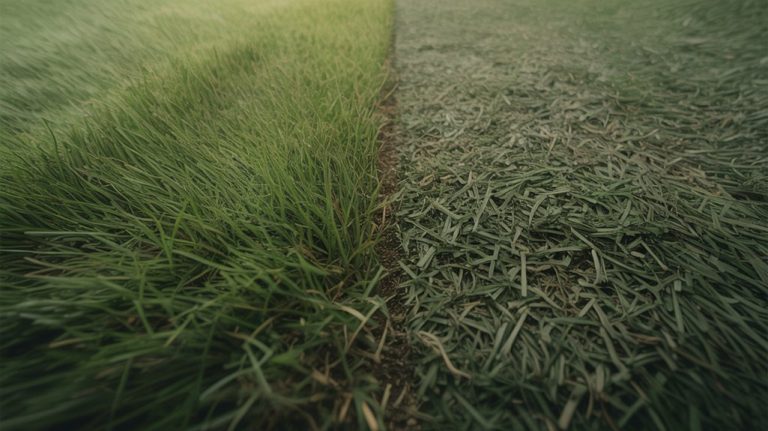
Residential synthetic turf under combined child and pet use typically delivers eight to twelve years of serviceable life, landing toward the lower portion of the eight-to-fifteen-year industry band. Colorado Springs compounds wear through high-altitude UV exposure and freeze-thaw cycling, making fiber stabilization and free-draining base construction critical specification decisions. Synthetic turf is a manufactured surface system—polymer fiber, infill, and engineered backing—installed over a prepared base to replicate functional turfgrass for play, pet activity, and landscape use.
Two forces account for most premature turf failure in residential settings: concentrated mechanical abrasion along traffic lanes and play zones, and biological degradation within pet-relief areas. Fiber abrasion is measurable — the Tetrapod-Walker test quantifies how much blade structure a surface retains under repeated lateral stress — and installations that underspecify face weight or tuft density in high-use corridors tend to show matting and fiber loss well before the broader field does. In pet zones, the failure mode is chemical rather than mechanical: urease-producing bacteria convert urine urea to ammonia while uric acid crystallizes on fibers and backing, and because that crystalline residue resists casual rinsing, the infill layer accumulates biological load that degrades both material integrity and drainage performance over time.
Fiber abrasion resistance in synthetic turf play zones is evaluated under ASTM D7255, which employs the Tetrapod-Walker test to simulate the repetitive mechanical wear generated by foot traffic. Concentrated traffic lanes — the approaches to swing sets, the goal mouths of backyard kick-arounds, the paths dogs run daily — focus that abrasion into narrow corridors rather than distributing it across the full installation. Fiber geometry and polymer selection determine how well a blade recovers from repeated compression and lateral shear; HDPE blades and dual-fiber systems carry measurably stronger compaction recovery than softer monofilament constructions. Left unmanaged, flattened and abraded lanes accelerate infill migration, which compounds fiber stress and shortens the service life of the affected zones.
Urease-producing bacteria colonizing synthetic turf pet zones convert urine urea to ammonia while uric acid crystallizes on fiber surfaces and backing material, creating a biological load that casual rinsing cannot reverse. This dual degradation pathway — chemical and microbial — distinguishes pet zones from conventional wear lanes, where abrasion alone governs fiber loss. Polyurethane secondary backing resists moisture absorption and urine residue retention more effectively than SBR latex constructions, directly influencing service life in heavy pet-use environments. Zeolite infill, specifically clinoptilolite, addresses the ammonia pathway through cation-exchange capture of ammonium ions; periodic water flushing resets the lattice and sustains that function across the life of the installation.
Colorado Springs presents a set of environmental stressors that compound one another in ways most lower-elevation markets don’t encounter. Near 6,035 feet, ultraviolet intensity is materially higher than at sea level, and with roughly 300 sunny days annually and low ambient humidity, fiber UV stabilization through HALS chemistry and UV absorbers isn’t a premium upgrade — it’s a baseline requirement for any installation expected to reach the upper half of its service life. Rapid freeze-thaw cycling and seasonal snow loads add a second front, placing continuous hydraulic stress on the base and backing system such that free-draining base construction and verified drainage capacity become the structural foundation on which fiber longevity either holds or fails.
Colorado Springs sits at an elevation of 6,035 feet, where reduced atmospheric filtration intensifies ultraviolet radiation exposure beyond what ground-level installations in lower-altitude regions encounter. That UV load, combined with approximately 300 sunny days per year, accelerates fiber photodegradation at a rate that makes stabilization chemistry a non-negotiable specification requirement rather than an upgrade. Qualifying fiber systems under ASTM G154 or ASTM G155 accelerated weathering protocols confirms that the UV stabilization package — typically a combination of hindered amine light stabilizers (HALS) and UV absorbers compounded into the fiber — meets the duty cycle. Installations specified without verified weathering qualification in this climate face brittleness, color loss, and fiber fracture well before the service life would otherwise expire.
Colorado Springs experiences freeze-thaw cycling that can repeat dozens of times across a single shoulder season, subjecting turf base layers and backing systems to cumulative hydraulic stress with each melt-refreeze event. When drainage is compromised — whether by infill compaction, base settlement, or backing degradation — standing water enters freeze cycles and accelerates both base displacement and backing delamination. Free-draining crushed aggregate base construction, graded to move water away from the installation, directly addresses this mechanism. Drainage performance is verifiable under ASTM F2898 flood testing, and installations in Colorado Springs should carry documentation of that qualification. Spring snow load adds a compressive component that groomed infill and resilient fiber systems recover from more reliably than compacted or under-maintained installations.
Specification and maintenance decisions, made at installation and sustained afterward, are the primary variables determining where a turf system lands within its service-life band. Grooming restores blade orientation and redistributes compacted infill in traffic lanes; periodic flushing in pet-relief zones resets the zeolite infill’s capacity to capture ammonium before uric acid crystallization advances fiber and backing degradation. Backing composition, face weight, and fiber chemistry aren’t incidental choices — they’re the structural commitments that either compound or offset the cumulative wear a Colorado Springs household delivers year over year.
Zeolite infill, specifically the clinoptilolite variety, captures ammonium ions through cation-exchange rather than masking odor at the surface, making it the mechanistically sound choice for pet-relief zones in Colorado Springs installations. The capture process is reversible: periodic water flushing resets the lattice and restores adsorption capacity, extending the functional life of the infill layer between replacements. Colorado Springs’ near-300 sunny days annually and low ambient humidity accelerate uric acid crystallization on fibers and backing, a residue that resists casual rinsing and harbors urease-producing bacteria capable of sustaining ammonia generation long after the initial deposit. Scheduled flushing combined with prompt solid-waste removal interrupts that biological cycle, measurably reducing the cumulative chemical load that degrades fiber and backing integrity over the installation’s service life.
Polyurethane secondary backing does not absorb moisture or urine residues the way SBR latex backing does, a material difference that directly extends service life in heavy pet-use environments. That resistance to moisture retention interrupts the biological cycle by which urease-producing bacteria sustain ammonia generation within the backing layer itself, reducing cumulative chemical degradation over the installation’s lifespan. Fiber specification matters equally: HDPE or dual-fiber blade systems with strong compaction recovery, evaluated through the Tetrapod-Walker abrasion protocol under ASTM D7255, resist the concentrated wear that develops in fixed traffic lanes and play zones. Higher face weight and tuft density in those zones further slow fiber loss, while UV stabilization qualified under ASTM G154 or G155 accelerated weathering protocols addresses Colorado Springs’ high-altitude solar intensity — a condition that makes fiber stabilization a structural specification decision, not an optional upgrade.
Dogs do not ruin artificial turf when the installation is correctly specified for pet use. Uric acid crystallization and urease-driven ammonia generation accelerate fiber and backing degradation when pet zones lack zeolite infill and polyurethane secondary backing. Prompt waste removal and scheduled flushing of pet-relief areas remain the primary maintenance factors governing turf longevity in dog-active households.
Dual-fiber or stiffer HDPE blade systems paired with higher face weight and tuft density deliver the longest service life under concentrated residential play traffic. Fiber abrasion resistance, evaluated through the Tetrapod-Walker test per ASTM D7255, is the principal performance variable distinguishing adequate from premium specifications. Polyurethane secondary backing further supports longevity by resisting moisture retention in heavily trafficked zones.
Colorado Springs installations face meaningful UV exposure risk, given nearly 6,035 feet of altitude and approximately 300 sunny days annually that intensify solar radiation relative to lower-elevation markets. Quality fiber systems incorporate HALS chemistry alongside UV absorbers, qualified through ASTM G154/G155 accelerated weathering protocols, to resist photodegradation. Homeowners should confirm that any specified product carries verified UV stabilization credentials before installation.
Pet odor in artificial turf originates from uric acid crystals and ammonia produced when urease-active bacteria metabolize urine, and enzymatic cleaners that break those compounds at the molecular level outperform simple rinsing. Zeolite infill complicates removal if the cation-exchange capacity is saturated and overdue for flushing. Prompt waste removal, scheduled enzymatic treatment, and periodic zeolite regeneration through deep flushing collectively control biological load before odor becomes structural.
Residential synthetic turf installations serving active children and pets in Colorado Springs must satisfy fiber UV stabilization protocols under ASTM G154/G155, drainage performance verification under ASTM F2898, impact attenuation compliance under ASTM F1292 for play equipment zones, and infill specification standards that address the biological load of daily pet use. Backyard Paradiso brings demonstrated command of each of these requirements to artificial turf installation across the Colorado Springs market, translating specification precision into systems that hold their service life through high-altitude UV exposure, rapid freeze-thaw cycling, and concentrated residential duty. Consultations are available by appointment for homeowners in Colorado Springs, Monument, Falcon, and the surrounding Front Range corridor. Investment in a correctly specified installation recovers its functional value through years of extended service life, reduced maintenance demand, and usable outdoor square footage that performs reliably across every season the region delivers.