Physical Address
304 North Cardinal St.
Dorchester Center, MA 02124
Physical Address
304 North Cardinal St.
Dorchester Center, MA 02124

Owning artificial turf promises real savings and usability gains, but hidden costs and limitations may change everything you thought you knew.
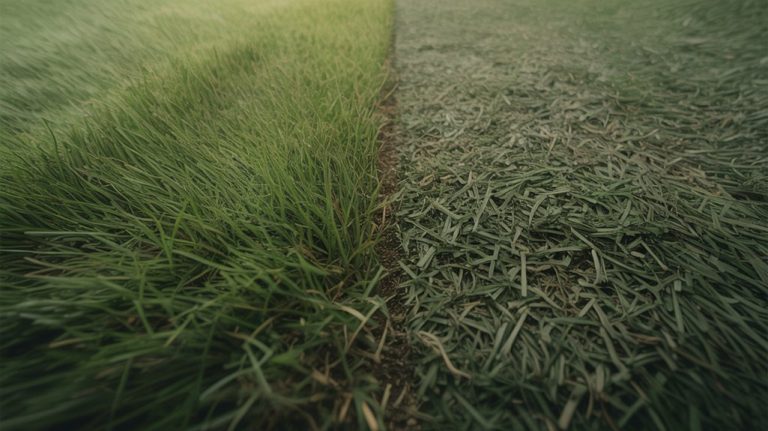
Artificial turf returns value to a homeowner through three measurable channels: eliminated recurring lawn inputs, consistently usable outdoor square footage regardless of season or weather, and household time no longer consumed by lawn maintenance. Those returns are strongest where water is constrained, turf conditions are poor, or use intensity is high. Artificial turf is a synthetic surface system installed in place of natural grass to deliver a functional outdoor area with reduced ongoing maintenance demands.
The returns from artificial turf don’t appear in a single category — they accumulate across eliminated inputs, recovered usability, and reclaimed time. Once lawn irrigation, mowing cycles, and chemical programs are removed from the recurring cost structure, the converted area stops drawing on the household’s budget and schedule in the ways a living lawn demands. Equally significant, the surface performs consistently across wet conditions and shoulder seasons that would otherwise render a natural lawn compacted, muddy, or off-limits — restoring functional square footage that many properties technically have but rarely get to use.
Replacing a natural lawn with synthetic turf eliminates irrigation water demand on the converted area entirely, removing that zone from any seasonal watering schedule or drought-restriction compliance burden. This reduction is specific to the footprint converted — no broader water-savings claim is defensible beyond that boundary. The eliminated inputs extend further than water alone: mowing cycles, fertilizer programs, herbicide and pesticide applications, and aeration services all cease on the converted surface. For households where lawn maintenance consumes meaningful labor hours or carries recurring service contract costs, those inputs do not taper — they stop at installation. The return is most pronounced where natural turf struggles under shade, heavy foot traffic, or pet use, conditions that typically escalate chemical and labor inputs before a lawn finally fails.
Synthetic turf surfaces remain uniformly usable in wet weather and shoulder seasons when saturated natural lawns become compacted, muddy, or functionally closed to foot traffic. The drainage capacity engineered into a synthetic system — routed through a perforated backing and prepared aggregate base — allows the surface to shed standing water and return to use in a timeframe that a waterlogged natural lawn cannot match. That functional availability extends the effective season of an outdoor area without physical modification to its footprint. For households where lawn areas sit unused through rainy periods or shifting months, the recovered use-hours represent a measurable return that operates independently of any maintenance-cost comparison.
Residential synthetic turf carries an expected service life of eight to fifteen years, a range determined less by time than by specification grade and use intensity. Backing composition is where that variance concentrates: polyurethane secondary backing retains tuft-bind more reliably than SBR latex under sustained UV exposure, moisture cycling, and heavy pet traffic, each of which accelerates fiber loss in lower-specification systems. Fiber longevity follows a parallel logic, governed by the UV stabilization package embedded at manufacture — systems qualified under recognized accelerated weathering standards hold color and tensile integrity meaningfully longer than those without such qualification.
Residential synthetic turf carries a documented service life range of eight to fifteen years, with actual longevity determined primarily by specification grade and use intensity. That range is not uniform across a product’s components — fiber, backing, and infill each age at different rates under load and environmental exposure. Published testing literature identifies polyurethane secondary backing as associated with longer tuft-bind retention than SBR latex backing, particularly under sustained UV exposure, heavy moisture cycling, or pet-use conditions. Accelerated weathering protocols under ASTM G154 and G155 serve as the recognized benchmarks for evaluating fiber color retention and tensile integrity, and a product’s qualification under those standards is a more reliable durability indicator than warranty language alone.
Polyurethane secondary backing retains tuft-bind integrity longer than SBR latex backing under sustained UV exposure, heavy moisture cycling, and pet-use conditions, according to published materials testing literature. Tuft-bind strength — the mechanical resistance that keeps fiber bundles anchored to the backing layer — determines whether a turf system holds its surface performance across its intended service life or degrades prematurely under load. SBR latex backing is more susceptible to hydrolytic breakdown and UV-induced embrittlement, failure modes that accelerate where drainage is incomplete or sun exposure is prolonged. At the fiber level, durability is governed by the UV stabilization package — specifically the combination of hindered amine light stabilizers and UV absorbers — with qualification under ASTM G154 and G155 accelerated weathering protocols representing the recognized benchmark for color retention and tensile integrity across a product’s service life.
Artificial turf carries three limitations that a responsible investment assessment can’t set aside. Synthetic fiber surfaces accumulate radiant heat in full sun to a degree that natural grass never approaches, and surface temperatures associated with burn risk to bare skin and paw pads aren’t edge-case anomalies — they’re a predictable consequence of direct solar exposure without evaporative cooling. Beyond heat, the financial structure concentrates cost at installation rather than distributing it across annual lawn care budgets, and end-of-life removal introduces a solid waste management obligation that the homeowner will eventually own.
Synthetic turf surface temperatures in full sun have been recorded above 120 degrees Fahrenheit, a threshold associated with burn risk to bare skin and paw pads. Unlike natural grass, which cools itself through transpiration, synthetic fiber retains and radiates absorbed solar energy, concentrating heat at the surface rather than dissipating it. Irrigation can reduce temperatures temporarily, but the cooling effect is short-lived and reintroduces the water input the installation was intended to eliminate. Households with children or pets who use the lawn barefoot during peak sun hours should treat this thermal behavior as a functional limitation, not an edge case — it is a structural characteristic of synthetic surfaces that no fiber specification currently eliminates.
Residential synthetic turf carries an expected service life of eight to fifteen years, after which the composite product — bonded fiber, backing layers, and infill — must be removed and managed as a solid waste stream rather than composted or recycled through conventional municipal channels. This end-of-life condition is not incidental; it is a known characteristic of composite synthetic materials that no current installation practice eliminates. The investment structure compounds this consideration: the full cost of materials and installation is concentrated at the point of purchase rather than distributed across annual lawn care expenditures, meaning the financial exposure is front-loaded against a finite service horizon. Households evaluating the investment should account for eventual removal costs alongside installation costs when calculating the long-term value proposition.
Artificial turf does not carry a guaranteed, universal effect on resale value — appraisers treat it as a site improvement whose reception varies by buyer preference and local market norms. Homes where natural lawn maintenance is structurally difficult may see stronger buyer response than those where a healthy lawn already performs well. Real estate professionals familiar with the specific market remain the appropriate source for localized valuation guidance.
Residential artificial turf carries an expected service life of eight to fifteen years, with actual longevity governed by product specification and use intensity. Backing composition is a meaningful conditioning factor — polyurethane secondary backing demonstrates stronger tuft-bind retention over time than SBR latex backing, particularly under high-UV, heavy-moisture, or pet-use conditions. Fiber UV stabilization packages further influence how well color and tensile integrity hold across the installation’s lifespan.
Whether artificial turf proves cheaper than natural lawn over time depends on installation cost, service life achieved, and the intensity of inputs the replaced lawn required. A synthetic surface reaching the upper end of its eight-to-fifteen-year service range against a high-input natural lawn presents a stronger cumulative value case. Eliminated irrigation, fertilizer, and mowing costs are the primary offsets to evaluate.
Artificial turf eliminates mowing, irrigation, and chemical programs but retains a maintenance requirement of its own: debris removal, periodic infill grooming, and rinsing remain necessary to preserve performance and hygiene. Pet-use installations intensify the rinsing requirement. Neglected infill compaction reduces the surface’s functional resilience and can shorten service life below the expected eight-to-fifteen-year range.
High-UV exposure, variable seasonal moisture, and water-use constraints in many markets create the precise engineering conditions that determine whether artificial turf reaches the upper range of its eight-to-fifteen-year service life or falls short of it — making fiber UV stabilization packages and backing material selection consequential decisions rather than specification details. Backyard Paradiso’s work across seven offices reflects direct familiarity with how those conditions interact at the installation level, informing the component-level guidance the firm brings to artificial turf projects. Consultations are available by appointment for homeowners evaluating the upfront investment against the functional square footage and eliminated recurring inputs the conversion represents. The firm serves residential clients across its full regional footprint, applying consistent specification standards whether the project is in a high-traffic pet-use setting or a shaded area where a natural lawn has demonstrably failed to perform.