Physical Address
304 North Cardinal St.
Dorchester Center, MA 02124
Physical Address
304 North Cardinal St.
Dorchester Center, MA 02124
Outdoor lighting decisions have long-term consequences your wallet will feel for years—discover which option truly wins.
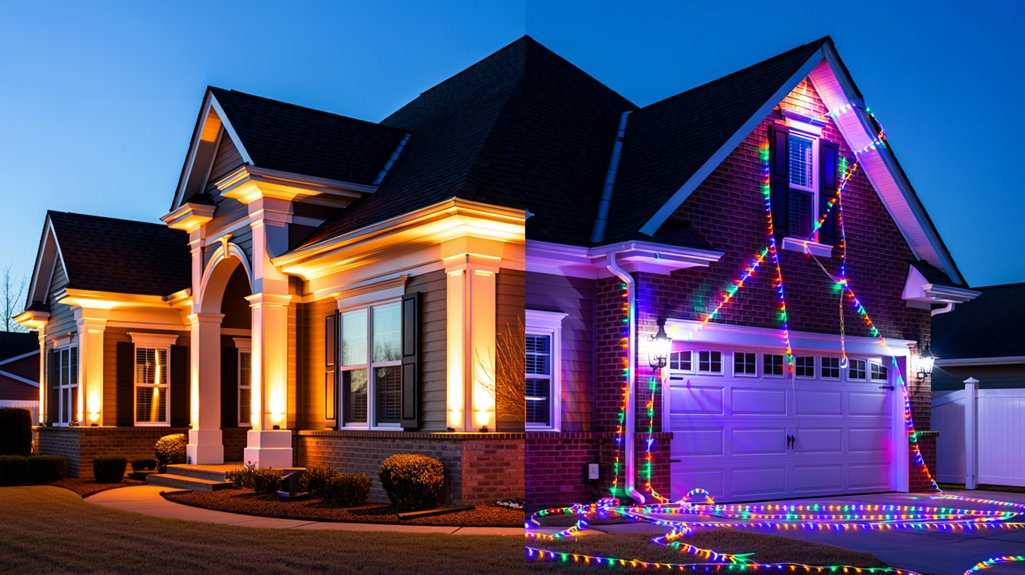
Permanent roofline lighting and seasonal holiday string lights are distinct product classes under separate regulatory frameworks, not interchangeable options on a single spectrum. Installation environment matters: eave-mounted permanent luminaires must carry wet-location listings to survive continuous weather exposure, while seasonal strings are evaluated under UL 588 for temporary use not exceeding 90 days. Permanent roofline lighting describes dedicated luminaires installed once at the fascia or soffit, supplied from a branch circuit, and designed to function as architectural accent lighting across all seasons rather than within a single holiday window.
The distinction isn’t a matter of preference—it’s a regulatory boundary. Seasonal holiday lighting strings fall under UL 588, the Standard for Seasonal and Holiday Decorative Products, which defines temporary use as installation not exceeding 90 days; the National Electrical Code reinforces that ceiling by permitting decorative holiday lighting installations for no more than that same window. Permanent roofline luminaires occupy an entirely separate product class, governed by NEC Article 410 or Article 411 for qualifying low-voltage systems, and are required to carry a wet-location listing appropriate to the eave environment where they’ll spend their service life exposed to weather year-round.
UL 588, the Standard for Seasonal and Holiday Decorative Products, defines temporary use as installation and use not exceeding 90 days, drawing a regulatory line that separates seasonal string lights from permanently installed luminaires as a matter of product classification, not merely convention. That boundary carries real consequences: a string light set evaluated under UL 588 is certified for a temporary-use cycle, not continuous year-round installation. The National Electrical Code reinforces the same posture, permitting temporary holiday decorative lighting for a period not to exceed 90 days while requiring that such products be listed. A permanent roofline luminaire — wet-location listed, supplied from a dedicated branch circuit, and governed by NEC Article 410 or Article 411 — belongs to an entirely different regulatory category and is engineered to the corresponding durability and installation standards.
NEC Article 410 governs permanently installed luminaires and requires that fixtures installed in exposed outdoor locations — including eave and fascia positions along a roofline — carry a wet-location listing, a classification distinct from the damp-location rating applicable to sheltered but unconditioned spaces. That distinction is not semantic: a wet-location listing confirms the fixture has been evaluated for direct exposure to rain, condensation, and standing water, conditions inherent to the eave environment across seasons. Seasonal string lights evaluated under UL 588 carry no such rating, as their standard addresses a temporary-use cycle rather than continuous weathering. The two product classes are thus separated not by degree of quality but by the governing standard itself — a regulatory boundary that determines the appropriate installation method, circuit requirements, and service expectations for each.
Seasonal string lighting imposes a recurring operational burden that a permanent installation doesn’t: each year, sets must be hung, taken down, stored, and replaced when individual runs fail — a cycle that demands ladder access at the roofline every season, whether the homeowner climbs it or a seasonal crew does. That ladder exposure isn’t incidental; it’s a fixed condition of the seasonal model, repeated indefinitely for as long as the household decorates. Permanent roofline fixtures, by contrast, are installed once by a qualified electrical professional and thereafter serviced only as conditions warrant, exchanging annual repetition for an occasional, purposeful site visit.
UL 588, the Standard for Seasonal and Holiday Decorative Products, defines temporary use as installation and removal within a window not exceeding 90 days, which means seasonal string lights are designed and rated for a recurring cycle of deployment and storage rather than continuous outdoor exposure. That cycle imposes a compounding labor burden: strings must be mounted, taken down, inspected, and packed away each season, with failed sets identified and replaced before the next installation. Each iteration returns the homeowner or a hired crew to the ladder, reintroducing fall-exposure risk that a one-time professional installation eliminates after the initial commissioning. A permanent roofline luminaire system, once installed and inspected, requires only periodic service rather than a seasonal ritual repeated indefinitely.
| Factor | Seasonal Holiday Strings | Permanent Roofline Lighting |
|---|---|---|
| Product listing | UL 588 seasonal decorative products, temporary use | Permanently installed luminaires, wet-location listed |
| Code posture | NEC permits holiday installations up to 90 days | NEC Article 410/411 permanent installation |
| Annual labor | Hung and removed every season | Installed once; serviced as needed |
| Ladder exposure | Recurring, every season | One professional installation |
| Use beyond holidays | Stored most of the year | Year-round architectural and accent scenes |
| Control | Plug timers and switched outlets | App, scene, and schedule programming |
Seasonal holiday string lights, evaluated under UL 588, are designed and rated for temporary deployment rather than indefinite outdoor service, which means each set enters a replacement cycle from the moment it is first installed. As individual strands fail — through socket corrosion, insulation fatigue, or controller failure accumulated across repeated outdoor exposures — the homeowner replaces the set rather than servicing a component, because the product class is not engineered for field repair. That replacement churn compounds across seasons: the cost and labor of acquiring, mounting, and disposing of successive sets accumulates in ways that a one-time professional installation does not. A permanently installed roofline luminaire system, listed for wet-location service under NEC Article 410, is a serviceable asset — individual fixtures or drivers can be replaced as needed without retiring the entire installation.
A permanent roofline system doesn’t idle between December and January — it’s an architectural lighting layer that operates on programmed schedules throughout the year, shifting color temperature and scene palettes to suit the season, the occasion, or simply the nightly ambient character the property calls for. That continuity matters because a roofline held at a consistent correlated color temperature anchors the entire exterior lighting composition, allowing landscape fixtures, pathway lighting, and soffit illumination to resolve into a unified night scene rather than a collection of unrelated sources. Where seasonal strings exist only within their holiday window, a permanently installed system earns its justification across all twelve months as a controlled, configurable element of the home’s architectural expression.
Permanently installed roofline luminaires operate under NEC Article 410 as fixed architectural elements, meaning their function is not bound to a seasonal window the way a temporary product evaluated under UL 588 is. That regulatory distinction has a practical consequence: a permanent system remains energized and addressable across the full calendar, available for scheduled scenes, color temperature holds, and programmable palettes that can be recalled on demand. Where seasonal strings serve a holiday window and then retire to storage, a permanent roofline system integrates with landscape and hardscape lighting as a unified night scene — consistent correlated color temperature held across eave, soffit, and grade-level fixtures rather than a patchwork of mismatched sources. A household seeking architectural cohesion in the off-season months finds the permanent system earning its installation cost across that broader operating calendar.
Correlated color temperature, measured in Kelvin on a scale defined by the International Commission on Illumination (CIE), determines whether a roofline reads as warm architectural accent or as a competing visual element against landscape and hardscape fixtures. Seasonal holiday strings, evaluated under UL 588 as temporary-use products, are not specified to hold a consistent CCT across a run; permanent luminaires governed by NEC Article 410 are selected and installed as a coordinated system. That coordination allows the eave, soffit, and grade-level fixtures to resolve into a unified night scene rather than a patchwork of mismatched sources. Across the ten months outside the holiday window, a permanent system holds that scene on schedule — programmable palettes and color temperature holds recalled on demand, serving the property as a functioning architectural element rather than sitting in seasonal storage.
Seasonal holiday lighting strings are not designed or listed for year-round installation. UL 588 defines their use class as temporary, with installations not exceeding 90 days, meaning the product’s listed rating expires well before a full calendar year concludes. Leaving such strings installed beyond that window places the installation outside its evaluated use condition.
Permanent roofline luminaires are designed and listed for continuous, year-round operation as architectural accent lighting, not seasonal deployment. Programmable controls allow scene scheduling across color temperatures, integrating the roofline into a unified night composition alongside landscape lighting. That operational continuity is the foundational argument distinguishing a permanent electrical installation from a temporary-use product class.
Permanent roofline lighting requires installation by a qualified electrical professional. As a permanently installed luminaire governed by NEC Article 410, the system demands a dedicated branch circuit, wet-location listed fixtures, and workmanship meeting adopted code—conditions outside the scope of a homeowner pulling seasonal strings from storage. Local authority having jurisdiction determines specific permitting requirements.
Permanent roofline fixtures are visible during daylight hours as a fixed architectural element along the fascia or soffit line. Fixture profile and finish selection determine how discreetly the system reads against the roofline in daylight conditions. Specifying a low-profile linear channel in a finish that coordinates with fascia trim minimizes visual presence while preserving full nighttime performance.
Permanent roofline lighting installed to NEC Article 410 wet-location standards on properties where architectural scale, fascia detail, and year-round visibility from the street demand a system that reads as a designed element rather than a seasonal addition. Backyard Paradiso works across these corridors, specifying and installing permanent linear LED channel and soffit luminaires at the eave and fascia as a single-installation electrical project supplied from a dedicated branch circuit. Consultations are available by appointment for homeowners evaluating permanent roofline lighting against the recurring annual cost and ladder exposure of seasonal strings. A permanent system recovered through avoided seasonal labor, reduced replacement cycles, and added programmable utility across twelve months represents a different value calculus than upfront price alone — one that aligns with how architectural lighting contributes to appraised presentation and functional night-use of the exterior. Backyard Paradiso extends this work to additional markets throughout the region, with jurisdiction-specific code compliance confirmed through the local authority having jurisdiction on each project.