Physical Address
304 North Cardinal St.
Dorchester Center, MA 02124
Physical Address
304 North Cardinal St.
Dorchester Center, MA 02124

Learn which outdoor projects deliver the most home value in Orlando's climate—the answer may surprise you.
Covered structures, outdoor kitchens, and quality hardscape flooring carry the strongest value case for Orlando homeowners. That value holds only when framing, surface materials, and installation methods are matched to central Florida’s heat load, annual rainfall, humidity-driven corrosion, and hurricane wind exposure. An outdoor living project converts exterior square footage into functional living area measured by actual hours of year-round occupation.
Resale recovery ratios—the kind tracked in national remodeling-impact research—offer directional value, but they’re market-dependent, project-dependent, and best interpreted by a licensed appraiser for a specific property; quoting them as benchmarks mistakes the general for the particular. The more durable measures are functional square footage and time-in-use: how much outdoor area performs as living area, and how many hours that area is actually occupied. Projects that score highest on both dimensions carry the strongest value case, regardless of what any national average suggests.
The Remodeling Impact Report, published annually by the National Association of Realtors, tracks resale recovery ratios for outdoor improvements but frames its findings as directional averages across diverse markets rather than predictive values for any single property. Those ratios shift meaningfully based on neighborhood price tier, buyer profile, and regional climate—conditions that a licensed appraiser weighing a specific Orlando property is positioned to interpret where a national dataset is not. The more durable measures are functional square footage, meaning outdoor area that behaves as usable living area, and time-in-use, meaning the hours a space is actually occupied across a calendar year. In Central Florida’s climate, both metrics favor covered, weather-managed outdoor rooms over unprotected yard features.
Functional square footage, as a valuation concept, treats outdoor area as living area only when that area supports sustained, weather-independent occupation. An uncovered Florida terrace fails that threshold for much of the year—not because of cold, but because unmanaged solar exposure, afternoon rain, and insect pressure reduce actual time-in-use to a fraction of available daylight hours. A covered, screened, or otherwise weather-managed outdoor room removes those friction points and shifts the space from seasonal feature to year-round room. In Orlando’s climate, where NOAA climate normals record more than 230 annual sunshine days alongside roughly 50 to 60 inches of precipitation, the gap between a protected outdoor room and an unprotected one is measured in hundreds of occupiable hours per year—a difference that both licensed appraisers and prospective buyers register when evaluating the functional envelope of a property.
The projects that move the value needle most aren’t decorative additions — they’re structural conversions that turn passive yard into functional square footage. Covered aluminum structures anchor that shift, because shade and rain protection are what transform an exposed terrace from a seasonal gesture into a year-round room; outdoor kitchens reinforce it by relocating daily activity outdoors rather than simply furnishing the space; and paver or composite deck surfaces make both possible by providing the stable, weather-resistant plane on which everything else depends. Each layer compounds the one beneath it, and the sequence matters.
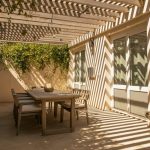
Florida Building Code Section 1609 classifies outdoor shade structures as wind-exposed assemblies subject to hurricane-level load calculations, a designation that directly shapes which covered structures hold their value over time in Central Florida markets. An aluminum pergola engineered to those wind requirements functions differently from an ornamental shade sail or a wood-framed trellis: it becomes a fixed architectural element, attached to the home, capable of supporting lighting, motorized louvered roof systems, and zip screens. That structural permanence is what converts a terrace from a seasonal feature into a functional room. In Orlando, where NOAA climate normals record more than 230 annual sunshine days and roughly 50 to 60 inches of rainfall, shade and rain protection are not amenities — they are the precondition under which outdoor square footage behaves like interior square footage.
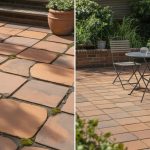
Outdoor kitchens built over paver or concrete substrates relocate daily cooking and dining activity outdoors permanently, shifting the functional center of the home rather than simply decorating its perimeter. That relocation is the mechanism by which an outdoor kitchen adds measurable value: time-in-use rises, and the covered terrace evolves from an occasional-use feature into an occupied room. In Orlando’s climate — where NOAA climate normals record more than 230 annual sunshine days — that room operates year-round. The floor system beneath it carries equal weight; a properly bedded paver patio or composite deck surface provides the structural and drainage foundation on which every other element depends, and in Central Florida’s 50 to 60 inches of annual rainfall, slope, jointing, and surface permeability determine whether the investment holds or deteriorates.
Orlando’s outdoor season doesn’t compress into a few hospitable months — it extends year-round, and that duration is what separates a covered lanai from a seasonal amenity into a functional second living room. In established submarkets like Windermere, Winter Park, Bay Hill, and Lake Nona, buyers arrive expecting a covered terrace, a summer kitchen, and a pool surround as baseline conditions rather than upgrades. That expectation, however, carries a corollary: materials must hold in an environment defined by sustained humidity, roughly 50 to 60 inches of annual rainfall, and hurricane-season wind loading, because a project that degrades within a few years doesn’t retain the value it was built to add.
NOAA climate normals recorded at Orlando International Airport log more than 230 days of measurable sunshine annually, a figure that transforms the covered lanai from a seasonal amenity into a functional year-round room. That solar exposure, combined with the region’s mild winter temperatures, means a properly enclosed and shaded terrace sustains active use during months when equivalent structures in northern markets sit idle. In submarkets such as Windermere, Winter Park, Bay Hill, and Lake Nona, the covered lanai, summer kitchen, and pool terrace have crossed from optional upgrade to baseline buyer expectation — a second living room by function rather than designation. The distinction matters because value follows use: outdoor area that behaves like conditioned living area is measured accordingly.
Central Florida’s combination of annual rainfall averaging 50 to 60 inches, sustained humidity, and hurricane-force wind exposure creates a material-performance environment that consumes underspecified outdoor construction within a few seasons. Aluminum framing resists the corrosion and mold pressure that compromise painted steel and untreated wood in this climate, while composite decking surfaces shed moisture without the warping and rot cycles that shorten the service life of dimensional lumber. Wind-conscious engineering is not optional in this region — structural requirements vary by jurisdiction, and the local building authority is the controlling reference for applicable load thresholds. Where materials fail, the functional square footage that drives value disappears with them; the outdoor room depreciates rather than compounds.
Aluminum pergolas add measurable value to a home when they convert open, underused terrace into a functional, weather-protected living area. Value retention depends heavily on material specification — aluminum framing resists Florida’s humidity, corrosion pressure, and wind loads where lesser materials depreciate quickly. In established Orlando submarkets, covered outdoor structure is a baseline buyer expectation rather than a discretionary upgrade.
An outdoor kitchen in Florida carries a strong functional value case because it relocates daily cooking and entertaining activity outdoors rather than simply decorating an existing space. Value retention depends heavily on material selection, as humidity, rainfall, and corrosion pressure degrade underspecified installations quickly. In high-expectation markets such as Windermere and Lake Nona, a summer kitchen reads as a baseline feature rather than an optional upgrade.
In Orlando’s premium submarkets — Windermere, Winter Park, Bay Hill, and Lake Nona — a covered lanai, outdoor kitchen, and pool terrace function as baseline buyer expectations rather than optional amenities. Market positioning in these communities treats the outdoor room as a second living space. Properties lacking these features may face comparative disadvantage during buyer evaluation.
Covered aluminum structures, paver surfaces, and outdoor kitchens built with corrosion-resistant materials hold value longest in humid Central Florida climates. Material selection is the governing variable — underspecified components degrade rapidly under combined heat, rainfall, and humidity pressure. Orlando’s year-round outdoor season rewards durable construction, making material quality the most reliable predictor of long-term investment retention.
Windermere’s lakefront corridors, Winter Park’s established canopy lots, Bay Hill’s golf-estate setbacks, and Lake Nona’s planned residential zones each carry distinct regulatory overlays and architectural expectations that shape how covered outdoor structures are permitted, engineered, and integrated into the broader property. Backyard Paradiso installs aluminum pergolas, motorized louvered systems, outdoor kitchens, paver surfaces, and supporting lighting and screen systems across these corridors, with each project scoped to the wind-exposure requirements, drainage conditions, and buyer expectations specific to the site. Consultations are available by appointment and are structured around functional square footage gains and the long-term value case for converting underused yard into year-round living area — a consideration that carries particular weight in markets where the covered lanai and summer kitchen read as baseline rather than optional. The firm also serves homeowners across the broader Orlando metro, including communities throughout Orange and Osceola counties where similar outdoor living standards apply.