Physical Address
304 North Cardinal St.
Dorchester Center, MA 02124
Physical Address
304 North Cardinal St.
Dorchester Center, MA 02124
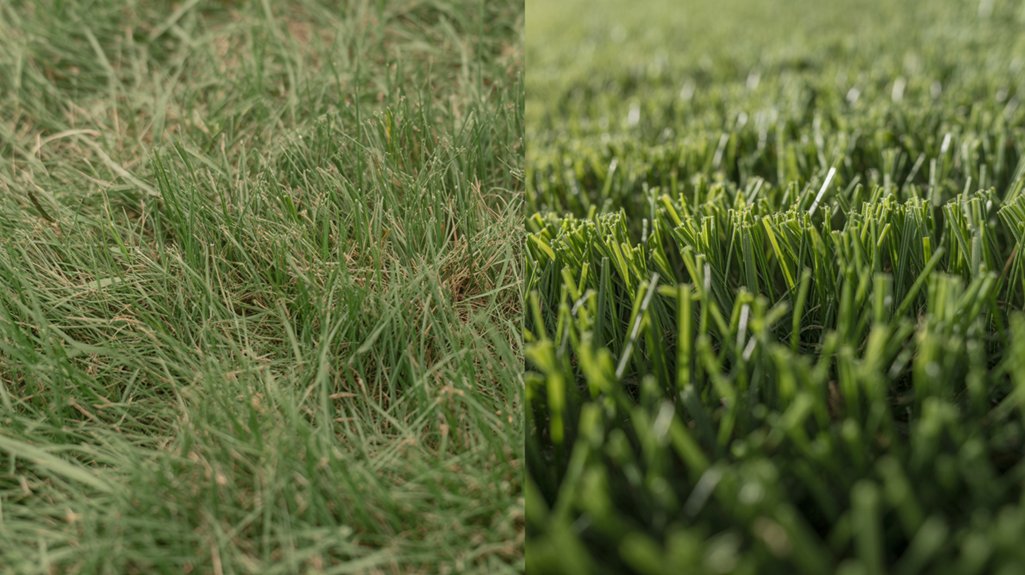
Choosing between artificial grass and turf in Denver depends on key material and performance differences that could make or break your installation.
Artificial grass and artificial turf are the same product, and the industry uses both terms interchangeably across residential and commercial applications. In Denver’s semi-arid Front Range climate, the distinction that actually matters is use case—landscape-grade versus sports-grade—not terminology. Artificial grass is a multi-layer synthetic surface system combining pile fibers, engineered backing, and a compacted aggregate base designed to replace natural lawn with a durable, low-maintenance alternative.
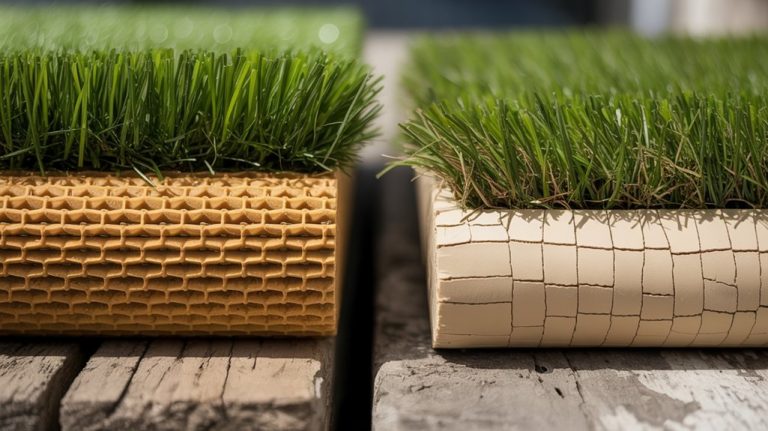
Both terms persist in parallel because the underlying material architecture—synthetic pile fibers heat-tufted into a polymer backing system—is effectively the same regardless of whether a product is marketed for a residential lawn or an athletic field. Most manufacturers apply “artificial grass” and “synthetic turf” to overlapping product lines, adjusting fiber geometry, infill specification, and backing weight to suit the end use rather than producing categorically distinct materials. The terminology diverges most clearly at the point of application, not at the point of manufacture.
Polyethylene and polypropylene monofilament and slit-film yarns serve as the primary pile fiber materials in both landscape-grade artificial grass and sports-grade synthetic turf systems. Because both product categories draw from the same polymer feedstocks and manufacturing processes, the terminology applied to them—artificial grass, artificial turf, synthetic turf—has consolidated into near-interchangeable use across manufacturers, installers, and specifying authorities. The Synthetic Turf Council, whose guidance defines minimum installation practice referenced by many jurisdictions, makes no binding terminological distinction between the categories at the fiber-construction level. What separates the two is performance specification rather than base chemistry: sports applications may blend nylon into the pile for added resilience, while residential landscape products prioritize multi-tone coloration and softness, yet both begin with the same foundational polymer architecture.
The Synthetic Turf Council, whose guidance defines minimum installation practice referenced by many jurisdictions and homeowner associations, applies no binding terminological distinction between artificial grass, artificial turf, and synthetic turf at the product-category level. This definitional convergence reflects manufacturing reality: both landscape-grade and sports-grade systems originate from the same polyethylene and polypropylene fiber supply chains, share primary and secondary backing assemblies, and require identical base preparation standards under ASTM D1557. Because the underlying construction is consistent, manufacturers marketing to residential Denver homeowners and those supplying athletic facilities draw from a common technical vocabulary, making term-swapping functionally inconsequential. The meaningful differentiation that does exist tracks performance specification—pile density, tuft bind, infill engineering—rather than nomenclature.
When the distinction between artificial grass and synthetic turf carries real weight, it’s in how each system is engineered for its intended load conditions. Landscape-grade artificial grass for residential lawns prioritizes multi-tone fiber aesthetics, softness underfoot, and the moderate-traffic durability that a front range yard actually demands. Sports-grade synthetic turf shifts the specification toward higher fiber density, reinforced backing, and infill systems calibrated to meet impact-attenuation thresholds that residential installations don’t require.
Residential landscape-grade artificial grass is commonly specified at a pile height of 1.5 to 1.75 inches, a dimensional range selected to replicate the visual texture of maintained natural lawn without the irrigation demand that Denver’s semi-arid Front Range climate makes prohibitive. At roughly 14 to 15 inches of annual precipitation, the region creates practical pressure to differentiate landscape-grade systems from sports-grade synthetic turf, even though manufacturers apply both terms to structurally similar multi-layer assemblies. Landscape-grade products prioritize multi-tone polyethylene fiber coloration, softness underfoot, and moderate-traffic durability rather than the high-density backing and engineered infill systems that athletic applications require. That use-case distinction, rather than any difference in base preparation or drainage standard, is where the terminology carries functional weight.
ASTM F1551 establishes the thorough performance characterization framework for synthetic turf playing surfaces, defining the fiber density, tuft bind, and infill specifications that separate sports-grade installations from residential landscape systems. Where landscape-grade artificial grass accommodates moderate foot traffic through softness-optimized polyethylene pile, sports-grade synthetic turf requires backing assemblies and infill depths engineered to meet impact-attenuation thresholds measured under ASTM F1292, the standard governing head impact criteria within playground and athletic use zones. Shock-pad underlayment systems are commonly added beneath sports-grade configurations to satisfy those attenuation requirements, a layer absent from nearly all residential installations. The functional consequence of conflating the two product categories appears in base design and infill specification, where substituting landscape-grade material into an athletic context produces measurable shortfalls in both surface resilience and long-term tuft bind performance.
Front Range installations carry site-specific demands that make system selection more consequential than it might appear in temperate climates. Denver’s high-altitude ultraviolet index accelerates fiber degradation in products without adequate UV stabilization, shortening the effective service life of systems that would otherwise perform adequately at lower elevations. Freeze-thaw cycling compounds the issue at the base level, where improperly drained aggregate compacted below ASTM D1557 thresholds tends to shift, which in turn compromises surface planarity and tuft integrity regardless of how well the pile itself is specified.
Residential artificial grass specified for Denver installations is commonly manufactured at pile heights between 1.5 and 1.75 inches, a range that balances natural appearance with the structural stability required under freeze-thaw cycling at 5,280 feet elevation. Pile height interacts directly with face weight and stitch rate: a higher pile at low face weight produces a sparse, less durable surface, while a well-balanced system maintains density through the full fiber length. Denver’s high-altitude ultraviolet exposure places additional demand on fiber integrity, making dtex—the linear mass density of individual yarns—a functional specification rather than a secondary consideration. Total face weight, measured in ounces per square yard, serves as the consolidated indicator of system durability across all three variables.
Denver sits at 5,280 feet elevation, where ultraviolet radiation intensity exceeds sea-level baselines by approximately 25 percent, making UV-stabilized polyethylene fiber a functional requirement rather than an optional upgrade for any artificial grass installation on the Front Range. Prolonged UV exposure at altitude degrades unstabilized fiber through photooxidation, accelerating brittleness, color fade, and tuft bind failure over the system’s service life. Base drainage carries equal weight as a system specification: ASTM D1557 governs compacted aggregate preparation at 90 to 95 percent modified Proctor density, a threshold that resists the heave and settlement generated by Denver’s repeated freeze-thaw cycles. A properly graded drainage layer beneath the geotextile separation fabric prevents moisture retention that would otherwise destabilize the base structure through successive seasonal changes.
Homeowners exploring synthetic lawn systems in Denver tend to arrive with the same cluster of questions, and the confusion is understandable given how loosely the industry applies its own terminology. Artificial grass, artificial turf, and synthetic turf reference the same multi-layer product category; distinctions that do exist track use case—landscape-grade versus sports-grade—rather than any formal classification. Whether a given system holds up under Front Range conditions depends less on what it’s called than on how its fiber chemistry, backing, and base construction respond to high-altitude UV exposure and freeze-thaw cycling.
Artificial grass and artificial turf refer to the same product: a multi-layer assembly of synthetic pile fibers, backing, optional infill, and an engineered aggregate base. A functional distinction does exist, tracking use case rather than definition, with landscape-grade products prioritizing appearance and sports-grade systems emphasizing durability and impact attenuation. The Synthetic Turf Council provides guidance that spans both categories.
For residential lawn applications, synthetic turf and artificial grass describe the same product. The terms diverge meaningfully only when use case shifts toward athletic or high-impact surfaces requiring engineered infill and impact-attenuation standards like ASTM F1292. Landscape-grade systems optimized for Denver’s UV exposure and freeze-thaw conditions remain the practical specification for residential lawns.
Artificial turf does not exclusively mean sports field turf, though the term carries that association in many contexts. The meaningful distinction tracks use case rather than product definition, with landscape-grade systems prioritizing appearance and softness while sports-grade systems emphasize impact attenuation and engineered infill. The Synthetic Turf Council addresses installation standards across both categories.
Both landscape-grade artificial grass and sports-grade synthetic turf perform reliably in Denver’s climate when properly installed. UV-stable fiber is a functional specification at 5,280 feet, where high-altitude ultraviolet exposure accelerates degradation in lower-grade systems. Decisive long-term performance depends on engineered base drainage rated to handle freeze-thaw cycling, per Synthetic Turf Council minimum installation guidance.
Denver’s semi-arid Front Range climate—roughly 14 to 15 inches of annual precipitation at 5,280 feet—combined with high-altitude UV exposure and recurring freeze-thaw cycling places specific functional demands on artificial grass installation that differ meaningfully from lower-elevation or higher-rainfall markets. Backyard Paradiso works within these conditions routinely, applying base preparation and fiber specification practices calibrated to the drainage and UV-stability requirements that govern long-term performance in this region. Consultations are available by appointment for residential properties across Denver and surrounding Front Range communities. Investment in a properly engineered artificial grass system is most accurately framed regarding eliminated irrigation costs, recovered functional square footage, and reduced seasonal maintenance burden rather than upfront expenditure alone—a framing that holds across installations in Denver proper, the surrounding metro, and neighboring communities where water-conservation considerations continue to shape residential landscape decisions.