Physical Address
304 North Cardinal St.
Dorchester Center, MA 02124
Physical Address
304 North Cardinal St.
Dorchester Center, MA 02124
Learn what Naples homeowners must install beneath artificial turf to prevent drainage failures, settlement, and costly repairs in coastal conditions.
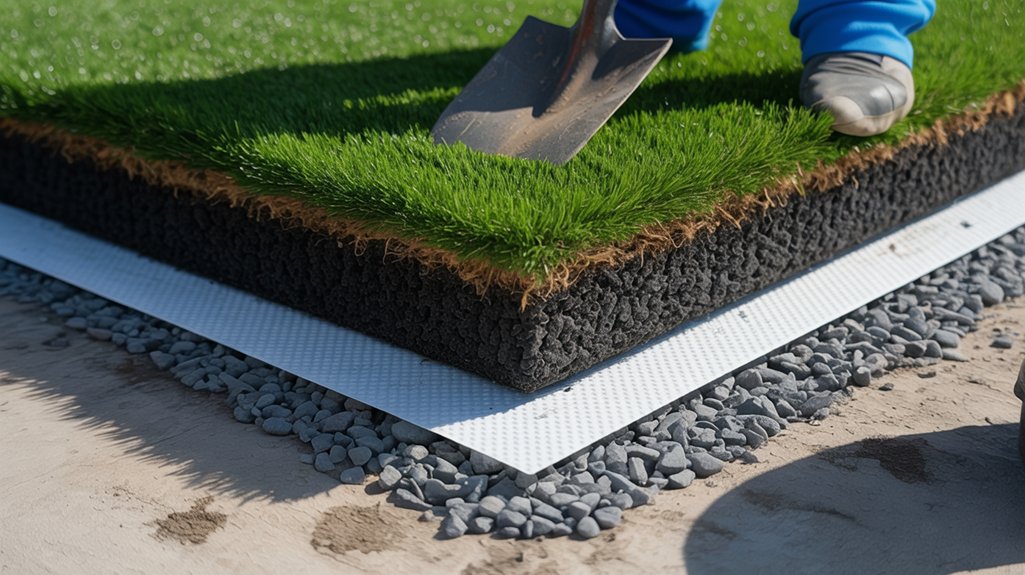
Artificial turf requires a layered sub-assembly beneath the synthetic fibers, including a compacted crushed-stone base, geotextile weed barrier, and graded subgrade. In coastal Southwest Florida, shallow water tables and 54 annual inches of rainfall make proper drainage slope and base permeability non-negotiable installation conditions. The sub-base system is the structural and hydrological foundation that stabilizes fibers, manages infiltration, and prevents settlement across the finished surface.
Beneath the synthetic pile, a compacted aggregate base—typically crushed stone or decomposed granite placed in lifts and densified to roughly 90–95 percent of modified Proctor density—determines whether the finished surface settles, holds grade, or sheds water as intended. That density threshold isn’t incidental; in Naples’ shallow-water-table environment, a base that fails to consolidate uniformly will telegraph unevenness through the backing over time. A geotextile separation fabric, laid between the prepared subgrade and the aggregate, keeps native sandy sediment from migrating upward into the base and compromising its drainage capacity and structural integrity.
Artificial turf base aggregate compacted to 90–95 percent of modified Proctor density per ASTM D1557 provides the dimensional stability required to prevent surface undulation and fiber-backing separation over time. This standard applies directly to Naples installations, where the underlying sandy coastal sediments offer minimal bearing capacity and are subject to seasonal saturation from the region’s approximately 54 inches of annual rainfall. Base depth for residential applications runs 3–4 inches, placed in compacted lifts to achieve uniform density throughout the profile rather than at the surface alone. Inadequate compaction allows differential settlement that opens seams, distorts drainage planes, and accelerates backing degradation—consequences compounded in Southwest Florida by the shallow seasonal water table characteristic of Collier County’s low-lying coastal geology.
Geotextile separation fabric placed between the compacted aggregate base and the native subgrade prevents fine-grained soil particles from migrating upward into the drainage layer through a process known as soil piping, which progressively reduces void space and permeability over time. In Naples, where the native subgrade consists of low-bearing-capacity sandy coastal sediments subject to seasonal saturation under approximately 54 inches of annual rainfall recorded at Southwest Florida International Airport, this migration risk is elevated compared to more stable inland soils. The fabric also functions as a weed barrier, blocking rhizome penetration into the base profile that would otherwise lift and distort the turf surface. Synthetic Turf Council installation guidance specifies that the separation layer must be permeable to water while retaining soil fines, maintaining drainage continuity through the full base assembly.
Naples receives roughly 54 inches of rain annually, and its shallow seasonal water tables leave little margin for a base system that can’t move water laterally and vertically without delay. Crushed stone or decomposed granite, compacted to the density required for structural stability, must retain enough void space to accept peak storm-event infiltration without saturating the synthetic pile above. Subgrade grading at a 1–2 percent slope away from structures guarantees that water reaching the native soil doesn’t pond beneath the base, where hydrostatic pressure would otherwise compromise both fiber performance and long-term dimensional stability.
Naples, Florida receives approximately 54 inches of annual rainfall, creating drainage demands that make base permeability the governing engineering variable in any artificial turf installation. Shallow seasonal water tables common to Collier County’s coastal sandy sediments compound surface infiltration challenges, meaning a poorly drained base layer will not simply drain slowly — it will saturate and destabilize the compacted aggregate beneath the synthetic pile. The crushed-stone base, typically 3 to 4 inches deep and compacted to 90 to 95 percent of modified Proctor density per ASTM D1557, must maintain sufficient void space after compaction to pass storm-event volumes without ponding. Subgrade grading to a minimum 1 to 2 percent slope, consistent with IRC site-drainage guidance, directs that infiltrated water away from foundations and toward compliant stormwater conveyance under South Florida Water Management District surface-water rules.
The International Residential Code requires finish grading to slope away from foundations at a minimum of 2 percent for at least 10 feet, a threshold that governs subgrade preparation beneath artificial turf installations in Naples, where seasonal water tables in Collier County’s coastal sandy sediments routinely rise within inches of the surface. When subgrade slope falls below this minimum, infiltrated storm water has no directed path to conveyance and instead backs up into the crushed-stone base, saturating the compacted aggregate and undermining the 90 to 95 percent modified Proctor density achieved during installation. The South Florida Water Management District‘s surface-water management rules further require that site drainage integrate with permitted stormwater systems, meaning subgrade grading decisions carry regulatory consequences beyond turf performance alone. Shallow water tables eliminate the tolerance margin that slightly underdrained installations might otherwise recover in higher-elevation, well-drained soils.
Once the base and drainage layers are set, infill and edge restraint determine how the finished surface performs under Naples-specific stressors. In pet-use areas, silica sand retains heat at surface temperatures that can exceed ambient air by 40–60°F on exposed southwestern exposures, making coated or antimicrobial specialty infill a functional rather than cosmetic distinction. Where synthetic turf meets pool coping, paver patios, or planters—transitions common across Port Royal and Pelican Bay estates—galvanized landscape spikes driven at six-inch intervals into a soldier-course or bender-board edge restraint prevent fiber curl and lateral creep that compounding moisture cycles would otherwise accelerate.
Silica sand infill raises artificial turf surface temperatures by as much as 20 to 30 degrees Fahrenheit above ambient air temperature under direct sun exposure, a thermal load that intensifies in Southwest Florida’s high-solar-angle climate. In Naples, where NOAA climate normals for Fort Myers Regional Airport record average July high temperatures near 92°F, surface temperatures on standard infill systems can approach or exceed 130°F, reducing usable hours during peak afternoon periods. Coated sand and specialized pet infill products are engineered to lower surface temperatures and resist compaction from repeated animal traffic, and the Synthetic Turf Council identifies infill selection as a primary variable governing both thermal performance and pet-area sanitation. Proper infill depth, typically specified by the turf manufacturer, also maintains fiber orientation and drainage permeability through the base aggregate.
Galvanized landscape spikes driven at 6-inch intervals secure artificial turf edges against the curling and separation that occurs at junctions between synthetic pile and hard surfaces such as paver patios, pool decks, and concrete borders. In Naples, where coastal salt air accelerates corrosion of ferrous fasteners, galvanized or stainless steel hardware is the appropriate specification to maintain holding strength over the installation’s service life. Edge restraint systems — whether a paver soldier course or a bender board profile — distribute lateral stress along the perimeter and prevent infill migration onto adjacent hardscape. The Synthetic Turf Council identifies edge anchoring as a critical installation element, because an unsecured perimeter allows pile fibers to lose vertical orientation, compromising both drainage through the base aggregate and the finished appearance of the surface.
Homeowners considering artificial turf installation share a predictable set of questions about what lies beneath the fibers, and the answers hinge almost entirely on site conditions rather than product specifications. Base depth, weed-barrier necessity, direct-soil installation, and drainage performance under heavy rain each depend on subgrade composition, slope, and the local climate‘s demands—factors that carry particular weight in low-lying coastal environments where shallow water tables and high annual rainfall amplify every base-layer decision. Addressing these questions directly clarifies why the assembly beneath artificial turf isn’t incidental to the system; it’s the system.
A properly engineered artificial turf base requires 3 to 4 inches of compacted crushed stone or decomposed granite, installed in lifts and compacted to approximately 90 to 95 percent of modified Proctor density per ASTM D1557. Naples’ shallow seasonal water table and 54 annual inches of rainfall make base depth and compaction particularly consequential for long-term performance. The Synthetic Turf Council’s installation guidelines reinforce these depth standards as minimums for residential applications in high-rainfall coastal environments.
A weed barrier is a necessary component beneath artificial grass installations. Geotextile fabric placed over the prepared subgrade separates the compacted crushed-stone base from native soil while suppressing weed intrusion through the drainage layer. The Synthetic Turf Council identifies proper fabric selection and placement as foundational to long-term base stability and system performance.
Artificial turf should not be installed directly on native soil. Without a compacted crushed-stone base layer, Naples’ sandy coastal sediments and shallow seasonal water table create conditions for uneven settlement, standing water, and fiber instability. The Synthetic Turf Council’s base preparation standards exist precisely to address these drainage and structural concerns.
Artificial turf drains through perforated backing and a permeable crushed-stone base, allowing water to pass into the subgrade rather than pooling on the surface. Performance depends on maintaining a 1–2 percent subgrade slope and adequate base compaction to prevent settlement that disrupts drainage flow. Naples installations must integrate with site stormwater designs governed by the South Florida Water Management District.
Port Royal, Aqualane Shores, and Pelican Bay share a common constraint in that their coastal sandy subgrades, shallow seasonal water tables, and architectural review overlays make base engineering and drainage design as consequential as any surface-visible element of a residential installation. Backyard Paradiso works throughout these corridors on artificial grass installations where subgrade grading, compacted aggregate base depth, and geotextile separation directly govern long-term drainage performance under Naples rainfall conditions. Consultations are available by appointment for properties across these neighborhoods as well as in Grey Oaks, Mediterra, Park Shore, Royal Harbor, and Golden Gate Estates. Because artificial turf eliminates irrigation demand and converts previously marginal or poorly draining lawn areas into usable functional square footage, the installation is typically evaluated against recovered outdoor living area and reduced maintenance exposure rather than material cost alone. Backyard Paradiso structures each consultation around site-specific conditions rather than generalized estimates.