Physical Address
304 North Cardinal St.
Dorchester Center, MA 02124
Physical Address
304 North Cardinal St.
Dorchester Center, MA 02124
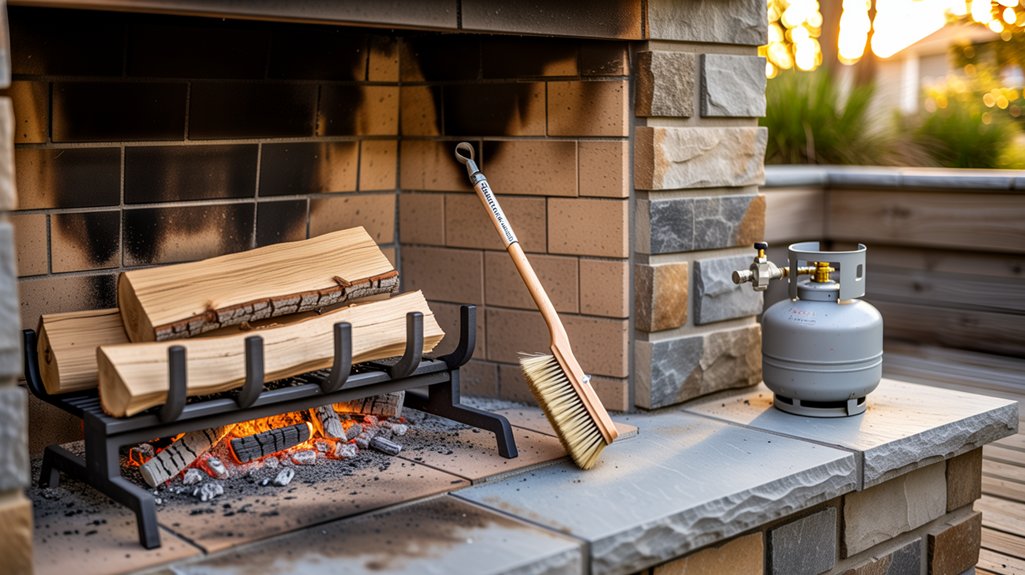
Discover the critical maintenance differences between wood, gas, and ethanol outdoor fireplaces—and why ignoring them could cost you more than you expect.
Wood-burning fireplaces carry the highest seasonal burden, requiring annual creosote removal, flue-liner inspection, and spark-arrestor cleaning; gas units demand annual burner and connection verification; ethanol units require only reservoir de-fueling and burner-pan wiping before each refueling cycle. Climate conditions — particularly northern freeze cycles — compound masonry wear and complicate cold-weather gas start-up procedures. Fuel-path maintenance encompasses the scheduled inspection, cleaning, and mechanical verification tasks tied directly to the combustion method a fireplace employs.
Wood-burning carries the steepest annual maintenance obligation of any outdoor fireplace fuel path. Under NFPA 211 Chapter 15, the flue liner, spark arrestor, and creosote accumulation require inspection before each season, with heavier creosote stages — classified by deposit density and adhesion — constituting a chimney-fire hazard that mandates remediation before the unit’s next use. Burning dry, seasoned cordwood held below 20 percent moisture content, per EPA BurnWise guidance, remains the most consequential variable in limiting creosote formation and, by extension, reducing the frequency and severity of corrective intervention.
NFPA 211 Chapter 15 classifies creosote accumulation into three progressive stages, with Stage 3 deposits — glazed, tar-like concentrations — constituting a direct chimney-fire hazard that prohibits continued operation until cleared. Stage 1 presents as light, flaky soot that responds to standard brushing; Stage 2 introduces hardened, tar-based buildup requiring mechanical removal; Stage 3 demands chemical treatment or professional restoration before any further use. Burning dry, seasoned cordwood below 20 percent moisture content, as emphasized under EPA BurnWise guidance, holds combustion temperatures high enough to retard accelerated creosote deposition. Annual inspection under NFPA 211 intervals also requires examination of the flue liner, spark arrestor, refractory mortar joints, and chimney crown — each a distinct failure point that, if neglected, compounds the hazard presented by any accumulated creosote.
Refractory mortar joints subject to thermal cycling lose cohesion at a rate that NFPA 211 identifies as a primary driver of accelerated structural degradation in wood-burning fireplace assemblies. Spalled or recessed joints allow combustion gases and heat to migrate laterally into the surrounding masonry, compounding any hazard already introduced by creosote accumulation in the flue. Repointing before each burning season — using refractory-grade mortar rated for sustained high-temperature exposure — restores the joint’s capacity to contain that thermal load. Cordwood discipline reinforces structural longevity: EPA BurnWise guidance specifies fuel below 20 percent moisture content, which sustains combustion temperatures high enough to limit the accelerated deposition that forces more aggressive mechanical intervention at the annual NFPA 211 inspection interval.
Gas and ethanol systems carry a lighter maintenance profile than wood-burning, though each fuel path introduces its own failure conditions that require disciplined seasonal attention. For gas appliances, annual service centers on burner-port cleaning, ignition verification, and gas-connection integrity — all aligned with NFPA 54 intervals — while propane installations add container inspection and AHJ-verified placement under NFPA 58. Ethanol demands less still, but the CPSC identifies refueling against a hot burner pan as the dominant failure mode, making cool-down verification and full reservoir evacuation non-negotiable before each refueling cycle.
NFPA 54 establishes the service interval framework governing annual burner-port cleaning, ignition testing, and gas-connection verification for outdoor gas appliances. Burner ports accumulate debris, insect nesting material, and oxidation byproducts over a seasonal cycle, and blocked ports alter combustion geometry in ways that stress ignition components and raise carbon-monoxide output. Propane installations carry the additional layer of NFPA 58 requirements — container condition checks and AHJ-verified placement distances — that a qualified technician must confirm at each service visit. Ethanol units operate outside gas-code jurisdiction entirely, requiring only reservoir evacuation, burner-pan wiping, and confirmed cool-down before each refueling cycle; the CPSC identifies hot-refueling as the dominant failure mode in that fuel class.
The CPSC identifies refueling a bioethanol burner while the reservoir remains hot as the dominant failure mode in that fuel class, making confirmed cool-down a non-negotiable service step before each refueling cycle. Heat retained in the burner pan and surrounding housing can persist well beyond the visible flame’s extinction, creating ignition conditions that are not apparent to the operator. Reservoir evacuation and burner-pan wiping complete the routine — both performed only after cool-down is verified by contact or timed interval. Gas appliances carry a structurally different reservoir concern: the manual shutoff valve must be closed at the supply point between service seasons, with ignition wiring inspected for insulation degradation before the system is returned to service.
Each fuel type dictates its own shutdown sequence, and deviating from that sequence — even partially — introduces moisture infiltration, component degradation, or ignition risk before the following season begins. Wood-burning units require masonry cleaning, structural inspection, and a fitted cover; gas units call for closure at the manual shutoff valve with ignition wiring verified; ethanol units must be fully de-fueled and kept dry, since any residual fuel left in the reservoir compounds evaporation residue and pan corrosion over dormant months. In northern climates, snow and ice accumulation on chimney caps must be cleared before any first fire of the season, and cold-weather gas start-up follows the appliance’s listed procedure without improvisation.
Proper off-season shutdown of an outdoor fireplace requires that gas-fueled units be isolated at the manual shutoff valve, a requirement aligned with NFPA 54 intervals for annual gas-system verification. Wood-burning units demand that masonry surfaces be cleaned, inspected for refractory mortar joint deterioration, and covered to prevent moisture infiltration that accelerates freeze-thaw spalling over successive seasons. Ethanol units must be fully de-fueled — the CPSC identifies residual fuel in a warm burner reservoir as the dominant failure mode — and kept dry throughout storage. In northern markets where NOAA climate normals record sustained freeze cycles, chimney caps must be cleared of accumulated snow and ice before any first cold-weather fire is attempted, and gas ignition systems must follow the manufacturer’s listed cold-start procedure before the unit is returned to service.
Accumulated snow and ice on chimney caps must be cleared before ignition, as blockage can force combustion gases — including carbon monoxide — back through the firebox opening rather than exhausting them through the flue. In northern markets where NOAA climate normals document sustained freeze cycles, cap obstructions form rapidly after precipitation events and may not be visible from grade without deliberate inspection. Cold-weather gas start-up compounds this concern, as propane — governed under NFPA 58 for outdoor container placement and operation — loses vaporization efficiency as ambient temperatures drop, requiring that the listed ignition sequence be followed precisely before the system is considered ready for service. Both conditions demand verification by appointment before seasonal first use.
Cleaning frequency, chimney requirements, and winterization protocols vary considerably across fuel types, and owners tend to carry assumptions from one system into another where they don’t apply. Wood-burning units demand the heaviest schedule — annual flue-liner inspection, creosote removal, and spark-arrestor cleaning — while gas units require annual burner-port and ignition service but no chimney sweep. Ethanol units carry the lightest burden, though reservoir and burner-pan maintenance before each refueling cycle is non-negotiable, as the consequences of skipping the cool-down verification are well-documented.
Cleaning frequency depends on fuel type — wood-burning units require annual flue inspection and creosote removal, gas units warrant annual burner and connection service, and ethanol burners require cleaning before each refueling cycle. Creosote accumulation stage determines whether a wood-burning fireplace may be safely operated before the next season. NFPA 211 Chapter 15 governs inspection intervals for solid-fuel appliances.
A gas outdoor fireplace does not require chimney sweeping, as no flue liner accumulates creosote byproduct. Annual service instead covers burner-port cleaning, ignition-system testing, and gas-connection verification aligned with NFPA 54 intervals. Propane installations carry the additional requirement of container inspection and AHJ-verified placement under NFPA 58.
Ethanol fireplaces carry the lightest maintenance burden of the three fuel types — requiring only reservoir emptying and burner – pan wiping before each refueling cycle. Complete cool – down must be verified prior to refueling, as the CPSC identifies hot – reservoir refueling as the dominant failure mode. Off – season storage requires the unit to be fully de – fueled and kept in dry conditions.
Winterizing an outdoor fireplace requires fuel-type-specific shutdown procedures completed before sustained freezing conditions arrive. Wood-burning units demand masonry cleaning, crown inspection, and chimney covering, while gas units require closure of the manual shutoff valve and ignition wiring verification, and ethanol units must be fully de-fueled and kept dry. Neglecting these protocols accelerates deterioration and creates hazardous restart conditions the following season.
Outdoor fireplace maintenance in this market carries specific code obligations — annual flue-liner inspection and creosote classification under NFPA 211 Chapter 15, burner-port and gas-connection verification at intervals aligned with NFPA 54, propane container placement confirmed through AHJ review under NFPA 58, and ethanol reservoir de-fueling protocols documented by the CPSC as the controlling safety threshold for that fuel class. Backyard Paradiso holds working command of each of these requirements across wood-burning, gas, and ethanol installations, applying them as the operational standard for outdoor fireplace maintenance rather than as supplementary reference. Consultations are available by appointment for properties across the region. Properly executed seasonal maintenance protects assessed value, preserves functional outdoor living area that appraisers recognize as recoverable square footage, and keeps the installation code-current between uses — considerations that matter to owners throughout the market.