Physical Address
304 North Cardinal St.
Dorchester Center, MA 02124
Physical Address
304 North Cardinal St.
Dorchester Center, MA 02124
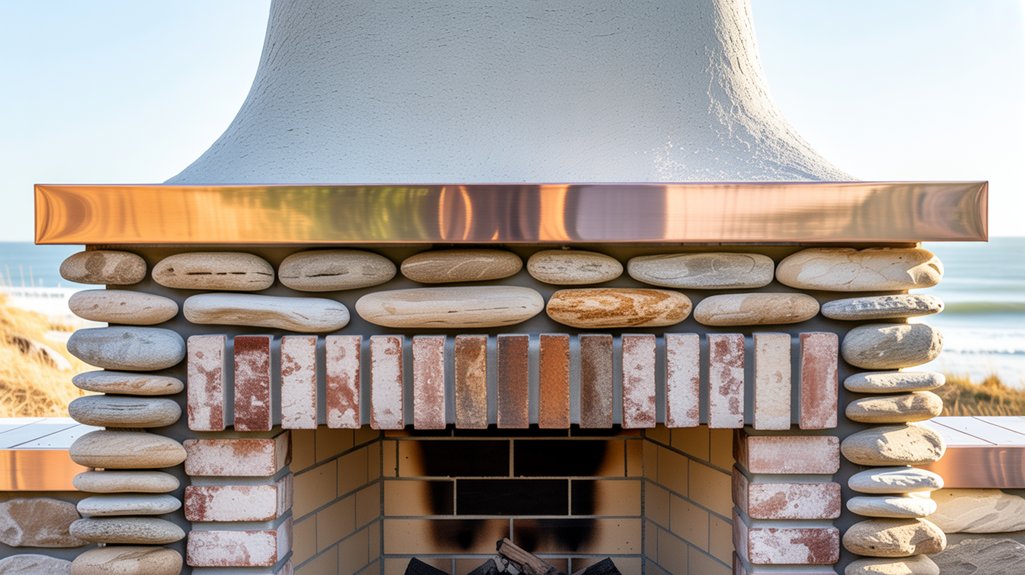
Keep your coastal outdoor fireplace standing strong against salt air—discover the critical materials that prevent corrosion before it's too late.
Type 316L stainless steel is the correct grade for every salt-exposed metallic component in a coastal outdoor fireplace, from the firebox shell to chimney caps and fasteners. The Atlantic and Peconic exposures across the South Fork create a persistent chloride environment that accelerates oxidation in lower-grade alloys. Type 316L is a molybdenum-bearing austenitic stainless that resists chloride-induced pitting corrosion in marine atmospheres where Type 304 provides insufficient protection.
Masonry fireboxes rely on refractory firebrick conforming to ASTM C1261, set in refractory mortar, with a clay flue liner meeting ASTM C315 installed per ASTM C1283 — a sequenced assembly where each component’s thermal tolerance directly conditions the integrity of the one above it. Where a metallic liner substitutes for clay, UL 1777 listing governs both the liner itself and its rated temperature ceiling, and deviation from that listing voids the performance basis the installation depends on. Material selection at the firebox and flue is not a finish decision; it’s a structural one, and the margin for substitution is narrow.
Refractory firebrick used in masonry fireplace fireboxes must conform to ASTM C1261, which governs the composition and performance of fireclay and high-duty brick under sustained thermal cycling. That standard addresses the dimensional stability and heat-resistance thresholds that prevent spalling and joint failure during repeated heating and cooling — conditions that outdoor fireplaces in maritime environments intensify, given the wide diurnal temperature swings common along the South Fork’s Atlantic and Peconic exposures. The clay flue liner seated above that firebox must meet ASTM C315, with installation following ASTM C1283 to guarantee proper draft geometry and joint integrity. Together, these layered specifications establish the thermal and structural baseline for any masonry fireplace system serving estates from Southampton through Amagansett.
Listed metallic chimney liners installed in residential fireplace systems must conform to UL 1777, the standard governing chimney liners with respect to temperature classification, material integrity, and system compatibility. That listing requirement establishes the performance threshold at which a metallic liner can be considered safe for continuous service — a threshold that carries particular weight in coastal environments where thermal cycling compounds the corrosive stress imposed by salt-laden air. Along the South Fork, where Atlantic and Peconic exposures accelerate oxidation on any unprotected metallic surface, UL 1777 compliance is the floor, not the ceiling, of acceptable specification. Estates in the Amagansett and Sagaponack corridors require Type 316 or 316L stainless steel for every salt-exposed liner component, as the chloride concentrations characteristic of oceanfront maritime conditions exceed the corrosion threshold at which Type 304 alloys remain reliable over time.
Salt air doesn’t corrode all stainless steel equally, and that distinction drives every material decision on a coastal fireplace project. Type 304 performs reliably in general service, but where Atlantic or Peconic exposure introduces sustained chloride loading — on oceanfront sites across Southampton, Amagansett, and the broader South Fork — Type 316 or 316L becomes the functional minimum for any metallic component that sees salt-laden air. That grade requirement doesn’t stop at the firebox shell; it extends to fasteners, chimney caps, and every other exposed metallic element, because a single undersized specification in the assembly is where premature failure begins.
Type 316L stainless steel provides measurably superior resistance to chloride-induced pitting corrosion compared with Type 304 due to its molybdenum content, a distinction that becomes structurally consequential in maritime environments where airborne salt deposition is continuous. The South Fork coastline — exposed to both Atlantic and Peconic Bay air masses — subjects every metallic chimney component to accelerating electrochemical attack that standard Type 304 alloy resists inadequately over time. For oceanfront properties in Southampton, Amagansett, and Sagaponack, every salt-exposed element — factory-built fireboxes, chimney caps, damper assemblies, and fasteners alike — is specified in Type 316 or 316L. Interior and sheltered installations with limited salt exposure may retain Type 304, provided the installation profile confirms distance from direct coastal wind exposure.
Chloride ions in salt-laden coastal air penetrate passive oxide films on standard stainless fasteners, initiating crevice corrosion at contact points between dissimilar metals or within threaded assemblies where oxygen depletion accelerates electrochemical attack. On the South Fork — where Atlantic and Peconic Bay exposures combine to produce continuous airborne salt deposition — this mechanism compromises structural fasteners, chimney cap retention hardware, and damper pivot points at rates that interior installations do not approach. Type 316L stainless, specified for every salt-exposed metallic component in East Hampton and Bridgehampton coastal installations, resists this attack through its molybdenum addition, which stabilizes the passive layer against chloride displacement. Caps, fasteners, and firebox enclosure hardware are all governed by the same grade requirement; no single component is exempt from the specification simply because its surface area is small.
The South Fork’s Atlantic and Peconic exposures place oceanfront sites within a windborne-debris belt governed by ASCE 7-22 design wind velocities running roughly 130 to 140 mph, a condition that amplifies salt-laden air infiltration into every unsealed joint and mechanical connection across the chimney assembly. That environment makes grade selection a systems-level decision rather than a component-level one — a Type 316L firebox paired with Type 304 fasteners will corrode at the fastener first, compromising the assembly regardless of the primary material’s performance. Estates served by appointment from Southampton through Amagansett carry that coastal exposure as a baseline condition, and metal specification must run consistently across the firebox, liner components, caps, and fasteners to hold integrity under sustained maritime stress.
ASCE 7-22 assigns a design wind speed of approximately 130 to 140 mph (V-ult) to oceanfront parcels along the South Fork, placing Southampton and Amagansett shorelines within a windborne-debris region that imposes structural and material requirements beyond standard residential construction. At those velocities, salt-laden particulate accelerates galvanic and crevice corrosion on exposed metallic components, making Type 316L stainless steel the minimum acceptable alloy for every chimney cap, fastener, and factory-built firebox element in Atlantic-exposed installations. Frost design depth on the South Fork reaches 36 inches, meaning foundation and footing work for any outdoor fireplace structure must extend below that threshold to remain code-compliant. Projects in Sagaponack and Bridgehampton are served by appointment to guarantee specifications reflect each parcel’s precise coastal exposure classification.
Galvanic corrosion between dissimilar metals accelerates measurably when chloride ion concentration in the atmosphere exceeds roughly 0.1 mg/m² per day, a threshold routinely surpassed within several hundred meters of Atlantic-exposed shoreline on the South Fork. That condition compels a unified alloy specification across every metallic element in the assembly — firebox shell, flue collar, chimney cap, anchor bolts, and fasteners — because a single lower-grade component introduced into a Type 316L assembly creates a preferential corrosion site that compromises the entire installation. Factory-built fireboxes specified under UL 1777 and their associated Class A chimney components under UL 103 must carry matching 316L designations throughout. Projects serving Southampton and East Hampton parcels with direct Peconic or Atlantic exposure are scheduled by appointment to verify that the full assembly specification reflects the precise corrosion zone classification of each site.
Owners specifying outdoor fireplaces on the South Fork consistently raise the same material questions, and the answers are more interdependent than they might first appear. Salt air doesn’t damage a fireplace uniformly — it targets metallic components selectively, meaning a correctly lined refractory masonry firebox can remain structurally sound while an undersized stainless chimney cap corrodes within a single season if it’s fabricated from the wrong alloy. Type 316L stainless is the correct grade for every salt-exposed component, from the factory-built firebox shell and fasteners to the chimney cap itself, while the firebox interior relies on refractory firebrick and matched mortar that are indifferent to coastal conditions by nature.
Type 316L stainless steel is the correct specification for coastal outdoor fireplaces in salt-air environments. Chloride exposure accelerates pitting corrosion in Type 304 alloys, making the molybdenum content of 316L essential for factory-built fireboxes, chimney caps, and fasteners alike. Properties served by appointment along the South Fork, including Amagansett and Sagaponack, receive full 316L specifications across every salt-exposed metallic component.
Salt air accelerates oxidation and pitting in standard ferrous and low-grade metallic components, making material selection a structural concern rather than a cosmetic one. Proximity to Atlantic and Peconic exposures — as found across Southampton, Amagansett, and the broader South Fork — intensifies chloride loading on every exposed surface. Type 316L stainless is the specified grade for salt-exposed metallic components, from fireboxes to fasteners and chimney caps.
Outdoor fireplace fireboxes are constructed from either site-built refractory firebrick assemblies or factory-built high-temperature stainless steel units matched to a listed Class A chimney system. Material selection shifts meaningfully in coastal environments, where salt air accelerates corrosion on metallic components. Properties served by appointment in Southampton and along the Atlantic-facing South Fork require Type 316L stainless for every exposed metallic firebox element.
Chimney caps in coastal environments require Type 316 or 316L stainless steel rather than standard galvanized or Type 304 material. Salt-laden air accelerates oxidation on exposed metallic components, and the Atlantic and Peconic exposures characteristic of the South Fork create persistent chloride conditions. Caps specified in 316L serve oceanfront installations from Amagansett to Southampton with materially longer service intervals.
From Sagaponack’s oceanfront parcels to the protected Peconic-facing estates of Southampton and Bridgehampton, the South Fork’s maritime exposure — salt-laden Atlantic air, ASCE 7-22 design wind velocities approaching 130 to 140 mph at the oceanfront, and a 36-inch frost depth — establishes material and structural requirements that separate coastal fireplace installation from standard residential practice. Backyard Paradiso serves these corridors by appointment, bringing the chimney and firebox material specifications covered in this article — Type 316L stainless at every salt-exposed component, refractory firebrick under ASTM C1261, and UL 1777-listed metallic liners — to estate properties where specification decisions carry long-term structural and resale consequence. Consultation is available by appointment across the East Hampton and Amagansett markets as well. Properly specified outdoor fireplace installations in this environment represent measurable recovery in functional outdoor square footage and assessed estate value, warranting the material investment that coastal conditions demand.