Physical Address
304 North Cardinal St.
Dorchester Center, MA 02124
Physical Address
304 North Cardinal St.
Dorchester Center, MA 02124
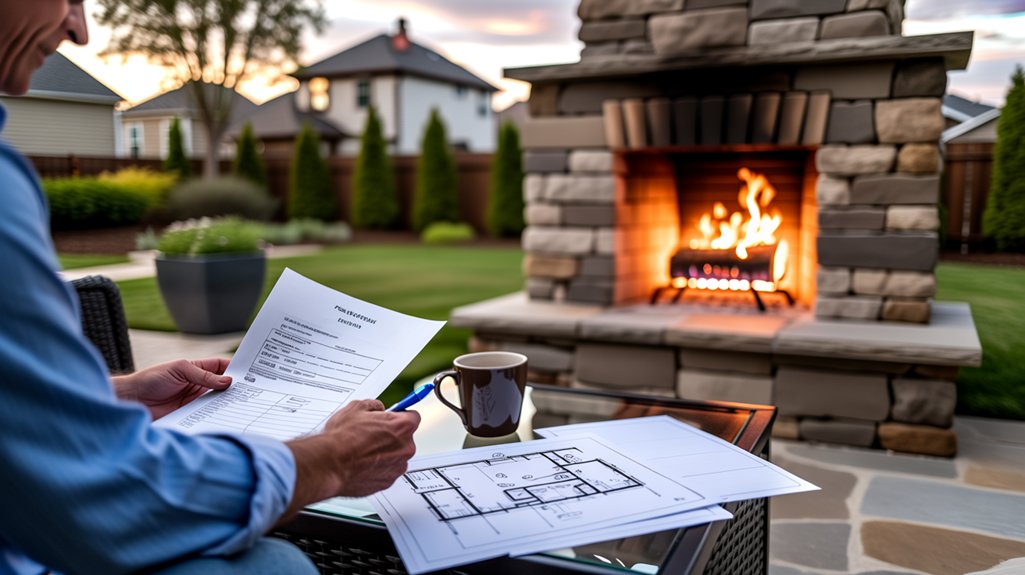
Knowing whether your outdoor fireplace requires a permit could mean the difference between full coverage and a denied insurance claim.
A permit for an outdoor fireplace is not a single form but a staged verification sequence that moves through plan review, footing inspection, liner inspection, and final inspection before the installation is considered code-compliant. Structural design, firebox dimensions, and site conditions each trigger discrete review points at corresponding construction phases. The permit record functions as the documentation chain that substantiates a compliant installation for resale title review and fire-loss insurance coverage.
A permanently installed outdoor fireplace meets the threshold for permitted construction in virtually all North American jurisdictions because IRC 2021 Chapter 10 and IFC 2021 Section 307 govern both the structural assembly and the firebox design as interdependent systems — not decorative additions. Where a governed community is involved, HOA approval precedes the permit application, since associations typically impose design and placement standards that must be resolved before the municipality’s review begins. The permit, then, isn’t a formality but the entry point into a staged verification sequence that the installation can’t legally bypass.
IRC Chapter 10 of the 2021 International Residential Code and Section 307 of the 2021 International Fire Code jointly classify a permanently installed outdoor fireplace as a regulated structure requiring a building permit. These two code frameworks establish the threshold at which a masonry or factory-built firebox shifts from a decorative feature to a permitted construction project subject to plan review and field inspection. The permit mechanism exists because a permanent fireplace introduces load-bearing conditions at the footing, combustion-containment requirements at the firebox and liner, and clearance specifications that cannot be verified through a final walkthrough alone. Together, IRC Chapter 10 and IFC Section 307 define the legal basis under which the authority having jurisdiction — the local AHJ — assumes oversight of the installation from structural design through completed construction.
HOA governing documents — commonly structured as Covenants, Conditions, and Restrictions — constitute a private contractual layer that operates independently of municipal building codes and requires satisfaction before a permit application reaches the AHJ. Where a planned community’s CC&Rs address outdoor structures, the architectural review committee holds authority to approve or deny a fireplace proposal on criteria that may include setbacks, material palette, height limits, and visual compatibility with adjacent properties. That approval is not a formality — a permit issued by the municipality does not override a CC&R restriction, and construction that proceeds without HOA authorization can compel removal regardless of code compliance. Backyard Paradiso coordinates this sequencing as part of permit management, ensuring HOA submission precedes rather than runs parallel to the municipal application.
The permit isn’t a single transaction — it’s a staged verification that tracks the installation through three distinct field inspections, each tied to a phase of construction that can’t be meaningfully assessed once the next layer goes in. Plan review comes first, examining the structural design and firebox specifications before a shovel breaks ground, which is where the AHJ confirms that the proposed assembly meets the applicable provisions of IRC 2021 Chapter 10 and IFC 2021 Section 307. Field inspections then follow at the footing stage, at the liner, and at final completion — a sequence that guarantees the work underneath supports the work above, and that the finished unit reflects what the approved plans specified.
IRC 2021 Chapter 10 structures outdoor fireplace permitting as a staged inspection sequence rather than a single administrative approval, with mandatory field verifications occurring at the footing, liner, and final phases before the jurisdiction issues a certificate of occupancy. Plan review opens the sequence before construction begins, examining structural calculations and firebox design to confirm compliance with load-path and clearance requirements. Field inspections then occur at defined construction thresholds — the footing before concrete is poured, the liner before the firebox is closed, and the final upon completion. Each stage produces a dated inspection record, and that cumulative documentation is what substantiates a compliant installation for resale disclosure and fire-loss insurance purposes. An unpermitted build produces no such record, making it a latent liability rather than a saved step. Backyard Paradiso manages this inspection coordination through its licensed-trade scheduling process; consultations are by appointment.
IRC 2021 Section R1001.1 requires that masonry fireplaces — including permanently installed outdoor units — conform to structural and firebox specifications that are verified through plan review before any construction begins. That review stage examines submitted drawings for load-path integrity, footing dimensions, firebox geometry, and clearance compliance, establishing on record that the proposed installation meets code before a single footing is excavated. Because the permit functions as a staged verification rather than a single administrative form, plan review is not a formality — it is the gate through which all subsequent field inspections flow. Deficiencies identified at this stage are corrected on paper rather than in masonry, which is why the review sequence exists upstream of construction. Backyard Paradiso coordinates this submission process through licensed-trade scheduling; consultations are by appointment.
Bypassing the permit strips the project of the staged verification record – footing sign-off, liner inspection, final approval – that establishes a compliant installation in the eyes of both a future buyer’s attorney and an underwriter reviewing a fire-loss claim. That absence isn’t a paperwork gap; it’s a latent liability embedded in the structure itself. When a claim arises or a title search surfaces an unpermitted build, the documentation doesn’t exist to reconstruct what the permit process would have confirmed.
An unpermitted outdoor fireplace produces no inspection record, leaving the installation without the staged verification — footing, liner, and final — that IRC 2021 Chapter 10 and IFC 2021 Section 307 require as documentation of a compliant build. That absence carries two distinct liabilities. First, a fire-loss claim submitted to a property insurer can be denied when the damaged structure lacks a permit history, because the insurer has no basis for confirming code-compliant construction. Second, the gap surfaces at resale, where title and disclosure review routinely flags unpermitted improvements as encumbrances requiring remediation. Backyard Paradiso manages permit coordination precisely because the documentation the process generates — plan review approval, field inspection sign-offs, final certificate — substantiates the installation’s compliance for every future purpose that depends on it.
Insurance coverage for fire-related losses depends on documented proof of code-compliant construction, a standard that an unpermitted outdoor fireplace structurally cannot meet. When a claim is submitted following a fire event, the insurer’s investigation includes confirmation that the damaged or destroyed structure was built to the applicable code — IRC 2021 Chapter 10 for construction and IFC 2021 Section 307 for open burning — and an installation without a permit history provides no such confirmation. The staged inspection record that a permit generates — plan review approval, footing sign-off, liner inspection, and final certificate — constitutes the evidentiary basis the insurer requires. Without it, denial is a foreseeable outcome rather than an exceptional one, making the unpermitted build a latent financial liability rather than a saved procedural step. Backyard Paradiso manages permit coordination so the documentation exists before any loss occasion demands it.
Permit requirements, inspection sequences, HOA authority, and insurance exposure represent the questions property owners raise most consistently when outdoor fireplace planning begins. Nearly all North American jurisdictions require a building permit for a permanently installed outdoor fireplace, though the precise threshold — whether a freestanding masonry structure or a prefabricated unit — varies by local code and warrants confirmation with the AHJ. What follows addresses each question directly, routing jurisdiction-variable specifics where they belong rather than asserting rules that only the governing authority can confirm.
Permanently installed outdoor fireplaces require a building permit in virtually all North American jurisdictions. Portable or freestanding fire pits typically fall outside permit requirements, though local ordinances vary and the governing AHJ remains the authoritative source. Backyard Paradiso coordinates permit documentation for qualifying installations and schedules consultations by appointment.
Permitted outdoor fireplace installations pass through a staged sequence — plan review examining structural and firebox design before construction begins, a footing inspection once excavation is complete, a liner inspection before enclosure, and a final inspection confirming the finished assembly. Each stage gates progress toward the next. Backyard Paradiso coordinates this inspection sequence as part of managed fireplace installation services.
HOA approval does not replace a building permit — the two authorizations operate on separate tracks and both are typically required. HOA governance addresses community aesthetic and use standards, while the municipal building permit triggers the structural and firebox plan review and staged field inspections that establish code compliance. Backyard Paradiso manages permit coordination alongside HOA submission sequencing.
An unpermitted outdoor fireplace can invalidate fire-loss insurance coverage because carriers increasingly require code-compliance documentation to confirm a covered installation. Without the staged inspection record — footing, liner, and final — no such documentation exists. Backyard Paradiso manages permit coordination to guarantee that record is established before construction begins.
Permanently installed outdoor fireplaces in North American jurisdictions trigger building permit requirements under IRC 2021 Chapter 10 and IFC 2021 Section 307, with HOA approval obligations, staged AHJ field inspections at the footing, liner, and final, and — for wood-burning units — a jurisdiction-variable air-quality and seasonal burn-restriction layer that varies materially by local authority. Backyard Paradiso carries demonstrated familiarity with that regulatory framework across this market, managing permit coordination and licensed-trade scheduling as a standard part of outdoor fireplace installation. Consultations are available by appointment for properties across the region’s served markets. The permit documentation produced through a properly staged installation — plan review, footing inspection, liner inspection, final sign-off — substantiates a compliant installation for resale title review and fire-loss insurance coverage, converting what might appear to be a procedural cost into recoverable documentation that an unpermitted build cannot replicate.