Physical Address
304 North Cardinal St.
Dorchester Center, MA 02124
Physical Address
304 North Cardinal St.
Dorchester Center, MA 02124
Keeping artificial turf looking pristine requires more maintenance than you might expect, and the reasons why will surprise you.
Artificial turf requires maintenance, though considerably less than natural grass. San Antonio’s intense UV load, expansive clay soils, and convective storm patterns make grooming, drainage integrity, and periodic rinsing practical necessities rather than optional tasks. Artificial turf is a synthetic ground cover engineered to replicate natural grass while eliminating irrigation, mowing, and fertilization demands through durable, UV-stable fibers and a permeable base system.
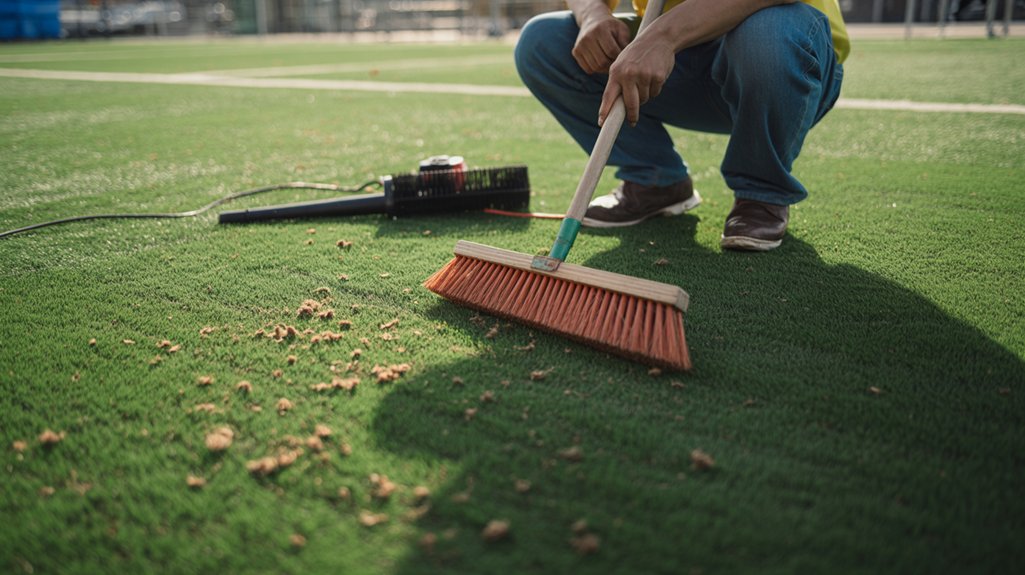
Routine maintenance for artificial turf centers on two tasks that, when performed consistently, preserve both the surface’s appearance and its structural performance. Debris removal keeps organic matter from accumulating at the fiber base, where decomposition accelerates infill compaction and creates conditions favorable to odor and microbial growth; brushing or power-brooming then lifts matted fibers and redistributes infill that foot traffic has displaced. In high-traffic zones, periodic infill top-up restores the ballast and fiber-support function that the material was installed to provide.
The Synthetic Turf Council identifies debris removal and fiber grooming as foundational routine maintenance criteria for installed synthetic turf systems. Organic matter—leaves, seed pods, and windblown particulate—settles into the pile and, if left undisturbed, promotes microbial activity that degrades both fiber and infill over time. In San Antonio, where convective storms carry debris loads and more than 250 sunny days accelerate organic decomposition at the surface, timely removal prevents compaction of the fiber canopy. Power brooming or stiff-bristle brushing lifts matted fibers and redistributes infill displaced by foot traffic, restoring pile height and maintaining the drainage pathways through the infill layer that allow intense storm runoff to clear through the permeable base beneath.
Infill displacement in high-traffic zones is a recognized maintenance condition under Synthetic Turf Council guidance, requiring periodic top-up to restore pile support and drainage function. As foot traffic concentrates on fixed paths—entry corridors, play areas, and pet runs—crumb rubber or silica sand infill migrates laterally, reducing the cushioning layer and allowing fibers to mat under load. In San Antonio, where August surface temperatures on synthetic turf can exceed ambient air temperatures by a significant margin under intense UV exposure, matted fiber in depleted zones compounds heat retention and accelerates wear. Restoring infill depth re-establishes the structural support that keeps fiber blades upright, maintains the void space through which storm runoff drains to the compacted crushed-stone base beneath, and extends the functional service life of the installed system.
San Antonio’s combination of more than 250 sunny days and August highs near 96 degrees places sustained UV and thermal stress on turf fibers, making UV-stable product selection a practical prerequisite rather than an upgrade. Heat concentrates in high-traffic lanes, where ungroomed fibers mat and lose resilience, so periodic brushing maintains both fiber orientation and drainage capacity through the surface layer. The region’s expansive clay soils drain slowly even under ideal conditions, and when convective storms deliver intense downpours, a well-compacted crushed-stone base determines whether runoff clears quickly or pools—a consequence that also governs how effectively periodic rinsing controls odor in pet and high-use zones.
San Antonio averages more than 250 sunny days per year, a figure that places cumulative ultraviolet exposure among the highest of any major Texas metropolitan area. That radiation load accelerates fiber degradation in turf systems manufactured without UV-stabilized polyethylene or nylon blends, shortening functional lifespan and causing color shift visible within a few seasons. Heat compounds the problem: August highs near 96 degrees concentrate stress in high-traffic lanes, where foot pressure and thermal softening together flatten fiber blades over time. Periodic power-brooming redistributes fibers and restores pile orientation, preventing the matted channels that form when grooming is deferred through the hottest months.
San Antonio’s expansive clay soils, classified mainly in Hydrologic Soil Groups C and D by the Natural Resources Conservation Service, produce slow native infiltration rates that concentrate runoff volume during convective storms. A properly constructed permeable base of 3 to 4 inches of crushed stone, compacted to 90 to 95 percent of modified Proctor density per ASTM D1557, allows stormwater to clear through the turf system rather than pond at the surface. During drought stages, SAWS watering restrictions eliminate supplemental irrigation as a practical option, making periodic rinsing for odor and debris control a targeted maintenance task rather than routine landscape hydration. Drainage performance determines how effectively rinsing removes organic residue from pet and high-traffic areas.
Synthetic turf eliminates the recurring obligations that define conventional lawn care — mowing, irrigation, fertilizing, and overseeding — replacing a variable, season-driven maintenance cycle with a predictable and considerably lighter one. In San Antonio, where SAWS drought-stage restrictions already complicate irrigation schedules, a surface that requires no water to sustain its appearance removes a significant operational constraint. Pet areas and high-traffic zones do introduce their own upkeep, namely prompt waste removal and periodic rinsing with enzymatic cleaners, but those demands are discrete and manageable rather than cyclical.
Synthetic turf eliminates the three recurring lawn-care tasks—mowing, watering, and fertilizing—that account for the majority of residential lawn maintenance hours each season. In San Antonio, where SAWS drought-stage restrictions can curtail irrigation schedules and natural grass requires consistent moisture to survive summer heat, a turf surface that needs no irrigation represents a measurable operational difference. NOAA climate normals for the San Antonio area record August mean highs near 96 degrees Fahrenheit, a thermal load that accelerates cool-season grass dormancy and increases supplemental watering demand. Overseeding and fertilization cycles, typically required two to three times annually on warm-season turf, are also removed from the maintenance calendar entirely once synthetic turf is installed.
The Synthetic Turf Council identifies prompt solid waste removal and periodic rinsing with enzymatic or compatible cleaners as standard maintenance criteria for pet and high-traffic turf installations. Organic material left on synthetic fiber creates conditions for bacterial growth and odor retention, with the surface’s drainage performance serving as the primary factor in how effectively liquid waste clears the system. In San Antonio, where convective storms deliver intense downpours onto expansive clay soils classified largely in Hydrologic Soil Groups C and D, a properly constructed permeable base—3 to 4 inches of crushed stone compacted to 90 to 95 percent of modified Proctor density per ASTM D1557—determines whether rinsing and rainfall clear waste efficiently or pool at the surface. High-traffic lanes also require periodic brushing to lift matted fibers and redistribute infill displaced by repeated foot or pet activity.
Artificial turf isn’t maintenance-free, and that distinction shapes nearly every question homeowners bring to a consultation. Brushing frequency depends on traffic load and fiber type, but high-use lanes in San Antonio’s intense heat benefit from grooming often enough to prevent matting before it sets. Cleaning is necessary rather than optional, infill settles and depletes in heavy-use zones over time, and both conditions respond better to early, routine attention than to deferred correction.
Artificial turf is low-maintenance, not maintenance-free. Debris removal, fiber grooming, infill top-up in high-traffic zones, and periodic rinsing remain routine requirements even after mowing, watering, and fertilizing are eliminated. The Synthetic Turf Council treats grooming, drainage management, and waste removal as standard maintenance criteria rather than optional care.
Brushing artificial turf every one to two weeks maintains upright fibers and prevents matting in high-traffic lanes. San Antonio’s intense heat and ultraviolet exposure accelerate fiber flattening, making consistent grooming particularly important during summer months. A power broom or stiff-bristle rake distributes infill evenly, a standard the Synthetic Turf Council includes in routine maintenance guidance.
Artificial grass requires periodic cleaning to remain sanitary, odor-free, and visually consistent. Pet waste, organic debris, and foot traffic accumulate on synthetic fibers regardless of infill type, making removal and rinsing a routine necessity rather than an optional task. Prompt waste removal paired with enzymatic cleaners compatible with drainage systems reflects Synthetic Turf Council guidance on standard maintenance practice.
Infill does require periodic top-up in high-traffic zones where displacement and compaction gradually reduce fill depth. The rate of loss varies with use intensity, foot traffic patterns, and whether the area serves pets or active play. Synthetic Turf Council maintenance guidance identifies infill replenishment as a routine criterion alongside grooming and drainage management.
San Antonio’s combination of UV-intense summers exceeding 250 sunny days, expansive clay soils rated mainly in Hydrologic Soil Groups C and D, and SAWS drought-stage watering restrictions creates a maintenance environment where artificial turf performance depends directly on base drainage integrity, fiber stability under sustained heat, and consistent grooming to prevent traffic-lane matting. Backyard Paradiso works within these conditions regularly, applying that site familiarity to artificial grass installation and the maintenance planning that follows it. Consultations are available by appointment for properties across Alamo Heights, Terrell Hills, Stone Oak, and The Dominion. Investment in properly maintained artificial turf is framed regarding eliminated irrigation costs under active watering restrictions, recovered lawn-care hours across the season, and functional outdoor square footage that remains usable through the heat months when natural turf typically declines — considerations that translate directly into assessed value and resale positioning in estate neighborhoods throughout the region.