Physical Address
304 North Cardinal St.
Dorchester Center, MA 02124
Physical Address
304 North Cardinal St.
Dorchester Center, MA 02124
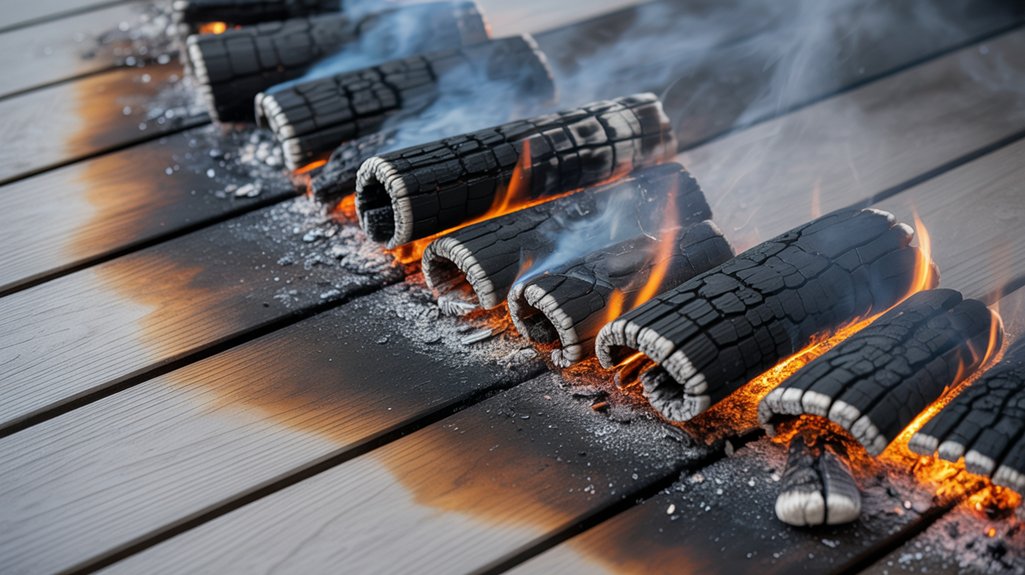
Protecting your home starts with understanding whether composite decks are flammable—the answer may surprise you.
Composite deck boards are combustible materials, and no composite product is classified as noncombustible under building code standards. Denver’s semi-arid Front Range climate, characterized by dry vegetation, recurring drought, and ember exposure near foothill properties, intensifies the practical significance of that combustibility. Composite deck boards are engineered outdoor planking manufactured from wood-plastic or PVC-based materials, designed to serve as the walkable surface layer of a deck structure.
When composite deck boards ignite, they don’t behave like a single material class — PVC-based composites and wood-plastic composites carry meaningfully different flame-spread characteristics under ASTM E84 testing, with some products reaching the code ceiling of 200 and others rated well below it. That index number determines how quickly flame travels across a surface under controlled conditions, which shapes exposure risk on a deck where a grill, a fire feature, or an ember intrusion event introduces an ignition source. Several composite and PVC products have earned ignition-resistant or reduced-flame-spread designations, a practical distinction that matters on Denver’s semi-arid Front Range, where dry vegetation and recurring drought extend the window of real ember exposure around foothill-adjacent properties.
ASTM E84 establishes the flame-spread index scale used to classify composite decking, with IRC Section R507.2.2 requiring plastic composite boards to carry an index no higher than 200. Under the ASTM E84 classification framework adopted in IBC Chapter 8, that ceiling corresponds to Class C performance, the lowest permissible rating, while scores of 26 to 75 qualify as Class B and 0 to 25 as Class A. PVC-based composite products frequently achieve lower indices than the code floor, placing some boards in Class B or Class A territory without qualifying them as noncombustible materials. On Denver’s semi-arid Front Range, where drought conditions and dry vegetation sustain real ember-transport risk, the distinction between a code-minimum Class C board and a lower-rated product carries meaningful consequence for deck detailing and substructure selection.
PVC-based composite deck boards carry flame-spread indices that frequently fall below the Class C ceiling of 200 established under ASTM E84, with select products achieving Class A ratings of 25 or lower. ASTM D7032, the product standard referenced in IRC Section R507.2.2, governs the performance requirements composite boards must satisfy before those flame-spread ratings carry regulatory weight. Reduced flame-spread performance reflects slower surface ignition and diminished fire propagation under standardized test conditions, not an absence of combustibility. On Denver’s Front Range, where semi-arid conditions and drought-stressed vegetation sustain ember-transport exposure across foothill-adjacent properties, the difference between a code-minimum Class C board and a Class A-rated PVC composite influences substructure selection, skirting detailing, and alignment with wildland-urban interface amendments enforced under the 2025 Denver Building and Fire Code.
IRC Section R507.2.2 sets the baseline: composite deck boards, stair treads, guards, and handrails must comply with ASTM D7032 and carry a flame-spread index no higher than 200 under ASTM E84 testing. That ceiling corresponds to Class C under the IBC Chapter 8 classification framework, which scales from Class A (0–25) through Class B (26–75) down to Class C (76–200). Some composite products meet Class A or B thresholds, a meaningful distinction on Denver’s Front Range where ember exposure and dry seasonal conditions can push deck assemblies closer to their material limits.
IRC Section R507.2.2 requires plastic composite deck boards, stair treads, guards, and handrails to comply with ASTM D7032 and carry a flame-spread index not exceeding 200 as tested under ASTM E84. This threshold corresponds to Class C performance under the IBC Chapter 8 flame-spread classification framework, which assigns Class A to indices of 0–25, Class B to 26–75, and Class C to 76–200. Wood decking faces no equivalent statutory flame-spread ceiling under the IRC, making ASTM D7032 compliance a material differentiator rather than a universal construction baseline. PVC-based composite products frequently achieve flame-spread indices below the Class C ceiling, with some earning Class A or Class B ratings, though no composite product qualifies as noncombustible under building code definitions.
Under the ASTM E84 flame-spread classification framework adopted in IBC Chapter 8, materials are assigned to one of three classes: Class A (index 0–25), Class B (index 26–75), or Class C (index 76–200). IRC Section R507.2.2 sets the compliance ceiling for plastic composite deck boards at a flame-spread index of 200, which corresponds to the Class C threshold—the lowest performance tier recognized under that framework. PVC-based composite products frequently test below that ceiling, with some achieving Class A or Class B ratings. Wood decking carries no equivalent statutory flame-spread requirement under the IRC, meaning composite boards subject to ASTM D7032 testing face a fire-performance accountability standard that conventional lumber does not.
Front Range estate decks in foothill-adjacent zones face ember accumulation and radiant-heat exposure that make substructure detailing as consequential as the board surface itself. Noncombustible ground cover beneath the deck, fine metal screening at joist bays, and tight flashing at wall connections work together to interrupt the ignition pathways that composite boards alone can’t eliminate. Grills and fire features require noncombustible pads and maintained clearances even on composite surfaces carrying a Class B or Class A flame-spread rating, because localized heat flux at those points exceeds what any rated decking is tested to resist.
FEMA wildland-urban interface guidance identifies ember intrusion beneath deck surfaces as a primary ignition pathway for structures in fire-prone regions. Composite deck boards, even those carrying a Class C flame-spread index under ASTM E84, remain combustible materials that can sustain ignition when embers accumulate in cavities formed by the substructure. Denver’s semi-arid Front Range climate, averaging 14 to 15 inches of annual precipitation at 5,280 feet, produces dry vegetation conditions that extend ember transport risk across foothill-adjacent properties. Defensible space strategy pairs ignition-resistant decking with noncombustible substructure components, fine metal screening at deck perimeter gaps, noncombustible ground cover beneath the deck plane, and tight flashing at ledger connections to deny ember accumulation points.
NFPA wildland-urban interface guidance requires noncombustible pads beneath grills and portable fire features placed on composite deck surfaces, regardless of the board’s ASTM E84 flame-spread classification. Composite boards, even those meeting the Class C threshold of 200 or below permitted under IRC Section R507.2.2, remain combustible materials subject to sustained ignition from radiant heat and direct flame contact at cooking and fire-feature installations. Denver’s semi-arid Front Range conditions—averaging 14 to 15 inches of annual precipitation at 5,280 feet under persistent drought cycles—reduce ambient moisture content in both vegetation and exposed deck materials, lowering the effective ignition threshold during peak fire season. Noncombustible pads, maintained clearances, and tight perimeter detailing function together as layered controls against ignition at these concentrated heat sources.
Composite decking is combustible and can catch fire. IRC Section R507.2.2 requires composite boards to meet a flame-spread index no higher than 200 under ASTM E84, establishing a Class C minimum performance floor that wood decking is not required to meet. PVC-based composites frequently achieve lower flame-spread ratings than that threshold.
Composite deck boards often carry a lower flame-spread index than many conventional wood species, making them comparatively more resistant to flame propagation rather than truly fireproof. ASTM E84 testing required under IRC Section R507.2.2 sets a maximum flame-spread index of 200 for composite boards, with PVC-based composites frequently achieving stronger ratings. Denver’s semi-arid Front Range conditions make that performance distinction practically meaningful for foothill-adjacent estate properties.
Grills and fire pits can be placed on composite decking when positioned on noncombustible pads with manufacturer-specified clearances maintained beneath and around heat sources. Composite boards carry a flame-spread index no higher than 200 under ASTM E84 but remain combustible materials vulnerable to sustained radiant heat. Denver’s semi-arid Front Range climate and wildland-urban interface exposure make proper noncombustible pad installation and ember management especially consequential for foothill estate properties.
Composite decking can meet baseline fire code requirements but may fall short of wildland-urban interface amendments that demand ignition-resistant materials. IRC Section R507.2.2 requires composite boards to achieve a flame-spread index no higher than 200 under ASTM E84, though WUI jurisdictions routinely impose stricter thresholds. Denver’s 2025 Building and Fire Code governs these requirements for Front Range properties near fire-prone foothill zones.
Composite deck boards installed under the 2025 Denver Building and Fire Code must satisfy IRC Section R507.2.2, comply with ASTM D7032, and carry an ASTM E84 flame-spread index no greater than 200, with wildland-urban interface amendments in Front Range jurisdictions frequently tightening that floor toward Class A or Class B performance. Backyard Paradiso applies those code thresholds directly to composite deck selection and detailing, steering through the material classification and fire-performance documentation that estate properties on the semi-arid Front Range require. The firm consults by appointment, allowing each project’s scope — board classification, substructure specification, ember-intrusion screening, and noncombustible pad placement — to receive the site-specific analysis that complex lots demand. Investment in correctly specified composite decking is framed regarding service-life extension, reduced maintenance cycles, and the functional outdoor square footage that properties across Denver, Cherry Hills Village, and the foothill communities carry into long-term value.