Physical Address
304 North Cardinal St.
Dorchester Center, MA 02124
Physical Address
304 North Cardinal St.
Dorchester Center, MA 02124
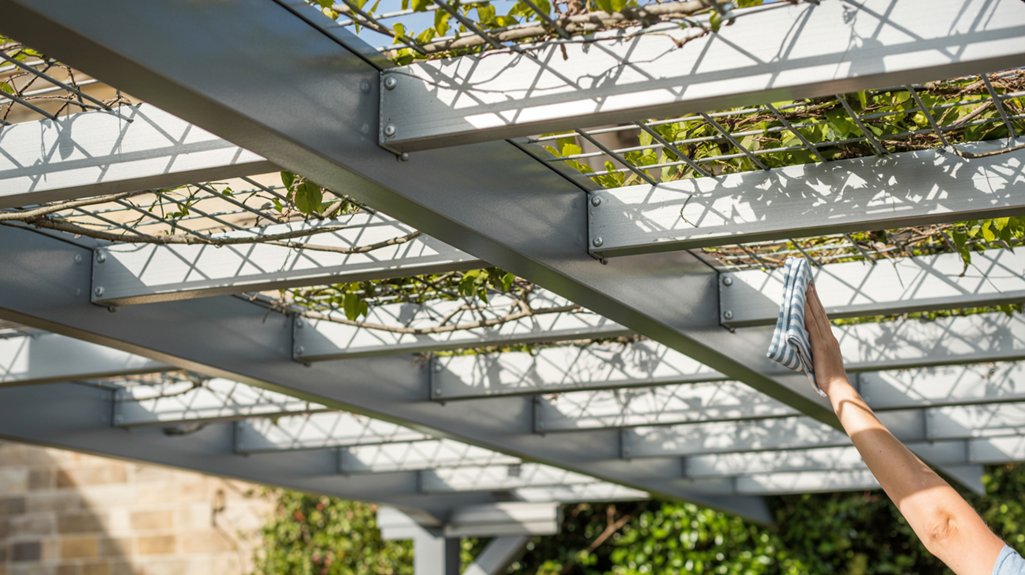
Just because aluminum pergolas require far less maintenance than wood doesn't mean they need none—discover what tasks actually matter.
Aluminum pergolas in Orlando require a defined but minimal maintenance routine centered on periodic washing, pre-wet-season gutter and drainage-channel clearing, annual louver pivot lubrication, and inspection of electrical enclosures under NEC wet-location standards. Central Florida’s June-September monsoon season, combined with high humidity and ultraviolet exposure, concentrates most maintenance demands into seasonal intervals rather than continuous upkeep. An aluminum pergola is a freestanding or attached outdoor structure using extruded aluminum framing to support a louvered or fixed roof system, extending functional living space into the exterior environment year-round.
The actual maintenance list for an aluminum pergola in Orlando is short. Powder-coated surfaces need periodic washing to clear the pollen loads and particulate residue that Central Florida’s wet-dry seasonal cycle deposits on horizontal and semi-horizontal planes, where buildup accelerates UV micro-degradation of the finish over time. Integrated gutters and drainage channels warrant clearing before June, when the onset of near-daily thunderstorms can overwhelm a debris-restricted outlet and force standing water against framing connections that are otherwise designed to shed it.
Powder-coat finishes meeting AAMA 2604 performance standards are rated to resist film erosion and color change through years of exterior ultraviolet and moisture exposure, but accumulated surface contamination still degrades the coating’s protective function between cleaning cycles. Central Florida’s June-September wet season deposits airborne pollen, mold spores, and organic debris across horizontal and vertical surfaces in concentrations that accelerate surface oxidation if left unaddressed. A low-pressure rinse with fresh water and a mild, non-abrasive soap — applied with a soft cloth or brush — removes biological and particulate buildup without compromising the powder-coat film. For pergolas installed along the Butler Chain of Lakes or Bay Hill, where lakeside humidity intensifies mold adhesion, two washing cycles per year, timed before and after the monsoon season, constitute the full cleaning obligation.
Orlando’s average annual rainfall of 50 to 60 inches falls mainly within the June-September wet season, delivering concentrated storm volumes that can overwhelm uncleared drainage channels within a single afternoon thunderstorm cycle. Aluminum pergola systems with integrated gutters and drainage columns route that water load away from the structure’s base and the adjoining hardscape, but only when the channels are free of organic debris accumulated during the preceding dry season. Fallen oak catkins, pine needles, and windblown particulate common across Winter Park and Baldwin Park canopy corridors compact into mats that block outlet points and allow standing water to back up against frame connections. Clearing those channels once before the monsoon season opens constitutes the full pre-season drainage obligation.
Motorized louver systems introduce two discrete maintenance obligations that, when deferred, carry functional rather than cosmetic consequences. Each pivot point in the louver array requires annual lubrication to preserve full-travel articulation under the thermal cycling and humidity load that Orlando’s nine-month warm season imposes on aluminum-to-aluminum contact surfaces. Electrical enclosures, GFCI devices, and any low-voltage lighting components governed by NEC Article 411 warrant an annual inspection for gasket integrity and moisture intrusion, given that wet-location compliance depends on sustained seal performance, not just initial installation condition.
Motorized louver systems operating under Orlando’s June–September wet season accumulate particulate and humidity-driven oxidation at pivot points across every rotation cycle, conditions that ASCE/SEI 7’s component and cladding provisions implicitly acknowledge by classifying louvered roofs within a high-exposure envelope category. When pivot friction increases incrementally, the actuator motor compensates by drawing higher current, accelerating wear across the drive train before any visible stiffness appears. A full-travel function check—cycling louvers from fully open to fully closed and back—reveals binding early, while pivot lubrication with a dry or silicone-based product prevents metal-on-metal wear that compromises weather-seal integrity. For Orlando-area installations along the Butler Chain of Lakes and Bay Hill, where afternoon storm cells rotate louvers under load, this annual routine preserves the motorized system’s designed operational lifespan.
NEC Section 210.8 mandates GFCI protection for all 120-volt, 15- and 20-ampere receptacles installed in outdoor locations, a requirement that applies directly to the integrated electrical components common in motorized aluminum pergola systems. Orlando’s June–September wet season subjects every enclosure, junction box, and device to sustained humidity, windblown rain, and rapid thermal cycling that degrade gasket compression and conduit seals incrementally. Article 411 governs low-voltage lighting systems within these same structures, requiring listed components and wet-location ratings where exposure is continuous. An annual inspection of GFCI trip function, enclosure integrity, and conduit entry seals—timed before the wet season onset—identifies compromised protection before standing moisture reaches live conductors, which in Orlando’s flatwoods-adjacent corridors like Lake Nona and Baldwin Park represents an elevated risk given seasonal high water tables and pooling near grade.
Aluminum’s maintenance profile is defined as much by what it eliminates as by what it requires. No staining cycle, no sealant reapplication, no rot treatment, and no termite inspection appear on the schedule — obligations that wood structures in Zones 9b–10a accumulate with near-mechanical regularity given the region’s sustained humidity, UV saturation, and warm-season moisture cycling. Where wood refinishing intervals compress under those conditions, AAMA 2604- and 2605-rated powder-coat finishes hold their bond to the substrate without periodic intervention, maintaining both color retention and chalk resistance across the service life of the structure.
Aluminum framed under ASTM B221 in 6063-T5 or 6061-T6 alloy does not absorb moisture, eliminating the biological degradation pathways that govern wood’s entire maintenance calendar. Because aluminum carries no cellulose, Formosan and subterranean termites — both established in Orange County — find no nutritional value in the material, making annual termite inspection contracts structurally irrelevant to the pergola itself. Powder-coat finishes meeting AAMA 2604 or 2605 standards are factory-applied under controlled electrostatic and cure conditions, replacing the field-applied stains and sealers that wood structures require on recurring cycles to resist Florida’s 50 to 60 inches of annual rainfall and sustained ultraviolet loading. Rot treatment, fungicide application, and wood preservative recoating never appear on an aluminum maintenance schedule.
AAMA 2605 certification requires a powder-coat finish to retain at least 50 percent gloss after ten years of South Florida outdoor exposure testing, a threshold wood field-finishes cannot meet under the sustained ultraviolet loading and humidity characteristic of USDA Hardiness Zones 9b–10a. Factory-applied powder coatings cure under controlled electrostatic conditions, bonding to aluminum extrusions at a molecular level that field-brushed stains and sealers applied to wood never replicate. Orlando’s June–September wet season, which delivers the majority of the region’s 50 to 60 annual inches of rainfall in concentrated afternoon storm events, accelerates extractive bleed, grain-checking, and finish delamination on wood structures on cycles measured in years rather than decades. An aluminum pergola finished to AAMA 2604 or 2605 standards asks nothing of the homeowner that wood refinishing calendars demand: no sanding, no recoating, no fungicide treatment timed ahead of storm season.
Homeowners across Orlando’s estate corridors tend to share a short list of practical questions once an aluminum pergola is installed. How often washing is warranted, whether motorized louvers require annual attention, and what Florida’s sustained humidity actually does to aluminum alloys are among the most common. What happens when pergola gutters clog during the June-September storm season rounds out the set, and each question has a defensible answer grounded in material behavior and local conditions rather than general precaution.
Aluminum pergolas in central Florida benefit from washing two to four times per year, with a thorough rinse before the June wet season onset. Orlando’s combination of high pollen load, afternoon thunderstorm residue, and coastal-influenced humidity accelerates surface film buildup on powder-coat finishes. Structures along the Butler Chain of Lakes and Bay Hill corridors, where lakeside air carries additional particulate, warrant the higher end of that frequency.
Motorized louver systems benefit from annual pivot-point lubrication and motor-housing inspections to maintain smooth operation through Orlando’s high-humidity, high-UV environment. Salt-laden air near lake corridors such as the Butler Chain of Lakes can accelerate wear on mechanical pivot hardware if lubricant is not refreshed. NEC wet-location compliance for integrated electrical components should be confirmed during the same annual service interval.
Architectural aluminum alloys used in pergola framing develop a passive oxide layer that effectively halts further corrosion, making humidity-driven deterioration a non-issue under central Florida’s conditions. AAMA 2604- and 2605-rated powder-coat finishes provide an additional barrier against the region’s prolonged wet-season exposure. Homeowners in lakeside corridors such as Windermere and the Butler Chain of Lakes benefit most from confirming finish-grade compliance at the time of installation.
Clogged pergola gutters during Orlando’s June–September wet season redirect sheet flow onto footings, adjacent paving, and landscaping rather than through designated downspouts. Sandy upland soils in Hydrologic Groups A and B absorb modest overflow quickly, but poorly drained flatwoods soils near lakefront estates on the Butler Chain concentrate standing water that accelerates footing saturation. Clearing drainage channels before monsoon onset remains the single highest-priority seasonal maintenance task.
Winter Park’s canopied lots and Baldwin Park’s lakeside parcels share a common regulatory and climatic overlay — Florida Building Code wind criteria, sandy well-drained upland soils grading toward seasonally high water tables near water features, and a wet-season maintenance cycle that places measurable demands on any outdoor structure. Backyard Paradiso installs aluminum pergolas across these corridors, approaching each project with the soil conditions, drainage patterns, and low-maintenance material performance that the article establishes as central to long-term ownership in central Florida. Consultations are available by appointment at the Orlando office. For properties in Windermere, Bay Hill, and the Butler Chain of Lakes estate corridors, the conversation typically encompasses value recovery relative to functional square footage added and the extended usable hours per year that a weather-responsive louvered system delivers. Lake Nona and the broader Orange County unincorporated areas represent additional markets where the same installation standards and site-specific assessments apply.