Physical Address
304 North Cardinal St.
Dorchester Center, MA 02124
Physical Address
304 North Cardinal St.
Dorchester Center, MA 02124
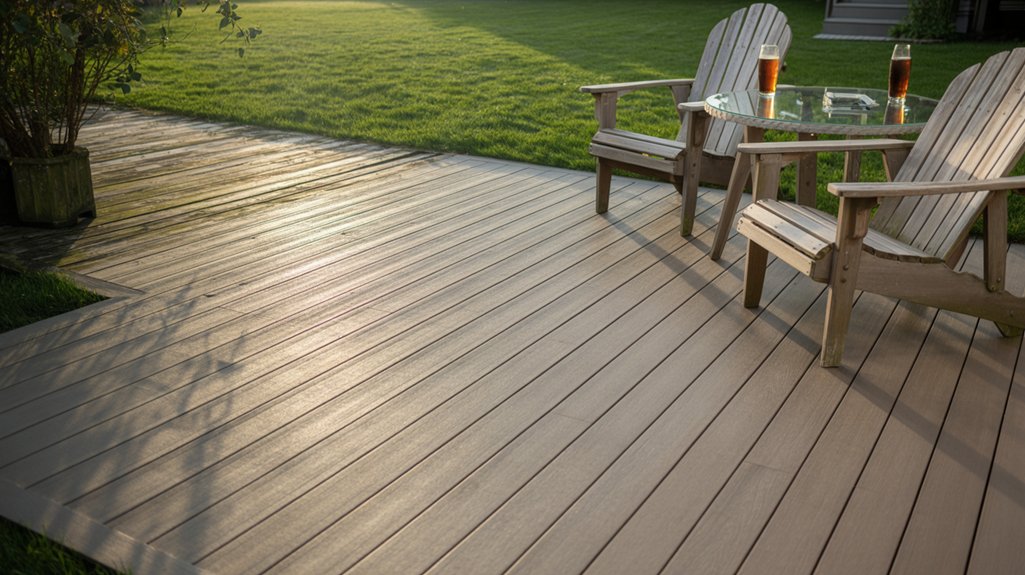
Getting a composite deck may be the smartest investment you make—but the numbers might surprise you.
Composite decking earns its premium in Denver across a 25-year ownership horizon, where altitude-intensified UV exposure, freeze-thaw cycling, and expansive Front Range clays accelerate the maintenance burden that pressure-treated wood carries. Co-extruded construction—which seals wood fiber in a continuous polymer shell—is the performance threshold that makes this value case defensible under Denver’s specific climate and geotechnical conditions. Composite decking is an engineered outdoor surface system that bonds wood fiber with polymer binders to deliver structural stability, fade resistance, and low maintenance demands across decades of exterior exposure.
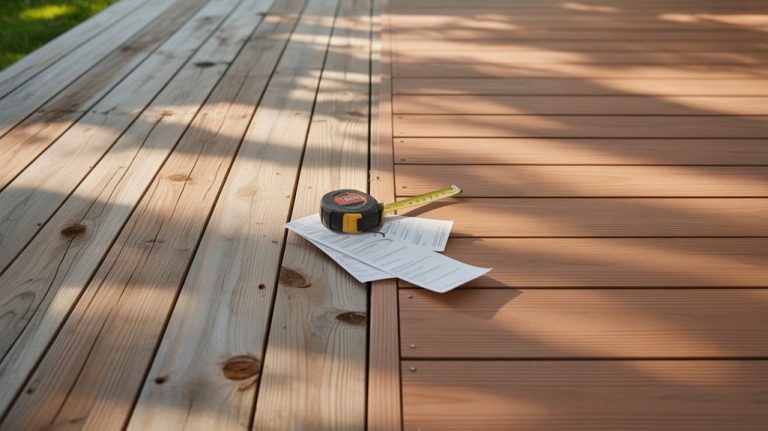
The purchase price gap between composite and pressure-treated wood narrows considerably once wood’s two-to-three-year refinishing cycle enters the accounting. Pressure-treated boards require periodic sanding, cleaning, and recoating to resist Denver’s freeze-thaw cycling and altitude-amplified UV degradation — a maintenance obligation that compounds across a 25-year horizon in both labor and material cost. Co-extruded composite boards, governed by ASTM D7032 performance standards, carry a sealed polymer shell that resists moisture intrusion and pigment breakdown without refinishing, shifting the ownership calculus well beyond the initial price differential.
Pressure-treated wood decking requires mechanical sanding, chemical stripping, and reapplication of water-repellent sealers or stain on a two-to-three-year cycle to maintain structural integrity and surface appearance under normal residential conditions. In Denver, that cycle compresses under compounding stress: NOAA climate normals for the Denver area record approximately 3,100 annual sunshine hours, altitude-intensified ultraviolet radiation accelerates surface oxidation, and seasonal freeze-thaw cycling works sealers loose at the grain level between refinishing intervals. Co-extruded composite boards, by contrast, carry a continuous polymer shell that requires no stripping, sanding, or recoating — periodic cleaning with soap and water constitutes the full maintenance obligation. Across a 25-year ownership horizon, the cumulative labor, materials, and lost-use time associated with wood’s refinishing cycle represent a recurring ownership cost that composite’s maintenance profile eliminates entirely.
ASTM D7032 establishes the performance benchmarks — including resistance to moisture, freeze-thaw cycling, and accelerated weathering — that plastic composite deck boards must meet before they qualify for residential structural applications under IRC Section R507.2.2. Those benchmarks matter in Denver precisely because the installation environment stacks multiple degradation vectors simultaneously: roughly 3,100 annual sunshine hours at altitude-intensified ultraviolet exposure, seasonal snowfall of 50 to 60 inches, and freeze-thaw cycling that begins earlier and ends later than in lower-elevation markets. Co-extruded boards, with a continuous polymer shell encasing the wood-fiber core, are engineered to perform within those thresholds across extended service horizons, compressing the total ownership cost relative to materials that degrade outside tested parameters before the 25-year horizon closes.
Denver’s roughly 3,100 annual sun hours arrive at an altitude where ultraviolet intensity exceeds what sea-level ratings anticipate, accelerating polymer breakdown and pigment degradation in decking materials whose surface chemistry isn’t engineered to compensate. Pressure-treated wood under these conditions doesn’t simply fade; it checks, splinters, and cycles through expansion and contraction with each freeze-thaw event until surface integrity becomes a maintenance liability rather than a periodic inconvenience. Co-extruded composite boards address this directly through a continuous polymer shell that encapsulates the wood-fiber core, limiting moisture ingress at the surface where freeze-thaw damage and UV oxidation do their most consequential structural work.
Denver’s elevation exposes composite decking to ultraviolet radiation at an intensity measurably greater than sea-level installations, a condition that accelerates polymer degradation in boards lacking a continuous co-extruded shell. At roughly 3,100 annual sunshine hours, according to NOAA climate normals for the Denver metro, the cumulative UV load compounds across seasons, driving color shift and surface breakdown in capped or uncapped wood-plastic composite products that rely on topical pigmentation alone. Co-extruded boards encapsulate the wood-fiber core within a continuous polymer shell, distributing UV and moisture resistance uniformly rather than concentrating it at a surface layer. Freeze-thaw cycling, recurring through Denver’s Zone 6a–6b shoulders, further stresses any surface discontinuity, making shell integrity the functional threshold that separates boards requiring periodic refinishing from those maintaining appearance across a 25-year ownership horizon.
Pressure-treated lumber decks in Denver’s Zone 6a–6b climate undergo repeated moisture absorption and desiccation cycles that cause wood fibers to swell, contract, check, and ultimately splinter across exposed walking surfaces. Denver’s seasonal snowfall of 50–60 inches, combined with the metro’s frequent shoulder-season freeze-thaw oscillations, drives liquid water into surface checks where freeze expansion widens existing cracks with each cycle. The resulting surface degradation elevates splinter risk on horizontal decking and stair treads—precisely the surfaces IRC Section R507 governs for composite board performance thresholds—while also accelerating structural softening at fastener points. Altitude-intensified UV exposure compounds the mechanism, as ultraviolet radiation breaks down lignin in exposed wood fibers, leaving a gray, fibrous surface with diminished structural coherence well before a 25-year ownership horizon is reached.
In Denver’s estate corridors, composite decking earns its premium not through upfront economics but through the structural and aesthetic permanence that sustains resale recovery across a 25-year horizon. Expansive Front Range clays introduce a geotechnical variable that makes footing depth a consequential decision rather than a formality — footings set at or below the 30-to-36-inch frost line resist the differential heave that otherwise compromises framing integrity and, by extension, the functional square footage a buyer evaluates at resale. A deck that holds level, retains its finish under 3,100 annual sun hours, and requires no cyclical refinishing converts what would be maintenance overhead into usable outdoor hours — a metric that performs differently in Denver’s climate than it does in lower-elevation markets.
Composite decking consistently recovers a higher percentage of its installed cost at resale than pressure-treated wood in Denver’s estate corridors, where buyers in Cherry Hills Village, Greenwood Village, and Cherry Creek North treat outdoor living space as functional square footage rather than supplemental amenity. At Denver’s elevation, altitude-intensified ultraviolet exposure—approximately 3,100 annual sunshine hours under conditions that accelerate polymer breakdown in lower-grade finishes—causes pressure-treated wood to gray, check, and splinter within years, visibly discounting perceived square footage at the point of sale. A co-extruded composite deck, by retaining surface integrity across Denver’s freeze-thaw cycling and hail exposure, sustains the functional equivalence argument: covered, usable outdoor square footage commands comparable consideration to interior finished space in high-demand Denver neighborhoods.
Denver Building Code structural provisions set the local frost-line depth at 30 to 36 inches, requiring deck footings to extend below that threshold to prevent heave-driven movement in the expansive clay soils common across the Front Range. Those clays exhibit shrink-swell behavior that exerts lateral and vertical pressure on under-engineered foundations, accelerating the structural misalignment that compounds maintenance costs over a 25-year ownership horizon. A composite deck system installed with code-compliant footings retains the level, continuous surface necessary to preserve its functional square footage argument at resale—a particularly consequential consideration in estate corridors such as Cherry Hills Village and Greenwood Village, where outdoor living space is evaluated against interior finished space. Correct footing depth is not an upgrade; it is the structural prerequisite that protects the entire ownership-value case.
A few recurring questions surface whenever Denver homeowners evaluate composite decking as a long-term investment. Whether the material holds its color under altitude-intensified UV exposure, how much annual maintenance it displaces, what resale recovery it supports in estate corridors like Cherry Hills Village or Greenwood Village, and whether Denver’s frost-line depth demands engineered footings — each question carries direct consequences for the total ownership calculus. The answers aren’t uniform, but they’re grounded in conditions specific enough to Denver’s climate, soils, and code framework to move the conversation beyond generality.
Co-extruded composite decking resists UV-induced fading considerably better than standard capped or uncapped alternatives under Denver’s roughly 3,100 annual sun hours and altitude-intensified ultraviolet exposure. The continuous polymer shell encasing the wood-fiber core is the conditioning factor, as it limits the photodegradation that compromises lower-grade finishes at Front Range elevations. Cherry Hills Village and Greenwood Village installations represent contexts where long-term color retention directly supports resale recovery.
Composite decking eliminates annual sanding, sealing, and staining cycles that pressure-treated wood demands under Denver’s freeze-thaw stress and altitude-intensified UV load. Co-extruded boards with continuous polymer shells resist moisture infiltration and surface oxidation more effectively than open-grain wood substrates. Periodic cleaning with soap and water represents the primary ongoing maintenance obligation across the ownership horizon.
Composite decks consistently support stronger resale positioning than pressure-treated wood alternatives, particularly in Denver’s estate corridors where buyers expect low-maintenance outdoor living spaces. Recovery rates vary by neighborhood, overall project quality, and how well the deck integrates with the home’s footprint. Properties in Cherry Hills Village, Greenwood Village, and Cherry Creek North tend to reflect the strongest correlation between premium outdoor amenities and buyer valuation.
Denver decks require footings that extend below the local frost line, commonly set at 30 to 36 inches per Denver Building Code structural provisions. Expansive Front Range clays with documented shrink-swell behavior can necessitate geotechnical review beyond standard prescriptive footing design. Community Planning and Development administers permit review where soil conditions or structural loads may trigger engineered footing documentation.
Freeze-thaw cycling across Denver’s Zone 6a–6b winters, expansive Front Range clay soils with pronounced shrink-swell behavior, and altitude-intensified ultraviolet exposure collectively define the performance conditions under which any composite deck installation must be engineered to last. Backyard Paradiso works within precisely these constraints, bringing demonstrated familiarity with frost-line footing requirements, substructure ventilation standards, and co-extruded board selection to composite deck projects across the Denver metro. Consultations are available by appointment from the firm’s Denver office. For properties in Cherry Hills Village, Greenwood Village, Cherry Creek North, Hilltop, Washington Park, and Lowry, composite decking represents a measurable position on total ownership cost across a 25-year horizon — one assessed through resale recovery, functional square footage equivalence, and the additional usable hours per year that a low-maintenance surface returns relative to pressure-treated wood requiring seasonal upkeep under the same demanding regional conditions.