Physical Address
304 North Cardinal St.
Dorchester Center, MA 02124
Physical Address
304 North Cardinal St.
Dorchester Center, MA 02124
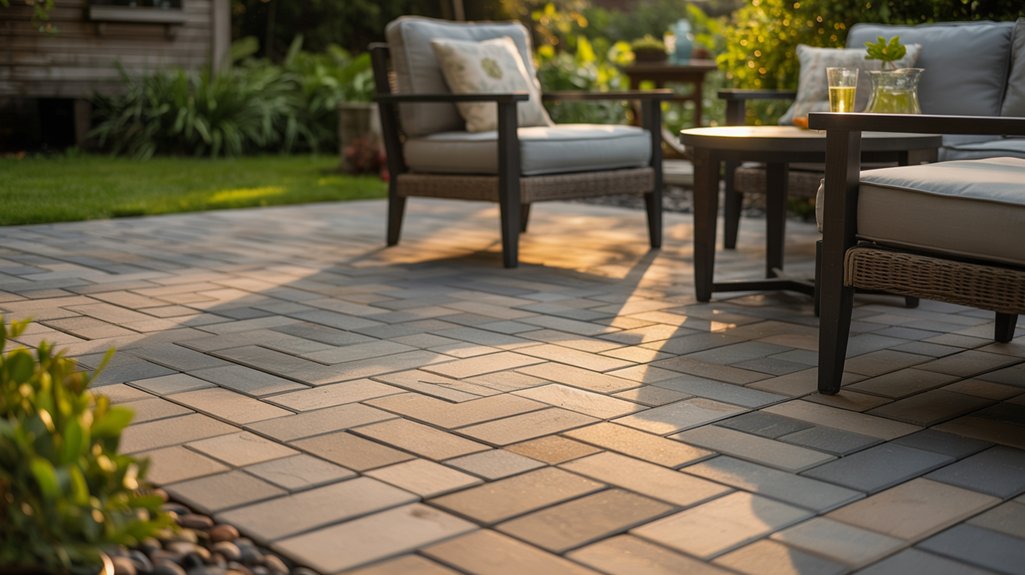
The benefits of paver stone patios go far beyond aesthetics, offering durability, easy repairs, and features that could transform your outdoor space entirely.
Paver patios deliver measurable advantages in durability, repairability, and design flexibility that poured concrete cannot replicate. In high-altitude climates like Colorado Springs, freeze-thaw cycling and de-icing salt exposure make ASTM C1645-tested units and individual-unit replaceability the conditions that matter most. A paver patio is a segmental flexible pavement of high-strength interlocking units on a compacted aggregate base, engineered to absorb ground movement and allow single-unit repair without visible patching.
Paver units manufactured to ASTM C936 carry compressive strengths that exceed what site-poured concrete typically achieves, and their freeze-thaw durability is a tested property rather than an assumed one — a meaningful distinction in climates where de-icing salts accelerate surface deterioration. That structural integrity is compounded by the segmental format itself, which allows ground movement to redistribute across individual joints rather than propagate as a continuous crack. When a unit does sustain damage, it’s lifted and replaced without patching, leaving no visible evidence of the repair.
Concrete interlocking paving units manufactured to ASTM C936 must achieve an average compressive strength of at least 8,000 psi, a threshold that exceeds what is typical of site-poured residential concrete slabs. That density is directly linked to freeze-thaw performance: ASTM C1645 limits average mass loss to no more than 225 g/m² after 28 freeze-thaw cycles conducted in a 3 percent saline solution designed to simulate de-icing-salt exposure. In Colorado Springs, where high-altitude elevation intensifies the frequency and depth of freeze-thaw cycling, that tested resistance is a functional requirement rather than an incidental specification. When an individual unit does sustain damage, it is removed and replaced without patching — a repair outcome a monolithic slab cannot replicate.
A segmental paver field allows any individual unit to be extracted and replaced without disturbing surrounding pavers, leaving no visible patch seam of the kind inevitable in a repaired concrete slab. That repairability is a direct consequence of the construction method: units are set in an unbound bedding layer over a compacted aggregate base, with no adhesive or continuous matrix locking them together. In Colorado Springs, where de-icing salt application and repeated freeze-thaw cycling accelerate surface degradation, the ability to replace a single compromised unit extends effective service life without full-surface intervention. Installation practice governed by CMHA standards — including edge restraint and bedding depth tolerances — guarantees replacement units re-seat to the same plane as the field, maintaining surface integrity and accessibility compliance under ICC A117.1 Section 302.1.
A paver patio’s structural classification as a flexible segmental pavement — rather than a monolithic slab — determines its behavior under ground movement; independent units shift and resettle without propagating a single fracture across the field. That same segmental construction means an at-grade installation carries no load into the building foundation, so the IRC imposes no footing requirement unless a load-bearing feature is integrated. Where stormwater management is a site consideration, permeable interlocking concrete pavement redirects infiltration through the joint matrix and base course rather than concentrating runoff at the surface.
| Benefit | Paver patio | Poured concrete |
|---|---|---|
| Design flexibility | Pattern, color, border, and unit-shape combinations | Limited; surface treatments only |
| Stormwater handling | Permeable interlocking concrete pavement (PICP) option available | Typically impervious |
| Surface and accessibility | Stable, firm, slip-resistant; joints within accessible-route tolerances (A117.1) | Slip resistance is finish-dependent |
| Cracking | Segmental flexible pavement — no single monolithic crack | Monolithic slab — cracks with heave or settlement |
| Repair | Individual unit replacement, no visible patch | Full-section repair or resurfacing |
| Freeze-thaw | Units tested to ASTM C1645 (de-icing-salt path) | Surface prone to spalling |
A paver patio installed on a compacted aggregate base functions as a segmental flexible pavement, distributing load through individual units rather than across a continuous monolithic slab. Because no single rigid plane spans the field, differential ground movement produces no through-crack that telegraphs across the surface — the joints absorb the displacement instead. Under the International Residential Code, a plain at-grade paver patio supported by grade is not a structure tied to the foundation, and footings are not required unless a load-bearing feature such as a pergola post or outdoor kitchen column is incorporated. In Colorado Springs, where seasonal freeze-thaw cycling repeatedly stresses slabs from below, the absence of monolithic cracking risk is a functional advantage rather than a marginal one.
Permeable interlocking concrete pavement (PICP) is a named pavement classification with surface infiltration rates field-verified through ASTM test methods, distinguishing it from conventional at-grade installations where runoff sheds laterally rather than infiltrating through the surface. The segmental construction that prevents monolithic cracking also enables this permeability: open-graded joints and bedding aggregate allow water to pass through the pavement cross-section and into a reservoir base course beneath. In Colorado Springs, where intense convective summer storms can overwhelm surface drainage on hardscape, the capacity to infiltrate runoff at the pavement surface reduces sheet flow across adjacent grades. Because PICP remains a flexible segmental pavement, it retains the same freeze-thaw durability and individual-unit repairability that govern conventional paver installations — permeability is an added functional property, not a trade-off against structural performance.
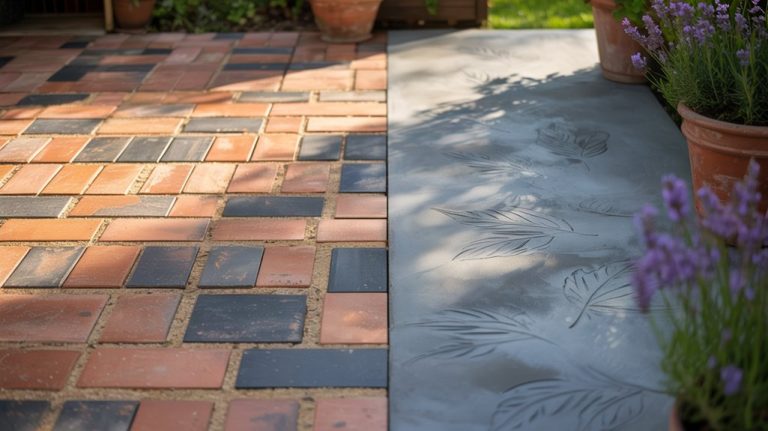
A paver surface, when installed to joint-opening and lippage tolerances consistent with ICC A117.1 Section 302.1, can function as a compliant accessible route without auxiliary treatment. That dimensional discipline — gaps held below the threshold that catches a cane tip or wheel edge, and surface plane kept within acceptable relief — is a product of installation practice rather than a concession to code. Beyond accessibility, the segmental format opens design latitude that a monolithic slab structurally can’t match: unit shape, color blend, laying pattern, and border coursing combine as independent variables, giving a paver field compositional range that poured concrete achieves only through applied surface treatments of considerably shorter service life.
A paver surface installed to the joint-opening and lippage tolerances specified under ICC A117.1 Section 302.1 qualifies as a firm, stable, and slip-resistant walking surface along an accessible route. The standard limits surface openings to those that do not allow passage of a half-inch sphere, a threshold that governs joint width selection and sand-set joint stability over time. Lippage between adjacent units must remain controlled to prevent trip hazards, a condition that depends on base flatness and compaction verified to ASTM D698 or D1557. In Colorado Springs, where repeated freeze-thaw cycling can displace improperly seated units, the segmental format offers a corrective advantage: individual units that shift or settle can be reset to restore compliant tolerances without disturbing the surrounding field.
Concrete interlocking paving units manufactured to ASTM C936 are produced in a range of shapes, surface textures, and colorfast pigment blends that a site-poured slab cannot replicate once cast. The segmental format allows pattern variables — running bond, herringbone, basketweave, and fan configurations — to be combined with border courses and accent units across a single field without introducing construction joints or control cuts. Because each unit is an independent element, color shifts and geometric layouts are achieved through placement sequence rather than formwork or masking. In Colorado Springs, where residential outdoor spaces contend with high-altitude UV exposure and de-icing salt application, the pigment and texture durability tested under the same ASTM C936 and C1645 framework that governs structural performance also governs long-term appearance retention.
Paver patios generate consistent questions about durability, maintenance demands, resale impact, and immediate usability — all of which trace back to the segmental construction method and material specification rather than to installation aesthetics alone. A paver field, once compacted and edge-restrained to CMHA standards, is load-ready as soon as the final course is set, with no curing window required. Maintenance stays limited to periodic joint sand replenishment and individual unit replacement where settlement or damage occurs, and NAR research supports the position that well-executed hardscaping contributes to residential resale value.
Paver patios offer durability, repairability, design flexibility, and freeze-thaw resilience that poured concrete cannot match. Those advantages trace to a single structural fact: the field is segmental rather than monolithic, so individual units are replaceable and ground movement does not produce a surface-spanning crack. CMHA installation standards governing base, bedding, and edge restraint determine whether those benefits are fully realized.
Paver patios are widely regarded as a value-adding outdoor improvement, with the National Association of Realtors citing hardscaping among recoverable landscaping investments. Actual value contribution depends on installation quality, design cohesion with the property, and local market conditions. In Colorado Springs, documented durability under freeze-thaw conditions strengthens the long-term case for that added value.
Paver patios are among the lower-maintenance hardscape options available for residential outdoor spaces. Individual units can be lifted and reset if settlement occurs, eliminating the patching and color-matching problems inherent to monolithic surfaces. CMHA installation standards for base compaction and edge restraint are the primary factors determining how infrequently that intervention becomes necessary.
A paver patio is ready for foot traffic as soon as installation is complete and edge restraints are set. No curing window applies because the segmental units achieve their rated compressive strength — a minimum 8,000 psi average under ASTM C936 — during manufacture, not on site. Full use begins immediately, a practical advantage over poured concrete’s mandatory curing period.
High-altitude freeze-thaw cycling, de-icing salt exposure, and expansive Front Range soil profiles create the dominant stressors that govern paver patio performance in the Colorado Springs market. Backyard Paradiso’s paver patio installation work is grounded in familiarity with those conditions — specifically the ASTM C1645-tested freeze-thaw durability requirements, base compaction standards, and edge-restraint practices that determine whether a segmental flexible pavement holds its grade through successive seasonal cycles. Consultations are available by appointment for properties across Colorado Springs, Monument, Fountain, and the broader El Paso County area. Investment in a correctly engineered paver patio is framed not as a line-item cost but as a durable surface asset — one that NAR research associates with measurable resale recovery and that trades in functional outdoor square footage with a service life a poured slab, subject to cracking and surface patching, is unlikely to match.