Physical Address
304 North Cardinal St.
Dorchester Center, MA 02124
Physical Address
304 North Cardinal St.
Dorchester Center, MA 02124
Just when you think choosing Texas pavers is simple, four competing options reveal surprising performance differences that could make or break your project.
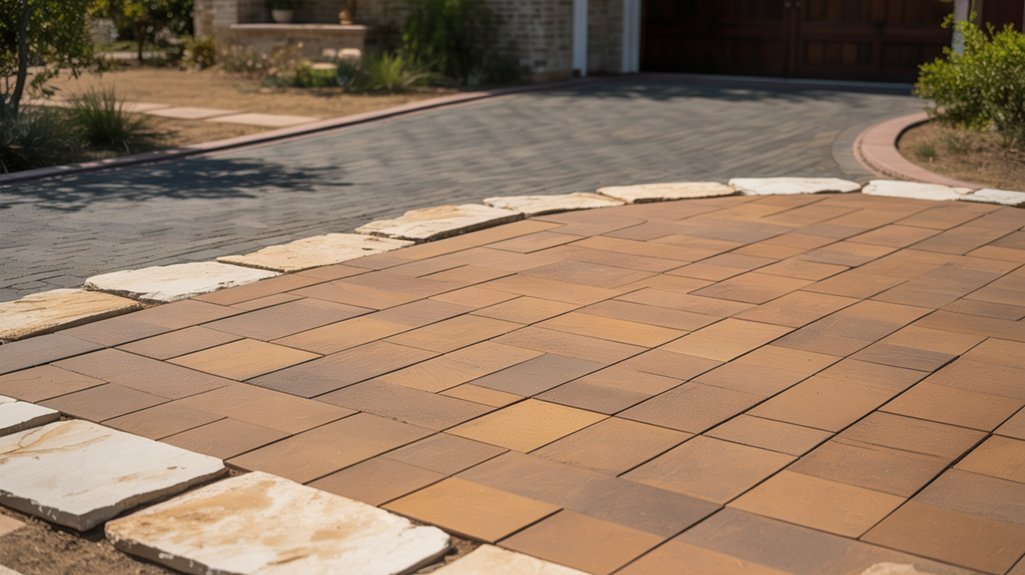
Four principal paver categories serve Texas driveway and patio applications: concrete interlocking pavers, clay brick pavers, natural stone pavers, and permeable interlocking concrete pavement. Expansive clay subgrades and Edwards Aquifer recharge zone impervious cover restrictions in the San Antonio region condition material selection and base preparation requirements across all categories. Pavers are modular surface units installed over engineered aggregate bases to create durable, trafficable finished surfaces for residential and commercial hardscape applications.
Concrete pavers manufactured to ASTM C936 carry an 8,000 psi minimum compressive strength requirement, which gives them the structural reserve to resist the load cycling and thermal stress that Texas driveways routinely impose. Thickness selection follows application: driveway installations require 3.125-inch units to distribute vehicle loads through the bedding layer without rocking or cracking, while 2.375-inch units perform adequately for pedestrian patio surfaces where concentrated point loads aren’t a governing concern. The interlocking profile distributes stress laterally across adjacent units, so the system’s performance depends as much on pattern integrity and edge restraint as on the compressive rating of any individual paver.
ASTM C936 establishes a minimum compressive strength of 8,000 psi for interlocking concrete pavers intended for vehicular and pedestrian applications. This threshold exceeds the compressive demands of residential driveways and patios by a meaningful margin, providing structural reserve against the load cycling and thermal expansion that characterize San Antonio’s climate. The region’s humid subtropical to semi-arid shift produces repeated wet-dry cycles that stress lower-grade concrete products, making the ASTM C936 floor a functional rather than merely regulatory benchmark. Projects within Bexar County’s expansive clay subgrade conditions compound this demand, as subgrade movement exerts lateral and vertical stress on individual paver units that compounds compressive loading.
Concrete interlocking pavers specified for residential driveway installations require a minimum thickness of 3.125 inches, compared with the 2.375-inch units acceptable for pedestrian patio applications. The distinction reflects the difference between static and dynamic load conditions: vehicular axle loads introduce point stresses and repetitive fatigue cycling that thinner units cannot distribute adequately across a bedding layer. In San Antonio’s expansive clay subgrade environment, where subgrade heave and differential settlement compound imposed loads, the additional thickness provides meaningful resistance to unit cracking and edge shear at the paver-to-paver joint. Patio-grade units at 2.375 inches satisfy pedestrian load demands while reducing material weight and cost where vehicle access is absent, making thickness selection a load-classification decision rather than an aesthetic one.
Clay brick pavers carry two governing standards—ASTM C902 for pedestrian applications and ASTM C1272 for heavy vehicular traffic—each of which classifies units by weathering exposure, traffic type, and allowable mechanical variation. Unlike concrete pavers, whose pigment disperses through the mix, clay brick derives its color from the mineral composition of the clay body and the kiln-firing temperature, a process that fixes hue with a permanence that UV exposure, surface wear, and chemical cleaning rarely diminish. San Antonio’s modest freeze-thaw cycling reduces the structural urgency of weathering-grade selection compared with northern markets, though projects at higher Hill Country elevations—where cold-air pooling and radiative frost events are more pronounced—warrant the more protective SX or MX classifications rather than assuming the region’s milder USDA Zone 8 baseline applies uniformly.
ASTM C902 classifies clay pavers into three weathering types—SW, MW, and NW—based on intended exposure conditions, with Type SW requiring a minimum compressive strength of 8,000 psi for applications subject to freezing while wet. ASTM C1272 extends this classification framework to heavy vehicular applications, establishing higher abrasion and strength thresholds appropriate for driveways and trafficked surfaces. In the San Antonio Hill Country corridor, where shallow clay loams over Cretaceous limestone create expansive subgrade conditions, clay pavers offer dimensional stability advantages tied to their fired-ceramic composition, which resists moisture absorption more effectively than unreinforced concrete units. Historic districts within Alamo Heights, Olmos Park, and Terrell Hills frequently specify clay brick pavers to maintain architectural continuity with early twentieth-century streetscape materials already embedded in those neighborhoods.
Clay pavers fired to ASTM C902 Type SW classification retain color integrity through kiln temperatures exceeding 2,000 degrees Fahrenheit, producing iron-oxide pigmentation that is chemically bonded into the ceramic matrix rather than applied as a surface coating. This thermal bonding mechanism distinguishes clay brick from concrete pavers, which rely on mineral oxide admixtures that can fade under prolonged ultraviolet exposure—a meaningful consideration across San Antonio’s 250-plus annual sunshine days. Freeze-thaw cycling in USDA Hardiness Zones 8 and 9 remains comparatively modest, with annual minimum temperatures between 10 and 30 degrees Fahrenheit limiting saturation-expansion stress cycles that cause spalling in lower-rated units. Historic corridors in Alamo Heights and Olmos Park, where early twentieth-century clay streetscape materials have performed across decades of Hill Country thermal swings, provide observable regional evidence of that long-term chromatic durability.
Natural stone and permeable pavers address two distinct pressures that define outdoor installations across the San Antonio region: the aesthetic expectation set by Hill Country limestone architecture and the regulatory constraints imposed by Edwards Aquifer recharge zone impervious cover limits. Limestone, granite, and travertine each carry ASTM classifications that govern their structural suitability for driveway and patio loading, and their selection isn’t simply aesthetic—material density, absorption rate, and surface texture determine how each performs under the region’s freeze-thaw cycling, hail exposure, and expansive clay subgrade movement. Where properties fall within recharge or contributing zones, permeable interlocking concrete pavement shifts from a design preference to a functional necessity, redirecting stormwater through an open-graded aggregate base rather than concentrating runoff that Edwards Aquifer Authority restrictions are specifically structured to prevent.
Texas Hill Country limestone, sourced from the same Cretaceous formations that define the Edwards Plateau geology, meets the dimensional and durability requirements of ASTM C568 when selected at Standard or High grades with minimum compressive strength thresholds of 7,500 and 12,000 psi respectively. That regional geological alignment gives locally quarried stone a material consistency advantage over imported alternatives on projects underlain by Edwards Aquifer karst. Travertine, classified under ASTM C503 as a marble-group stone, introduces open-cell porosity that reduces effective compressive strength and demands resin-filled or honed surfaces to resist the mechanical abrasion of vehicular driveway loading. Granite, governed by ASTM C615 with a minimum compressive strength of 19,000 psi, provides the highest load resistance among natural stone options and performs reliably under the hail and thermal cycling common to USDA Hardiness Zones 8 and 9.
Permeable interlocking concrete pavement (PICP) systems, as defined under ASTM C1782, are recognized by the Edwards Aquifer Authority as a strategy for managing impervious cover calculations on projects within designated recharge and contributing zones. The EAA imposes impervious cover restrictions across the Edwards Aquifer recharge zone to protect the karst infiltration pathways that supply the aquifer, and PICP installations—when designed with open-graded aggregate reservoirs and joint infiltration rates sufficient to meet site hydraulic loading—can qualify for partial or full credit against those thresholds. Aggregate base depths for PICP driveways typically exceed standard PICP patio specifications, with reservoir layers engineered to detention volumes that account for the region’s convective precipitation events, which deliver concentrated rainfall during spring and fall seasons.
Homeowners planning paver projects in San Antonio’s expansive clay terrain consistently raise four questions that shape both design decisions and project budgets. Base depth requirements, recharge zone regulations, long-term material performance under Texas heat and hail, and permit obligations each carry distinct technical and regulatory consequences that vary by site condition, zoning, and intended use. Addressing these questions directly helps clarify where contractor discretion ends and code compliance begins.
Pedestrian patios over expansive clay subgrades in San Antonio require 4–6 inches of compacted base material, while driveways demand 8–12 inches. Base material must be compacted in 3–4 inch lifts reaching 95 percent of modified Proctor density per ASTM D1557. Inadequate base depth on Hydrologic Soil Groups C and D soils accelerates differential settlement and paver displacement.
Permeable pavers are not universally mandated across all Edwards Aquifer recharge zone projects, but impervious cover restrictions administered by the Edwards Aquifer Authority frequently make permeable interlocking concrete pavement the only compliant path forward for larger installations. Site-specific impervious cover thresholds vary by jurisdiction and parcel classification. Projects in Boerne, Fair Oaks Ranch, and unincorporated Bexar County recharge areas should consult EAA guidelines before finalizing hardscape design.
Clay brick pavers rated to ASTM C902 or C1272 and thick-format concrete interlocking pavers meeting ASTM C936’s 8,000 psi minimum consistently outperform alternatives under San Antonio’s hail events and prolonged heat. Natural limestone, while regionally abundant over the Edwards Aquifer formation, can spall under repeated impact. Individual unit replaceability in either system limits long-term repair costs after severe convective storm damage.
Paver driveway installations in San Antonio generally require an impervious cover permit reviewed by the City of San Antonio Development Services Department under the Unified Development Code. Projects within the Edwards Aquifer recharge or contributing zones face additional impervious cover restrictions enforced by the Edwards Aquifer Authority. Permeable interlocking concrete pavement systems can reduce regulated impervious cover calculations for qualifying installations.
Expansive clay subgrades, Edwards Aquifer recharge zone impervious cover restrictions, and SAWS tiered drought protocols collectively shape how paver systems must be specified, bedded, and drained across the San Antonio market. Backyard Paradiso works within these constraints on driveway and patio paver installations throughout Bexar County and the surrounding Hill Country edge, applying base preparation standards and paver selection criteria calibrated to the soil and regulatory conditions that govern long-term performance here. Consultations are available by appointment for properties across The Dominion, Shavano Park, Alamo Heights, Terrell Hills, Boerne, Fair Oaks Ranch, and adjacent estate corridors. Properly specified paver installations in this market return measurable value through functional outdoor square footage, reduced long-term maintenance exposure relative to poured concrete on expansive clay, and documented resale recovery that reflects the durability standards the regional environment demands.