Physical Address
304 North Cardinal St.
Dorchester Center, MA 02124
Physical Address
304 North Cardinal St.
Dorchester Center, MA 02124
Navigating composite deck lifespan in Romeoville's harsh climate depends on surprising variables that could mean the difference between 15 and 30 years.
Capped composite decking, under typical residential conditions, delivers a service life in the range of 25 to 30 years before material degradation warrants replacement. Uncapped composite shortens that window considerably, typically performing reliably for 15 to 20 years before moisture infiltration and UV breakdown accelerate surface deterioration. Pressure-treated lumber operates in a narrower band still, averaging 10 to 15 years under sustained Romeoville freeze-thaw cycling. Composite deck lifespan, however, isn’t solely a product variable. Substructure quality, fastener selection, footing depth, and joist spacing each exert measurable influence on how long the surface material actually performs. The cap layer on premium composite boards does the critical work of resisting both UV degradation and moisture absorption, making that distinction consequential rather than merely commercial.
The Chicago southwest suburbs impose a specific set of performance conditions that compress or extend composite deck service life well beyond what manufacturers project for temperate climates. Romeoville’s clay-loam soil profile introduces frost-heave risk at post footings that must be set below the 42-inch frost line, and any substructure movement that follows an inadequate footing translates directly into deck board stress, fastener loosening, and accelerated surface wear. Capped composite performs measurably better under these conditions than uncapped material, but the substructure carrying it—joist species, joist spacing, and fastener corrosion resistance—ultimately determines whether that surface longevity is realized.
Humid continental climates impose conditions that separate high-performing composite decking installations from marginal ones faster than almost any other regional variable. Romeoville’s freeze-thaw cycling subjects composite deck boards and substructure components to repeated volumetric stress across any given shoulder season, with temperature swings sometimes exceeding forty degrees Fahrenheit within a single day. Capped composite products resist moisture ingress at the cellular level, which limits the expansion-contraction damage that accumulates in uncapped alternatives over successive winters. Clay-loam soil compounds the structural dimension of this equation; frost-heave movement at inadequately deep footings transmits stress directly into framing connections and fastener points. UV exposure throughout extended summers degrades surface chemistry in unprotected boards, accelerating oxidation and color shift in materials that lack a fully encapsulating protective shell.
Three material variables converge in Romeoville-area installations to determine whether a composite deck reaches its rated service life or falls short of it: board construction type, substructure material, and fastener specification. Capped composite decking outperforms uncapped product here because its polymer shell resists moisture intrusion at the board face, a condition that becomes consequential during repeated freeze-thaw cycling. Substructure material matters equally; pressure-treated lumber joists remain common, but their dimensional instability under seasonal moisture variation can stress fastener connections over time. Composite decking service life depends substantially on what supports it. Fastener corrosion, accelerated by road salt migration common to this region’s snowmelt runoff, compromises structural connections before board material degrades. Each variable compounds the others.
Composite deck longevity isn’t determined by the board material alone; the substructure, fastener selection, and footing depth each function as independent variables that either extend or compress the deck’s service life regardless of the surface product’s quality. Joist spacing tolerances matter particularly with composite boards, since spans beyond what the manufacturer specifies produce flex that accelerates surface fatigue at the fastener interface over successive freeze-thaw cycles. Footing depth relative to the regional frost line—42 inches in the Chicago southwest suburbs—controls whether the entire structure shifts seasonally, a movement pattern that stresses both fastener pullout points and the junctions where the deck meets adjacent hardscape elements.
The Chicago southwest suburbs present a particularly demanding performance environment for composite decking, where three independent stressors—freeze-thaw cycling, UV degradation, and substructure variability—operate simultaneously rather than in isolation. Clay-loam soils amplify frost-heave forces, transmitting movement through footings and into the deck frame itself. Composite deck UV exposure accelerates cap layer fatigue, particularly on south- and west-facing surfaces where cumulative radiation loads concentrate. Joist spacing and material selection determine whether the decking board responds to thermal expansion predictably or develops stress concentrations at fastener points. Each variable compounds the others. A properly seated footing doesn’t eliminate cap layer stress; it simply removes one failure pathway. Romeoville installations that perform across decades address all three stressors as a system rather than treating each in sequence.
Substrate instability and environmental exposure define the problem; installation practice determines whether a composite deck absorbs those stresses or fails under them. In Romeoville’s clay-loam soil, frost-line footings must reach sufficient depth to prevent heave from destabilizing the deck substructure seasonally. Joist spacing directly governs board deflection under snow load; tighter spacing becomes non-negotiable with longer board spans. Fastener selection carries equal consequence—corrosion-resistant hardware resists the salt and moisture cycling that degrades standard steel within a few winters. Adequate gapping between boards manages thermal expansion without warping. Drainage slope, typically modest but precise, prevents standing water from compromising ledger connections. Each variable operates in relation to the others; a single compromised element creates cumulative failure disproportionate to its individual significance.
A composite deck rarely functions as an isolated surface; it anchors a broader outdoor living program that typically includes pergolas, outdoor kitchens, fire features, and hardscape changes, each with its own material behavior and maintenance interval. When those adjacent assemblies cycle through freeze-thaw stress at different rates—concrete pavers shifting against a fixed composite perimeter, for instance—the connection details between systems become the first points of cumulative degradation. Recovery planning, consequently, has to account not just for the deck surface itself but for how the performance timeline of each integrated element either compounds or offsets the composite’s projected service life.
Four distinct service categories converge when a composite deck is integrated into an extensive outdoor living program: the deck platform itself, the substructure, the adjacent hardscape, and any covered or enclosed structures that share a connection point with the deck surface. Each category carries its own material lifespan and maintenance interval. When those intervals diverge, the weakest element determines the effective service life of the entire assembly. In Romeoville’s composite deck romeoville corridor, frost-heave displacement in adjacent hardscape can introduce lateral stress at ledger connections, accelerating fastener fatigue independent of deck surface condition. Coordinating these categories during design—rather than treating each as a separate contract scope—preserves material warranties, reduces remediation costs, and keeps the full outdoor living program functioning as a unified system across its intended service horizon.
When composite decking reaches the end of its primary service horizon, the recovery options available to the property owner depend less on the deck surface itself than on the condition of the substructure beneath it. Capped composite decking routinely outlasts the framing assembly it rests on, particularly in Romeoville’s freeze-thaw environment where joist degradation and fastener corrosion advance faster than surface wear. A structurally sound substructure allows board replacement without full demolition. Where framing has failed, however, selective recovery becomes impractical. The broader outdoor living program—pergola attachments, integrated lighting conduit, adjacent hardscape alterations—adds coordination complexity to any phased replacement sequence. Decisions made at original installation, including joist material, footing depth, and connection detailing, ultimately determine whether end-of-service recovery is incremental or wholesale.
Homeowners considering composite decking across estate properties in the Naperville, Wheaton, and Oak Brook corridor tend to circle back to a consistent set of questions once the initial material comparisons settle. Property type shapes the decision considerably—a multi-level deck integrated with an outdoor kitchen and pergola structure carries different substructure demands, snow-load assumptions, and fastener requirements than a ground-level platform adjacent to a patio. Maintenance expectations, footing depth relative to the Romeoville frost line, and the coordination of decking material with adjacent hardscape finishes all bear on the long-term performance calculus in ways that a surface-level product comparison doesn’t fully resolve.
Once the core question of composite deck longevity is answered, several related questions consistently surface—each one probing a different variable that affects how long a deck actually performs in practice. Homeowners considering a composite deck Illinois installation typically ask whether capped or uncapped boards perform meaningfully differently across freeze-thaw cycles. Others ask how substructure material—specifically whether the framing is steel, aluminum, or pressure-treated lumber—affects the deck’s overall lifespan. Footing depth relative to the frost line draws consistent attention, as does the role of fastener corrosion in accelerating board failure. Questions about snow load tolerance, UV-driven fading, and integration with adjacent hardscape features also recur. Each variable operates conditionally, and the answers depend substantially on site-specific exposure, installation quality, and product selection.
Property type shapes the composite deck decision in ways that go well beyond surface area or budget. Estate properties in Oak Brook or Wheaton, where outdoor living programs span multiple levels and integrate with pool surrounds or hardscape, typically favor capped composite over pressure treated because long-term dimensional stability outweighs initial cost differentials at that scale. Modest suburban lots present a different calculus. When deck footprint is limited and replacement cycles align with broader renovation timelines, composite vs pressure treated becomes a genuine cost-benefit question rather than a categorical answer. Commercial-adjacent or rental properties introduce maintenance frequency as the deciding variable. Composite’s reduced upkeep burden carries measurable operational value when owner intervention isn’t readily available across seasonal maintenance windows.
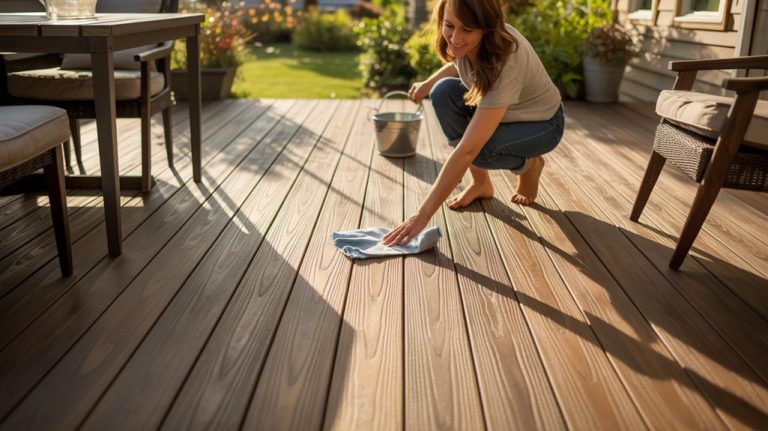
Composite decking demands less maintenance than pressure-treated lumber, but “less” doesn’t mean “none.” Capped composite boards resist moisture absorption and UV degradation more effectively than their uncapped counterparts, yet debris accumulation in the grooves between boards still warrants periodic attention, particularly in climates like Romeoville’s where freeze-thaw cycling can force trapped organic material deeper into fastener channels and board gaps over successive winters. Annual cleaning removes the biological matter that, left unaddressed, accelerates surface staining and compromises drainage pathways. Composite decks with hidden fastener systems require inspection of the substructure annually, as joist-to-beam connections and post-base hardware remain susceptible to corrosion regardless of the decking material above. Snow removal with plastic shovels rather than metal blades preserves the cap layer. Consistent, modest upkeep extends service life considerably.
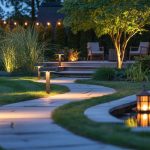
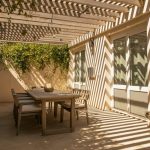
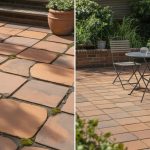
Decks don’t exist in isolation on estate-scale properties in Naperville, Wheaton, and Oak Brook—they anchor multi-level outdoor programs that integrate pergolas, outdoor kitchens, fire features, and hardscape connections into a continuous functional sequence. Composite decks connect effectively into adjacent pavers, concrete, or natural stone, provided expansion gaps accommodate differential movement across seasonal temperature ranges. Thermal cycling affects each material differently. Where a composite deck plane meets a masonry kitchen base or fire feature pad, correctly detailed flashing and drainage geometry prevent moisture accumulation at the junction. Outdoor living Romeoville installations frequently include covered pergola structures attached directly to the deck frame, which introduces point-load and ledger-connection requirements that the substructure must anticipate. Material continuity between decking and surrounding hardscape reinforces spatial coherence across the full outdoor program.
Homeowners in Naperville, Wheaton, Oak Brook, and the Romeoville corridor who are managing composite deck selection, substructure specification, and site integration benefit from working with a contractor whose regional experience accounts for frost-line footing requirements, clay-loam soil behavior, and the thermal cycling demands that distinguish Chicago’s southwest suburbs from milder climates. Backyard Paradiso operates by appointment, which allows project scoping to reflect site-specific conditions rather than standardized packages. Composite decks that perform across a thirty-year service window require decisions made early—footing depth, joist material, fastener specification, and drainage geometry—that can’t be corrected economically after installation. Backyard Paradiso brings that sequencing discipline to each project. Prospective clients can initiate contact through the company’s appointment-based consultation process.