Physical Address
304 North Cardinal St.
Dorchester Center, MA 02124
Physical Address
304 North Cardinal St.
Dorchester Center, MA 02124
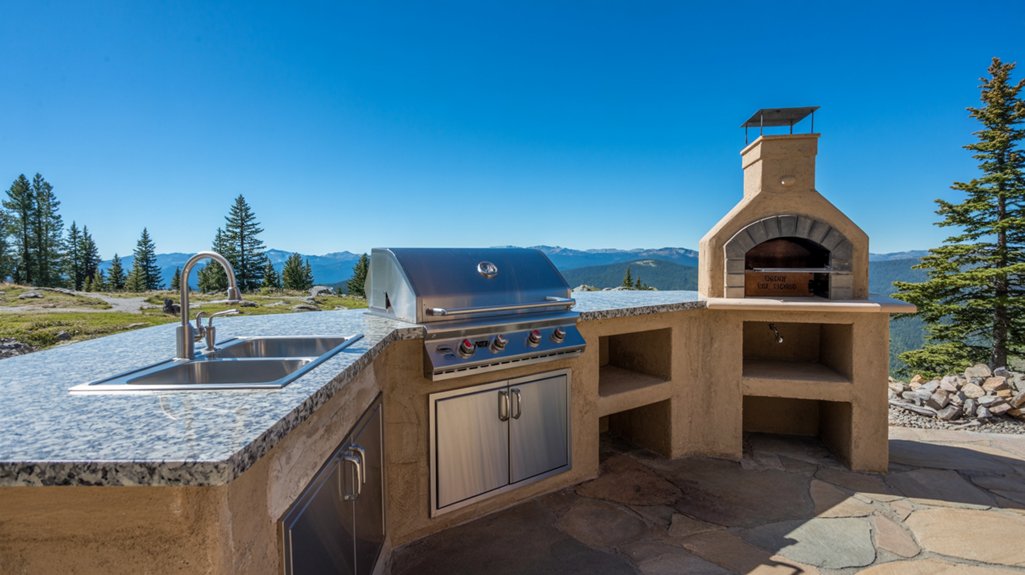
When building an outdoor kitchen at high altitude, the right features make all the difference—discover what actually works.
High-altitude outdoor kitchens perform best when built around altitude-adjusted gas appliances, freeze-thaw-rated countertop materials, and GFCI-protected weatherproof electrical systems. Colorado Springs averages 124 annual freeze-thaw cycles and sits above 6,000 feet, conditions that accelerate material failure and disrupt combustion in unadjusted gas equipment. An outdoor kitchen is a permanently or semi-permanently installed exterior cooking and entertaining structure integrating gas, electrical, and food-preparation systems into a unified outdoor living environment.
At Colorado Springs’ 6,035-foot elevation, reduced atmospheric pressure measurably diminishes available oxygen for combustion, causing gas appliances calibrated for sea-level operation to run rich, soot, and lose BTU output without orifice or regulator adjustment. NFPA 54 and the 2023 PPRBC’s adopted IFGC require that appliance input ratings and gas piping be sized to account for these elevation-adjusted outputs, a requirement that carries direct consequences for line diameter, pressure drop calculations, and total connected load across a full outdoor kitchen suite. Gas line sizing that ignores altitude-corrected BTU ratings risks insufficient pressure at the appliance terminals, particularly when multiple burners, a grill, and a side burner operate simultaneously under peak demand.
NFPA 54 (National Fuel Gas Code) requires that gas appliances installed at elevations above 2,000 feet receive input rating deductions to compensate for reduced atmospheric oxygen availability. At Colorado Springs’ city-center elevation of approximately 6,035 feet, that derating effect is substantial, and installations in higher-elevation communities such as Black Forest—which reaches approximately 7,362 feet—face even greater combustion performance losses. Without high-altitude orifice or regulator adjustments, burners operate with excess fuel relative to available oxygen, producing incomplete combustion, persistent sooting, and flame instability. The 2023 Pikes Peak Regional Building Code adopts the 2021 IFGC, which incorporates NFPA 54 provisions, making altitude-corrected appliance calibration and properly sized gas piping a code compliance requirement—not a discretionary upgrade—for every outdoor kitchen installation in the Pikes Peak region.
Gas piping for outdoor kitchen installations must be sized to accommodate elevation-adjusted appliance input ratings, as required under the 2021 International Fuel Gas Code adopted by the 2023 Pikes Peak Regional Building Code. At Colorado Springs’ city-center elevation of approximately 6,035 feet, high-altitude derating reduces effective BTU output, meaning that total connected load calculations must reflect corrected input values rather than sea-level nameplate ratings. Undersized piping based on unadjusted ratings produces insufficient gas pressure at the appliance manifold, compounding the combustion deficits already introduced by reduced atmospheric oxygen. In higher-elevation communities such as Black Forest, which reaches approximately 7,362 feet, the cumulative effect of derating and pressure drop across undersized runs creates measurable flame instability and increases the risk of incomplete combustion across multi-burner configurations.
Electrical and structural performance in Pikes Peak region outdoor kitchens depends on adherence to standards that reflect the area’s specific environmental exposure. NEC 210.8 mandates GFCI protection for all outdoor receptacles, and weather-resistant devices with in-use covers address the moisture conditions that Colorado Springs’ 124 annual freeze-thaw cycles impose on exterior installations. Structural framing must account for PPRBD’s 130 mph Vult design wind speed and a ground snow load of 43 psf below 7,000 feet—rising to 57 psf at elevations that include Black Forest—while cabinet cladding in ASTM A240 austenitic grades 304 or 316 resists the corrosion that freeze-thaw cycling and seasonal moisture accelerate in exposed metalwork.
NEC 210.8 mandates ground-fault circuit-interrupter protection for all outdoor receptacles installed in backyard kitchens, a requirement adopted in full under the 2023 Pikes Peak Regional Building Code. This provision applies regardless of receptacle height or proximity to a covered structure, meaning every outlet serving an outdoor kitchen island, refrigeration unit, or lighting circuit in Colorado Springs falls under mandatory GFCI compliance. Structural demands in the region are equally non-negotiable: the Pikes Peak Regional Building Department specifies a design wind speed of 130 mph Vult under a three-second gust at Exposure Category C, per ASCE 7-16. Masonry-anchored frames, post bases, and pergola connections must be engineered to resist lateral loads derived from that threshold, coordinated with a ground snow load of 43 psf below 7,000 feet or 57 psf at or above that elevation.
The Pikes Peak Regional Building Department specifies a ground snow load of 43 psf for sites below 7,000 feet and 57 psf at or above that elevation, figures that govern structural sizing for all pergola rafters, canopy framing, and horizontal shade structures in Colorado Springs outdoor kitchens. These thresholds, derived from ASCE 7-16 and adopted under the 2023 Pikes Peak Regional Building Code, require that cover structures over cooking areas be engineered for cumulative dead, live, and snow load combinations rather than snow alone. Cabinet enclosures exposed to that same environment are specified in austenitic stainless steel grades 304 or 316 per ASTM A240, materials selected to resist surface oxidation through 124 annual freeze-thaw cycles without dimensional distortion that would compromise door alignment or drawer clearance.
Colorado Springs’ 124 annual freeze-thaw cycles place sustained mechanical stress on masonry countertops, stone veneers, and foundation systems, particularly where expansive Pierre Shale underlies the site—a condition prevalent enough that the PPRBD mandates a site-specific soils report at first inspection. That shale’s volumetric instability under moisture fluctuation compounds frost-heave risk at the 38-inch frost line, making foundation design consequential for the long-term dimensional stability of any countertop or structural assembly above it. Outdoor refrigeration and ventilation equipment face a parallel constraint: at elevations ranging from 6,035 feet in the city center to roughly 7,362 feet in Black Forest, reduced atmospheric pressure affects compressor efficiency and combustion-dependent ventilation performance in ways that require altitude-rated equipment specifications rather than sea-level defaults.
The Pikes Peak Regional Building Department mandates a site-specific soils report at first inspection for outdoor construction projects across El Paso County due to the widespread presence of expansive Pierre Shale. This requirement directly affects foundation design for outdoor kitchen structures, as Pierre Shale can undergo significant volume change with moisture fluctuation, destabilizing footings and the masonry or stone counter assemblies attached to them. Compounding this challenge, the Colorado Springs region experiences approximately 124 annual freeze-thaw cycles, placing sustained mechanical stress on countertop materials and mortar joints. Stone and masonry surfaces must be selected and detailed for freeze-thaw durability, with frost line depth set at 38 inches, requiring footings to extend well below grade to prevent heave-driven structural movement.
Outdoor refrigeration units installed in Colorado Springs operate at a mean elevation of 6,035 feet, where reduced atmospheric pressure lowers the heat transfer efficiency of standard compressor-based cooling systems calibrated for sea-level conditions. At this elevation, ambient air density is measurably lower, reducing the capacity of condenser coils to shed heat, which can elevate compressor cycling frequency and shorten equipment service life. Black Forest installations face compounded stress, given elevations approaching 7,362 feet and the region’s approximately 124 annual freeze-thaw cycles, which subject refrigeration door gaskets, drain lines, and exterior cabinetry to sustained thermal expansion and contraction. Specifying units rated for high-altitude operation and housing them within ventilated enclosures built from austenitic stainless steel—grade 304 or 316 per ASTM A240—directly addresses both the thermodynamic and material durability demands of the Pikes Peak region.
Homeowners planning a backyard kitchen in Colorado Springs consistently raise the same practical concerns: whether gas appliances need altitude adjustments, which stainless steel grade holds up over time, whether PPRBD requires a permit, and how regional snow loads shape structural decisions. Each question carries real consequence for long-term performance and code compliance. The answers depend on site-specific conditions—elevation, neighborhood, and appliance configuration—that vary meaningfully across the Pikes Peak region.
Gas grills installed in Colorado Springs require high-altitude orifice or regulator adjustments due to reduced atmospheric oxygen at elevations averaging 6,035 feet. Lower air pressure disrupts air-to-fuel ratios, causing sooting, incomplete combustion, or flame instability in appliances calibrated for sea-level output. The 2023 Pikes Peak Regional Building Code, referencing NFPA 54 and the IFGC, governs compliant gas appliance installations throughout El Paso County.
Grade 316 stainless steel is the recommended choice for outdoor kitchen cabinetry and components in the Pikes Peak region. The addition of molybdenum in 316 provides superior resistance to chlorides and oxidation compared to grade 304, which becomes relevant given Colorado Springs’ 124 annual freeze-thaw cycles and deicing chemical exposure. Backyard Paradiso specifies both grades per ASTM A240 standards, with 316 preferred for high-exposure installations.
Backyard kitchens in Colorado Springs require permits from the Pikes Peak Regional Building Department when construction involves gas lines, electrical work, or permanent structural elements. The 2023 Pikes Peak Regional Building Code, adopting the 2021 IRC and IFGC, governs these installations as the sole authority having jurisdiction. PPRBD inspections also trigger mandatory site-specific soils reports given the prevalence of expansive Pierre Shale across El Paso County.
Snow load is a primary structural design factor for outdoor kitchen roofing and overhead structures in Colorado Springs. The Pikes Peak Regional Building Department specifies 43 psf ground snow load below 7,000 feet and 57 psf at or above 7,000 feet, with Black Forest installations subject to the higher threshold. Structural framing, post sizing, and footing design must account for these loads under the 2023 PPRBC.
Altitude-adjusted combustion performance, freeze-thaw durability across 124 annual cycles, expansive Pierre Shale soil conditions, and the 2023 Pikes Peak Regional Building Code‘s adopted IFGC and NEC 2023 requirements collectively define the engineering baseline for outdoor kitchen features installed across the Colorado Springs metropolitan area. Backyard Paradiso works within this specific regulatory and environmental framework across the region’s estate corridors, bringing field familiarity with high-altitude appliance calibration and site-specific permitting to each outdoor kitchen installation. Consultations are available by appointment for properties throughout Flying Horse, Broadmoor, Black Forest, Wolf Ranch, Kissing Camels, and surrounding Pikes Peak communities. Investments in compliant, altitude-rated outdoor kitchen systems consistently return functional outdoor living square footage that extends the home’s usable footprint and supports long-term resale recovery across Colorado Springs’ competitive residential market segments.