Physical Address
304 North Cardinal St.
Dorchester Center, MA 02124
Physical Address
304 North Cardinal St.
Dorchester Center, MA 02124
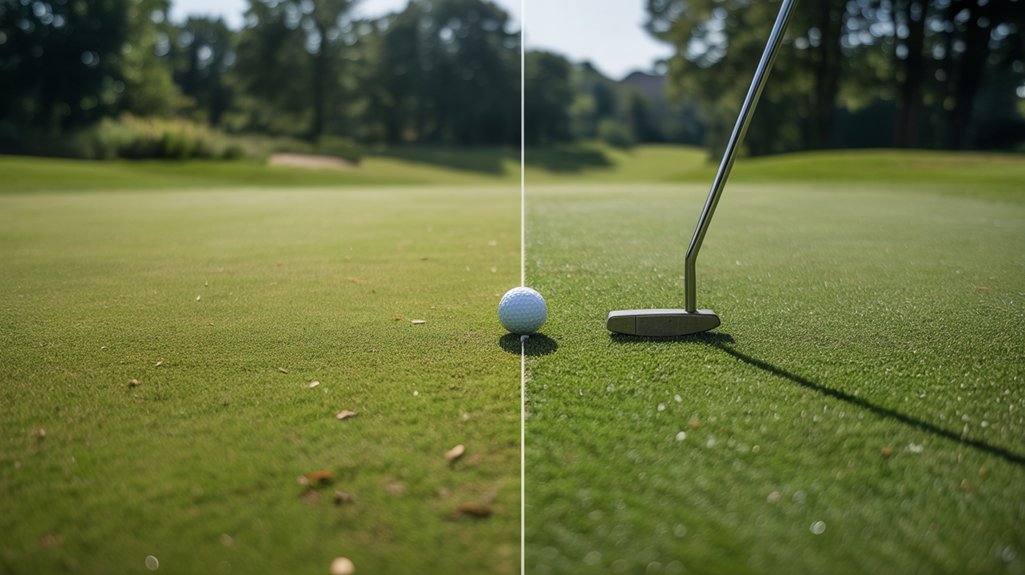
Uncover which putting green surface truly delivers better performance, lower maintenance, and lasting playability for your home golf setup.
Synthetic putting turf outperforms natural grass for most home golf installations in Orlando’s humid subtropical climate, where heat, persistent moisture, and UV intensity make a living green difficult to sustain at true playing quality. Performance depends on base compaction meeting ASTM D1557 standards and infill depth calibrated for consistent ball roll. Synthetic putting turf is a short-pile, high-stitch-density surface engineered to replicate the speed and roll characteristics of a maintained golf green without ongoing agronomic intervention.
A natural grass putting green isn’t simply planted and maintained like a lawn; it demands a sustained agronomic program — precise mowing heights, topdressing schedules, irrigation cycles, and chemical inputs — calibrated to hold the surface density and smoothness that produce true ball roll. Orlando’s climate compounds every variable: the humid subtropical conditions that characterize Central Florida sustain fungal pressure, accelerate thatch development, and stress cool-season grasses beyond their viable range, while the summer wet season introduces moisture loads that disrupt surface consistency faster than routine maintenance can correct. What a natural green requires, in this region, is effectively a professional-grade upkeep commitment that most residential sites can’t reliably sustain.
Maintaining a bentgrass putting green at regulation speed requires mowing to a height between 0.100 and 0.125 inches, a cutting frequency that demands near-daily attention during the growing season. At that height, the turf becomes physiologically vulnerable, requiring precise irrigation scheduling, frequent topdressing with sand to maintain surface firmness, and a structured chemical program addressing fungal pressure, insect damage, and weed competition. In Orlando’s humid subtropical climate, where summer temperatures regularly exceed 90°F and humidity accelerates disease cycles, that maintenance window narrows considerably. The agronomic burden is continuous rather than seasonal, and any lapse in the program — missed mowing, deferred topdressing, or an untreated disease outbreak — degrades ball roll and surface consistency in ways that take weeks to correct.
Central Florida’s summer wet season delivers relative humidity levels that regularly exceed 90 percent during overnight hours, sustaining the prolonged leaf wetness that accelerates fungal disease cycles on closely mown turf. At the mowing heights required for true roll — between 0.100 and 0.125 inches — bentgrass and similar cool-season grasses lose the canopy density that buffers against pathogen pressure, leaving them acutely vulnerable during Orlando’s June-through-September monsoon pattern. Pythium blight, dollar spot, and brown patch can progress from early symptom to severe stand loss within 48 to 72 hours under these conditions, compressing the treatment window to a point where a single missed fungicide application carries measurable consequences. Nematode pressure in Central Florida’s sandy soils adds a second biological stressor that natural-grass green managers must monitor and address through separate chemical protocols.
Synthetic putting turf’s performance derives from two interdependent variables: pile height and stitch density set the surface geometry that governs how a ball releases and tracks, while sand infill depth calibrates the resistance that translates directly into speed and trueness of roll. Where pile runs short and dense, ball contact stays consistent across the surface rather than varying with fiber deflection. ASTM F1551 provides the characterization framework through which these properties are measured and verified, anchoring performance claims to repeatable, condition-specific data rather than manufacturer assertion.
ASTM F1551 establishes the characterization testing framework used to evaluate playing-surface properties of synthetic putting turf, including ball-roll distance and surface pace. A short, dense pile height combined with precisely calibrated sand infill creates the low-friction, consistent surface that determines how a putted ball behaves from contact through its full travel path. Infill depth is not incidental — small variations in sand level alter both the effective pile height and the degree of fiber support underfoot, shifting ball speed in measurable increments. The result is a surface whose pace and trueness are set during installation and maintained through periodic grooming and infill redistribution rather than through the agronomic interventions a natural grass green demands continuously.
ASTM F1551 is the named characterization standard governing the measurement of playing-surface properties for synthetic putting turf, including ball-roll distance, surface pace, and related performance metrics. The standard establishes a repeatable testing framework that translates installation variables — pile height, fiber density, and sand infill depth — into documented surface behavior rather than subjective assessment. Because infill calibration and fiber geometry together determine how a putted ball decelerates across the surface, F1551 testing provides the technical baseline against which a finished green can be evaluated and, where needed, adjusted through grooming or infill redistribution. This framework is particularly relevant in Orlando’s climate, where heat and humidity accelerate fiber wear and infill migration, making periodic verification against documented performance baselines a functional maintenance consideration rather than a formality.
Orlando’s climate doesn’t forgive a poorly engineered base. Central Florida’s wet season delivers near-daily thunderstorms across a compressed window, and without a compacted aggregate foundation graded to carry water away from the surface, standing water compromises both playability and long-term fiber integrity. UV-stable fiber compounds and secure perimeter anchoring address the region’s high ultraviolet load and inland wind exposure, conditions that accelerate degradation in materials specified for temperate markets.
Orlando receives between 50 and 60 inches of annual rainfall, concentrated in a summer wet season characterized by near-daily thunderstorms that can deposit several inches of water within hours. Without a properly engineered sub-base, that volume saturates the ground beneath a putting surface and renders it unplayable or structurally unstable for days at a time. ASTM D1557 establishes the compaction benchmark that addresses this risk directly: a crushed-aggregate base layer of approximately three to four inches, compacted to 90 to 95 percent of modified Proctor density, creates the load-bearing platform and drainage gradient that channels storm runoff away from the surface. Integrating that base into the site’s broader stormwater plan keeps a synthetic putting green puttable within hours of even the heaviest wet-season rain.
Central Florida’s position within USDA Hardiness Zones 9b to 10a places synthetic turf fiber under sustained ultraviolet exposure that accelerates degradation in non-UV-stabilized materials, making UV-stable fiber a functional specification rather than an optional upgrade. Orlando logs over 230 sunny days annually, according to NOAA climate normals, sustaining cumulative solar load that breaks down unstabilized polymer fibers over time, reducing both surface consistency and fiber integrity. Wind detailing carries equal weight: inland hurricane exposure requires perimeter securing and seam construction capable of resisting uplift forces. Together, UV-stable fiber selection and mechanically anchored perimeter detailing extend surface life and preserve the ball-roll characteristics that ASTM F1551 characterization testing is designed to measure and verify.
Homeowners weighing a putting surface against Orlando’s climate, HOA constraints, and year-round use patterns tend to surface the same practical questions. Synthetic putting turf holds a clear advantage in Central Florida’s humid subtropical conditions, where heat, rainfall, and pest pressure make a natural grass green resource-intensive to sustain at any functional standard of play. Infill type and depth govern ball-roll speed and surface consistency on a synthetic green, while a properly engineered base keeps the wet-season rainy season from interrupting use — the defining measure of value in a market where usable hours matter more than calendar aesthetics.
For most home installations, synthetic putting turf outperforms natural grass in consistency, durability, and year-round usability. Climate conditions, particularly in humid subtropical regions like Orlando, make natural greens resource-intensive and prone to weather-related closures. Synthetic surfaces remain puttable after heavy rain and through summer heat, substantially increasing playable hours across the calendar year.
Natural grass putting greens in Orlando demand daily or near-daily mowing, frequent irrigation, topdressing, aerification, and ongoing fungicide and pesticide programs to remain playable. Central Florida’s humidity and heat accelerate disease pressure, compressing the margin for any lapse in the agronomic calendar. Communities like Bay Hill and Windermere, where golf-adjacent estates are common, reflect how rarely homeowners sustain that regimen long-term.
Sand infill depth and particle size are the primary variables controlling ball roll speed and consistency on a synthetic putting green. Finer, shallower infill produces a truer, faster roll, while coarser or deeper fills slow the surface and dampen response. Periodic leveling restores uniformity after traffic and weather redistribution, a grooming task replacing the topdressing calendar a natural green demands.
Synthetic putting turf handles Orlando’s rainy season reliably when installed over a properly engineered base. A compacted aggregate foundation of three to four inches, graded to drain into the site’s stormwater plan, prevents surface pooling during the wet season’s near-daily thunderstorms. Backyard Paradiso’s Orlando office routinely addresses these drainage specifications during consultation for estate properties throughout Windermere, Lake Nona, and Dr. Phillips.
Synthetic putting green installations in Central Florida must meet a compacted aggregate base held to 90–95 percent of modified Proctor density per ASTM D1557, surface drainage integrated into the site stormwater plan, UV-stable fiber specified against the region’s sustained ultraviolet load, and playing-surface properties evaluated against ASTM F1551 benchmarks. Backyard Paradiso brings demonstrated command of those engineering and performance requirements to synthetic putting green installations across Orlando’s varied residential geographies. The firm consults by appointment, extending its work into communities across Winter Park, Windermere, Lake Nona, Dr. Phillips, Bay Hill, Baldwin Park, and the country-club corridors reaching Heathrow and ChampionsGate. For properties governed by architectural-review committees in these neighborhoods, that technical fluency carries practical weight at the permit and approval stage. A well-executed synthetic green returns usable hours through Orlando’s wet season and peak summer heat that a natural grass surface, under the same conditions, would rarely deliver.