Physical Address
304 North Cardinal St.
Dorchester Center, MA 02124
Physical Address
304 North Cardinal St.
Dorchester Center, MA 02124
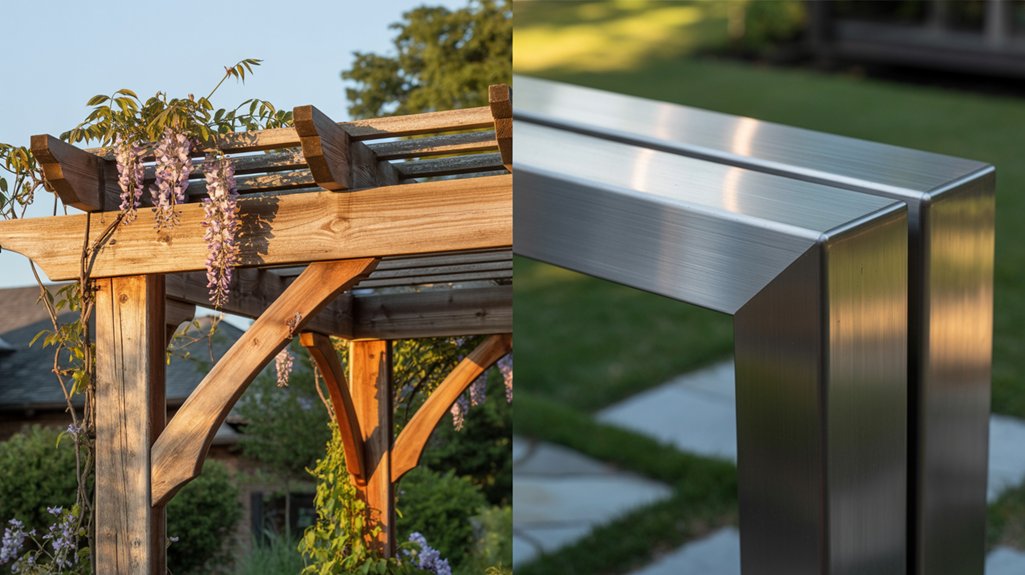
Wooden and aluminum pergolas each have surprising strengths and weaknesses that could make or break your outdoor investment.
Aluminum outperforms wood in pergola construction across durability, structural integrity, and long-term maintenance demands. In freeze-thaw climates like Romeoville, Illinois, where seasonal moisture cycling accelerates rot, warping, and checking in timber, aluminum’s corrosion-resistant oxide layer and engineered snow load capacity make it the more reliable structural choice. A pergola is an open-framework overhead structure designed to define outdoor living space while supporting shade, climbing plants, or attached roofing elements.
Aluminum’s structural edge over wood begins at the molecular level: the metal’s self-protective oxide layer renders it immune to rot, insect damage, and moisture-driven warping that progressively compromise timber under seasonal freeze-thaw cycling. Extruded from architectural alloys such as 6005A-T5 and 6063, aluminum pergola members hold their dimensions across decades without the recurrent sealing and staining that wood demands simply to remain structurally sound. That dimensional stability isn’t incidental — it’s what allows engineers to specify aluminum framing to the Aluminum Design Manual with confidence that the as-built geometry won’t drift from the design geometry over the structure’s service life.
| Property | Aluminum pergola | Wood pergola |
|---|---|---|
| Corrosion, rot, and dimensional stability | Self-protecting oxide; will not rot, warp, or rust | Subject to rot, warping, checking, and insect attack |
| Structural design basis | Extruded alloys (e.g., 6005A-T5, 6061-T6); designed to the Aluminum Design Manual and ASCE 7-22 | Graded dimension lumber; heavier sections for equal span |
| Maintenance | Periodic cleaning | Recurring sealing or staining |
| Recyclability | Infinitely recyclable (recycled-content claims per FTC Green Guides) | Renewable material; not reusable as a structural section |
Aluminum alloys used in structural pergola framing, including 6063 and 6061-T6, form a self-protecting oxide layer that prevents corrosion without ongoing surface treatment. This passive oxidation mechanism means the underlying metal does not progress to structural degradation the way ferrous metals do, and powder-coat or anodized finishes extend surface appearance further without functioning as the primary corrosion barrier. Wood, by contrast, is subject to moisture-driven rot, seasonal checking, and dimensional warping when protective coatings fail or maintenance lapses. In a climate like Romeoville’s, where freeze-thaw cycling accelerates moisture infiltration into exposed grain, dimensional instability in timber pergola members is an expected maintenance outcome rather than an exceptional failure condition.
Structural aluminum pergola extrusions are engineered to the Aluminum Design Manual (ADM 2020), with members commonly specified from alloys such as 6005A-T5, 6061-T6, 6063, and 6082-T6 per ASTM B221. These alloys are selected for their combination of extrudability and structural efficiency, allowing complex cross-sectional profiles that optimize moment of inertia without adding dead load. Aluminum pergola systems typically impose a dead load of 3 to 8 psf, a range that permits longer clear spans than equivalent timber sections would allow under the same loading conditions. Wood cannot match this performance consistency because its structural properties vary with grain orientation, moisture content, and species — variables that aluminum extrusion eliminates through controlled alloy composition and temper designation.
Structural performance under snow and wind loads separates aluminum from wood most decisively, because aluminum’s strength-to-weight ratio allows longer clear spans without the section depths that timber requires to resist equivalent forces. Both materials answer to ASCE/SEI 7-22, which governs ground snow load under Chapter 7 and wind pressure under Chapters 26 through 30 — the same load basis that drives beam and post sizing in high-snow markets like Romeoville, where freeze-thaw cycling compounds seasonal structural demand. Aluminum’s light dead load, typically 3 to 8 psf, means the frame doesn’t compete against itself the way heavier timber assemblies do, leaving more structural capacity available for the live loads that jurisdictional maps and site conditions actually impose.
ASCE/SEI 7-22 establishes the snow and wind load criteria that govern structural sizing for pergolas in Romeoville, Illinois, where ground snow loads from Chapter 7 and wind provisions from Chapters 26 through 30 represent the controlling design conditions. Illinois freeze-thaw cycling compounds snow load demands, requiring beam and post sections sized beyond what many warmer-climate installations require. Aluminum pergola members extruded from alloys such as 6005A-T5 and 6061-T6 and specified to ASTM B221 are engineered under the Aluminum Design Manual (ADM 2020) to meet these combined demands, while wood members of equivalent dimension carry greater dead load and are subject to section loss from decay and checking that degrades their load-carrying capacity over time. The structural distinction between the two materials becomes most consequential under accumulated snow.
Aluminum’s strength-to-weight ratio allows structural pergola members extruded from alloys such as 6061-T6 and 6005A-T5 to achieve longer clear spans than timber sections of equivalent cross-sectional dimension. Dead loads for aluminum pergola systems typically fall between 3 and 8 psf, a range low enough that beam and post sizing is governed by applied snow and wind loads rather than the self-weight of the structure itself. In Romeoville, where ASCE/SEI 7-22 Chapter 7 ground snow loads and freeze-thaw cycling control design, that reduced dead load margin translates directly into available structural capacity for accumulated snow. Wood members of equivalent dimension carry greater dead load and are subject to progressive section loss from decay, checking, and insect damage — conditions that erode load-carrying capacity in ways that aluminum, dimensionally stable under its protective oxide layer, does not experience.
Finish quality determines how much maintenance a pergola actually requires over its service life, and aluminum frames coated to AAMA 2604 or 2605 standards resist chalking, fading, and adhesion loss under sustained UV and moisture exposure — conditions that strip untreated or under-maintained wood of both its protective layer and structural integrity. Wood demands recurring sealing or staining cycles to hold dimensional stability and resist decay, while a properly finished aluminum frame needs little more than periodic cleaning. Aluminum’s recyclability adds a long-term material advantage, though any recycled-content claims remain subject to FTC Green Guides substantiation requirements.
AAMA 2605 sets a minimum 70 percent polyvinylidene fluoride (PVDF) resin content requirement for architectural coatings and mandates that compliant finishes retain color and gloss through accelerated weathering equivalent to five years of Florida exposure testing. This threshold matters in freeze-thaw markets such as Romeoville, Illinois, where seasonal temperature cycling creates thermal expansion stress that lower-grade coatings — those meeting only the less demanding AAMA 2604 standard — cannot sustain across a comparable service life. AAMA 2604 coatings carry a minimum five-year performance expectation, whereas AAMA 2605 coatings are warranted for periods commonly reaching ten to fifteen years in field applications. An aluminum pergola finished to AAMA 2605 consequently enters service with a chemically bonded, dimensionally stable surface layer that requires no repainting, no staining, and no periodic sealing of the kind that wood pergolas demand every one to three years.
Aluminum is classified as infinitely recyclable by the Aluminum Association, with recycled aluminum requiring approximately 95 percent less energy to produce than primary metal refined from bauxite ore. This characteristic extends beyond environmental accounting and into long-term material performance: an aluminum pergola frame retains full structural and finish integrity across decades without the intervention that wood demands. Where a wood pergola requires sealing or staining on a one-to-three-year cycle to resist moisture-driven rot, checking, and insect attack, a powder-coated or PVDF-finished aluminum frame — particularly one finished to AAMA 2605 — requires only periodic cleaning to maintain its appearance and corrosion resistance. In a freeze-thaw market such as Romeoville, Illinois, that maintenance differential compounds over the service life of the structure.
Homeowners comparing wooden and aluminum pergolas tend to raise the same practical questions: how long will it last, how much can it carry, and how much ongoing attention does it require. Aluminum’s oxide layer resists corrosion without periodic sealing or staining, while wood’s service life depends almost entirely on whether that maintenance cycle holds. Snow capacity isn’t incidental — aluminum pergola systems engineered to ASCE/SEI 7-22 ground snow load criteria accommodate the accumulation conditions common to Illinois winters, which timber sections of comparable dimension often can’t match without upsizing.
Aluminum pergolas reliably outlast wood in most residential applications, resisting rot, insect damage, warping, and corrosion without the recurring maintenance that timber demands. Longevity depends on finish quality, with powder-coated or anodized aluminum frames performing best across decades of freeze-thaw cycling. In markets like Romeoville, where Illinois snow loads and moisture conditions accelerate wood deterioration, aluminum’s dimensional stability represents a measurable structural advantage.
Aluminum pergolas are not universally stronger than wood, but they deliver a superior strength-to-weight ratio that enables longer clear spans with lighter structural members. Alloys such as 6061-T6 and 6005A-T5 are engineered to the Aluminum Design Manual, while timber performance degrades over time through rot, warping, and insect damage. Backyard Paradiso specifies aluminum framing precisely because its structural integrity remains consistent under Illinois snow and wind loading across decades.
Aluminum pergolas require minimal maintenance compared to wood structures. Powder-coated or anodized aluminum forms a self-protecting oxide layer that resists corrosion, warping, and rot without recurring sealing or staining cycles. Periodic cleaning is generally sufficient to preserve the finish, making aluminum the lower-maintenance choice for Romeoville’s freeze-thaw climate.
Aluminum pergolas are engineered to handle snow loads when designed to ASCE/SEI 7-22 Chapter 7 ground snow load requirements. Jurisdiction-specific snow load values govern beam and post sizing, making local code adoption maps the controlling reference. In Romeoville, Illinois freeze-thaw cycling and regional ground snow loads are primary structural design drivers for any aluminum pergola installation.
Romeoville’s proximity to the DuPage River corridor and its established subdivisions along Weber Road and Normantown Road place residential lots within Illinois snow load and freeze-thaw cycling conditions that directly shape how outdoor structures must be engineered and specified. Backyard Paradiso installs aluminum pergolas across these corridors, applying load determinations under ASCE/SEI 7-22 and alloy specifications drawn from architectural extrusion standards to meet the structural demands those site conditions impose. Consultations are available by appointment for homeowners evaluating aluminum pergola installation, and the conversation typically addresses how a properly engineered aluminum structure recovers value as functional outdoor square footage rather than as a maintenance liability. Backyard Paradiso extends the same installation approach to neighboring markets including Bolingbrook, Plainfield, Joliet, and Naperville, where comparable regulatory environments and seasonal load conditions make the aluminum-over-wood case on the same performance terms.