Physical Address
304 North Cardinal St.
Dorchester Center, MA 02124
Physical Address
304 North Cardinal St.
Dorchester Center, MA 02124
On their own, pergolas may not provide enough shade—but the right roof type and enhancements can make all the difference.
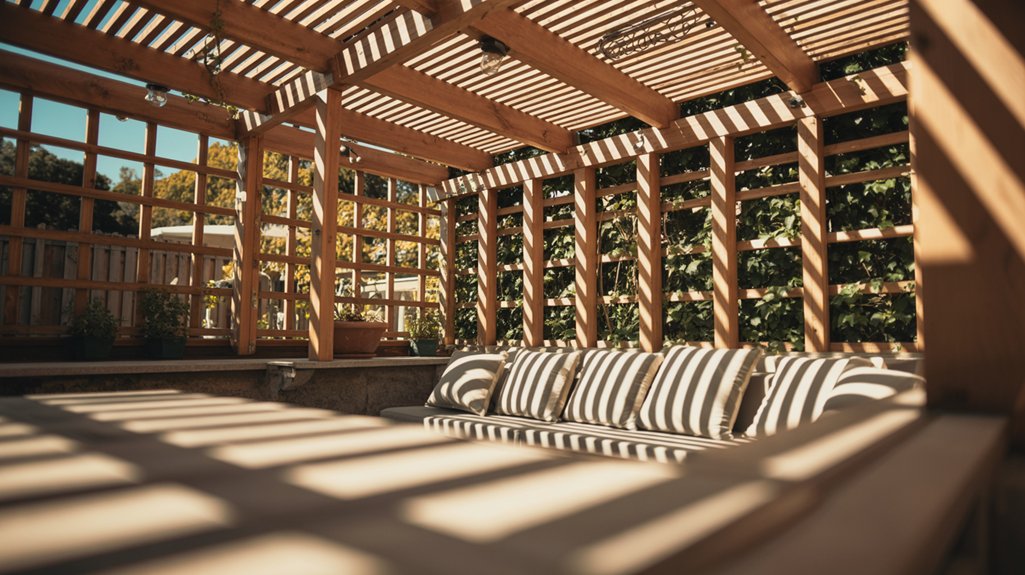
How much shade a pergola provides depends entirely on its roof type, not the structure itself. In high-sun climates like Naples, a fixed open-lattice roof delivers only dappled, shifting shade, while a louvered or solid-roof system provides adjustable or complete coverage. A pergola is an aluminum outdoor structure whose shade performance is determined by whether its roof is fixed-slat, motorized louvered, or solid.
Shade performance in a pergola isn’t a single variable — it’s almost entirely a function of roof type, and the three aluminum configurations Backyard Paradiso builds each produce meaningfully different outcomes. An open-lattice or fixed-slat roof casts dappled, shifting shade determined by the ratio of slat width to gap, a coverage pattern that weakens considerably when the sun climbs high overhead, as it does reliably in a low-latitude market like Naples. A motorized louvered roof rotates its blades from fully open to fully closed on demand, giving the owner direct control over shade density throughout the day, while a solid aluminum roof eliminates that variable entirely by delivering constant, weather-resistant coverage regardless of sun angle.
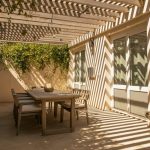
A fixed-slat aluminum pergola roof delivers shade coverage determined by the ratio of slat width to the gap between slats, a proportion that sets a hard ceiling on how much direct solar radiation the structure intercepts at any given moment. Because that shadow plane is static, the pattern shifts continuously as the sun moves across the sky, producing dappled, mobile coverage rather than consistent block shade. In Naples, Florida, where NOAA climate normals document exceptionally high solar angles at midday during summer months, a fixed-slat roof intercepts the least radiation precisely when thermal load is greatest, as overhead sun passes through gaps with minimal obstruction. Orientation can be specified to favor shade at a particular hour, but no fixed-slat configuration compensates for the geometry of a near-vertical sun angle.
A motorized louvered-roof pergola shifts from an open structure governed by ASCE 7-22 Chapter 29 to a configuration with solid-roof pressure coefficients as its blades rotate toward the closed position, requiring the supporting structure to be engineered for the worst-case louver angle. This mechanical range gives the owner on-demand control over shade intensity, from fully open sky to a substantially closed surface that blocks direct solar radiation across the entire roof plane. In a high-sun market such as Naples, Florida, where midday solar angles render fixed slats least effective at peak thermal load, that adjustability is the functional distinction that determines whether a pergola delivers meaningful shade. A solid-roof aluminum pergola removes the variable entirely, providing full, constant overhead coverage and weather protection regardless of sun angle or time of day.
Slat width relative to gap determines the fraction of sunlight a fixed-lattice roof intercepts, but orientation determines when that fraction actually reaches the space below. A pergola oriented to maximize coverage during morning or late-afternoon hours will underperform at midday in a high-sun latitude like Naples, where the sun climbs steeply enough to pass between fixed slats with minimal obstruction. A motorized louvered roof sidesteps that constraint entirely, allowing blade angles to track shifting sun positions across the day rather than committing to a single shading condition.
Slat orientation relative to true south determines at which hour of day an open-lattice pergola delivers its maximum shadow coverage on the surface below. When fixed aluminum slats run east-to-west, they intercept the sun most effectively during the morning and late-afternoon arcs, but overhead midday sun passes through the gaps at a steep angle, reducing shade substantially. In Naples, Florida, where solar altitude at summer solstice noon exceeds 83 degrees above the horizon based on NOAA solar position data for that latitude, the gap-to-slat ratio becomes the critical variable — wider gaps produce proportionally more direct sunlight penetration precisely when heat gain is greatest. Rotating the slat axis or adjusting spacing narrows the window of effective coverage without eliminating the underlying geometric limitation.
A motorized louvered-roof pergola allows blade rotation across a full 0-to-150-degree arc, enabling the owner to track solar position from morning through afternoon by adjusting louver pitch incrementally throughout the day. Unlike fixed-slat systems, where shade coverage is locked to a single geometric relationship between slat width and gap, adjustable louvers maintain effective interception regardless of solar altitude. In Naples, Florida, where NOAA solar position data places the summer solstice noon sun above 83 degrees of elevation, this matters considerably — a fixed roof cannot respond to that angle, but a louvered system closed to a near-horizontal pitch blocks near-vertical midday radiation directly. When blades reach full closure, the roof shifts toward solid-surface wind loading behavior governed by ASCE 7-22, requiring structural design to account for elevated pressure coefficients at that louver position.
The roof plane itself doesn’t always define the practical limit of a pergola’s shade coverage, particularly where low-angle morning and afternoon sun enters laterally beneath the structure. Integrated motorized screens — often zip-track systems that tension fabric within a channeled frame — extend protection to the sides, and canopy or fabric elements can supplement fixed or louvered roofs where partial coverage would otherwise leave occupants exposed. One structural variable worth noting is that a louvered roof’s wind classification shifts as its blades rotate: fully open, the system behaves as an open structure, while fully closed, it attracts the higher pressure coefficients associated with a solid roof, which means the underlying frame must be engineered for the worst-case louver position regardless of how the owner typically operates it.
Motorized zip screens mounted to the perimeter of an aluminum pergola frame can block low-angle solar radiation arriving at angles below 30 degrees from horizontal, which neither a louvered nor a fixed-slat roof plane intercepts. Morning and afternoon sun in low-latitude markets such as Naples, Florida, travels at precisely these shallow angles, leaving occupants exposed to direct glare and radiant heat despite full overhead coverage. Integrated motorized screens address this gap by deploying vertically along one or more sides, extending the shaded envelope beyond the roof footprint. Fabric canopy panels serve a similar supplementary function on structures where screen track hardware is not incorporated into the original extrusion design, though canopy elements do not provide the same adjustability or weather resistance as zip-guided screen systems.
A motorized louvered-roof pergola shifts between two distinct structural wind classifications under ASCE 7-22 as its blades rotate from fully open to fully closed. In the open position, the assembly behaves as an open structure governed by Chapter 29 of ASCE 7-22, which applies external pressure coefficients appropriate to a structure that allows wind to pass through. As blades close, the roof plane increasingly approximates a solid surface, triggering higher net pressure coefficients that govern the load cases for the structural frame, fasteners, and anchoring system. Engineers designing louvered pergolas in high-velocity wind zones, including coastal markets such as Naples, Florida, must consequently calculate for the worst-case louver position rather than averaging across the blade rotation range.
A pergola’s capacity to provide shade isn’t a fixed characteristic — it’s a function of roof type, louver position, and sun angle relative to the structure’s orientation. Louvered roofs offer a clear functional advantage over fixed-slat systems because they let the owner adjust blade angle throughout the day rather than accept whatever shadow geometry the fixed geometry produces at any given hour. An open-lattice pergola can receive motorized screens or zip-screen enclosures that extend shade to low-angle sun on the sides, effectively compensating for what the roof plane alone can’t cover.
A pergola’s shade performance depends almost entirely on its roof type, ranging from dappled partial coverage to full, constant protection. Fixed-slat roofs shift shadows throughout the day and often underperform at midday in high-sun markets like Naples, while louvered and solid-roof systems deliver reliable, controllable coverage. Backyard Paradiso matches roof type to each client’s specific shade requirement.
Louvered pergolas offer superior shade control compared to fixed-slat systems because the rotating blades adjust from fully open to fully closed on demand. In high-sun markets like Naples, where midday sun angles are steep, fixed slats often fail to deliver meaningful coverage. Backyard Paradiso matches louvered roofs to clients prioritizing adaptable, all-day shade management.
Orienting a pergola so its fixed slats run east-to-west maximizes shade during peak midday hours by blocking overhead sun most effectively. In high-sun markets like Naples, however, even ideally oriented fixed slats often fail to deliver meaningful midday coverage because the sun climbs too steeply. Adjustable louvered roofs eliminate orientation dependency by rotating blades on demand regardless of solar angle.
Shade can be added to an open pergola through integrated motorized screens, zip screens, or canopy elements that extend coverage beyond the fixed roof plane. Low-angle morning and afternoon sun, which slats rarely intercept effectively, is the primary target for these additions. Backyard Paradiso incorporates such systems alongside aluminum roof structures to address gaps fixed slats leave throughout the day.
Port Royal, Aqualane Shores, and the estate corridors along Gulf Shore Boulevard share a combination of high-sun exposure, premium lot scale, and outdoor living traditions that place meaningful shade performance among the primary functional requirements for any covered structure. Backyard Paradiso installs aluminum pergolas throughout these corridors, matching roof type — open-lattice, motorized louvered, or solid — to the shade conditions each site and owner actually require. Consultations are available by appointment, allowing the firm to assess orientation, sun angle, and intended use before any system is specified. Because a pergola that delivers reliable midday shade in a high-sun market like Naples effectively extends conditioned living area into the outdoor environment, the investment carries direct functional square footage equivalence that is recognized in resale positioning. Backyard Paradiso serves clients across Marco Island, Bonita Springs, and Estero under the same specification discipline applied in Naples.