Physical Address
304 North Cardinal St.
Dorchester Center, MA 02124
Physical Address
304 North Cardinal St.
Dorchester Center, MA 02124
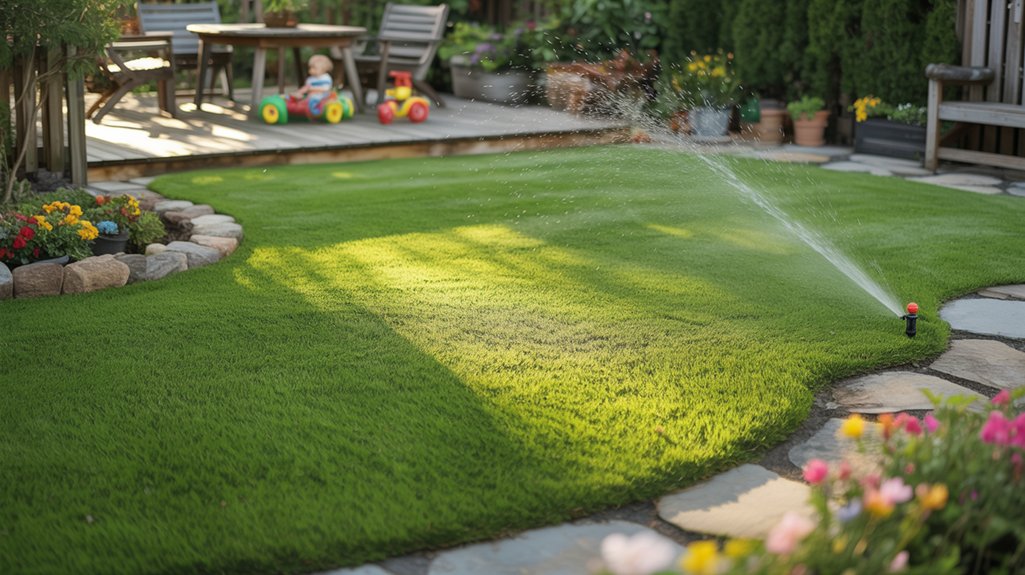
Knowing the surprising benefits of artificial grass for your backyard could change everything about how you maintain your outdoor space.
San Antonio backyards benefit substantially from artificial grass through eliminated irrigation demand, consistent appearance across extreme heat cycles, and stable performance over the expansive clay and caliche soils that degrade natural turf. SAWS drought-restriction stages and once-weekly watering windows make irrigation elimination especially consequential in this climate. Artificial grass is a synthetic surface system engineered to replicate functional turf using UV-stabilized polyethylene fibers over a compacted aggregate base, providing year-round usability independent of rainfall, soil conditions, or seasonal dormancy.
San Antonio’s tiered drought-restriction framework, administered through SAWS and calibrated against the Edwards Aquifer’s 10-day rolling average, periodically confines landscape irrigation to a single assigned day per week within narrow morning and late-evening windows. Under those constraints, natural turf on the region’s expansive clay soils — where slow infiltration already limits moisture absorption and root-zone recovery — struggles to sustain the consistent saturation schedules that cool-season and transitional grasses require. Artificial grass eliminates irrigation demand entirely, removing a property from the restriction cycle and reducing aquifer drawdown pressure regardless of which phase SAWS has declared.
The San Antonio Water System administers tiered drought-restriction stages tied to the 10-day rolling average of Edwards Aquifer levels, under which residential irrigation is limited to a single assigned watering day per week within windows of 5–10 a.m. and 9 p.m.–midnight. For warm-season turfgrass species, which require frequent deep watering cycles to sustain root depth through August highs near 96°F, a once-weekly restriction renders adequate soil moisture recovery functionally unachievable during peak demand periods. Natural lawn viability collapses precisely when stress is highest, leaving homeowners managing decline rather than maintenance. Artificial grass eliminates irrigation dependency entirely, decoupling lawn appearance from aquifer levels and removing the compounding pressure of stage escalations that tighten restrictions further as drought conditions deepen.
The San Antonio Water System‘s stage-based drought restrictions limit residential irrigation to a single assigned watering day per week, within windows of 5–10 a.m. and 9 p.m.–midnight, directly capping the volume of water any landscape can receive regardless of seasonal demand. Artificial grass requires no irrigation at all, removing a residential property from SAWS stage compliance obligations entirely. The Edwards Aquifer Authority regulates recharge and contributing zones across the Hill Country corridor, where aquifer levels drive stage escalations that compound restrictions as drought deepens. Eliminating lawn irrigation severs the connection between aquifer drawdown cycles and landscape performance, preserving functional outdoor space through periods when natural turf decline is otherwise structurally unavoidable under the restriction framework.
San Antonio’s roughly 250 annual sunshine days place sustained UV exposure at the center of any turf durability conversation. UV-stabilized polyethylene fiber resists the photodegradation that would otherwise compromise pile integrity and color retention across the region’s long warm season, which stretches well beyond most temperate benchmarks. Where expansive clays in Hydrologic Soil Groups C and D shift seasonally under natural turf root systems—heaving crowns, cracking sod, and producing uneven surface conditions—a properly compacted aggregate base decouples the synthetic surface from that ground movement, sustaining consistent performance regardless of soil-moisture cycles.
San Antonio averages approximately 250 days of sunshine per year, a cumulative UV load that accelerates fiber degradation in synthetic turf systems not engineered with UV-stabilized polyethylene construction. The Synthetic Turf Council’s fiber specification guidance identifies UV stabilization as a required characteristic for installations in high-insolation climates, where prolonged exposure to ultraviolet radiation causes unprotected fibers to embrittle, discolor, and shed structural integrity over time. In San Antonio’s USDA Hardiness Zones 8 and 9, August ambient temperatures approach 96°F, and radiant heat at the turf surface compounds photochemical stress beyond what UV exposure alone represents. UV-stabilized polyethylene fibers resist this combined thermal and photochemical load, maintaining pile resilience and color fidelity through conditions that would otherwise shorten functional service life.
Expansive clay soils classified in Hydrologic Soil Groups C and D underlie significant portions of San Antonio’s residential corridors, producing volumetric shrink-swell cycles that fracture natural turf root zones and create uneven, patchwork surfaces through repeated wet-dry seasons. San Antonio’s concentrated spring and early-fall precipitation — averaging approximately 32.9 inches annually — drives those clay movements with particular intensity, leaving natural grass vulnerable to heaving, pooling, and bare-soil exposure precisely when outdoor living demand peaks. Compacted aggregate base installed at 90 to 95 percent of ASTM D1557 Modified Proctor density beneath synthetic turf systems bridges across this soil movement, distributing surface loads without transferring differential settlement to the pile layer above. The result is a stable, consistent surface that retains its functional geometry and appearance through seasonal soil cycles that routinely degrade natural turf in neighborhoods across Alamo Heights, Terrell Hills, and the Hill Country corridor.
Artificial grass holds its color and texture regardless of whether San Antonio’s summer heat has scorched the season or a dry stretch under SAWS drought restrictions has ruled out supplemental irrigation entirely. Homeowners across Alamo Heights, Stone Oak, and the Hill Country corridor eliminate the mowing, fertilizing, and reseeding cycle that natural turf demands to recover from both climatic stress and the slow infiltration rates of expansive Group C and D soils. That consistency depends, however, on base preparation achieving 90 to 95 percent of Modified Proctor density—a standard that’s particularly consequential over caliche, where inadequate compaction or unaddressed subsurface irregularity translates directly into surface instability and premature fiber wear.
Synthetic turf installations specify polyethylene fiber pile heights of 1.5 to 1.75 inches over a compacted aggregate base, a fixed dimensional profile that requires no mowing, fertilizing, or seasonal reseeding regardless of growing-season length. In San Antonio, where NOAA climate normals record roughly 250 days of sunshine annually and a warm season bounded by a last frost near March 20 and a first frost near November 12, natural turf demands active maintenance across an unusually long calendar window. Synthetic turf eliminates that cycle entirely, holding consistent density and color through summer heat, expansive-clay soil movement, and the caliche conditions that cause natural grass to thin and require repeated overseeding in neighborhoods across Stone Oak, The Dominion, and the Hill Country corridor.
Compacted aggregate base material placed at 90 to 95 percent of ASTM D1557 Modified Proctor density provides the stable foundation dimension that allows synthetic turf to hold consistent pile geometry and surface drainage performance across seasons. In San Antonio’s expansive-clay soils — classified mainly in Hydrologic Soil Groups C and D — subgrade movement under natural turf causes root-zone disruption, surface irregularity, and chronic thinning that demands repeated seasonal correction. A properly compacted aggregate base isolates the synthetic turf system from that subgrade behavior, maintaining the minimum 2 percent slope required under IRC site-drainage provisions to direct water away from foundations. The result is a surface that holds its dimensional profile and appearance through summer heat cycles and wet-season clay expansion without the reseeding or regrading interventions that natural turf in neighborhoods like Alamo Heights and Terrell Hills routinely requires.
San Antonio homeowners considering artificial grass tend to raise the same practical concerns: whether the system genuinely eliminates irrigation exposure under SAWS drought-restriction stages, how the aggregate base and perforated backing perform over expansive clay that shifts seasonally, what HOA covenants across estate corridors like Alamo Heights or The Dominion actually permit, and what ongoing maintenance looks like in a climate defined by intense UV and concentrated rainfall events. These questions share a common thread — each one connects installation decisions made at the outset to long-term performance consequences that aren’t easily corrected after the fact. The answers aren’t uniform across every property, but the underlying conditions in San Antonio’s clay-heavy, caliche-underlain landscape make them the right questions to ask.
Artificial grass eliminates residential irrigation demand entirely, making SAWS drought-restriction stages functionally irrelevant for turfed areas. Stage-based watering windows apply only to living landscape, so synthetic surfaces remain unaffected regardless of Edwards Aquifer level readings. Homeowners in Stone Oak, Shavano Park, and The Dominion who convert lawns to synthetic turf remove irrigated turf from their SAWS water budget permanently.
Artificial grass tolerates San Antonio’s expansive clay soils by decoupling surface performance from the underlying shrink-swell movement through a compacted aggregate base that distributes load and accommodates minor vertical displacement. Hydrologic Soil Group C and D clays common across Bexar County still require proper sub-base grading to maintain the minimum two-percent drainage slope. Backyard Paradiso evaluates site-specific soil conditions across estate corridors including Alamo Heights, Terrell Hills, and The Dominion before installation begins.
HOA approval of artificial grass in San Antonio varies by community, with some associations in estate corridors such as The Dominion, Stone Oak, and Sonterra maintaining explicit guidelines governing turf aesthetics, pile height, or border treatments. Deed restrictions typically require architectural review committee approval before installation begins. Homeowners should request written governing documents from their association before contracting any work.
Artificial grass in South Texas requires periodic rinsing, light brushing of fibers, and debris removal rather than mowing, fertilizing, or irrigation. San Antonio’s caliche soils and expansive clay conditions that complicate natural turf establishment have no effect on a properly installed synthetic system. Backyard Paradiso serves homeowners across Alamo Heights, Stone Oak, The Dominion, and surrounding estate corridors where these low-maintenance characteristics translate directly into reclaimed leisure time.
San Antonio’s expansive clay soils in Hydrologic Soil Groups C and D, shallow caliche over Edwards limestone, and SAWS drought-restriction stages that limit irrigation to once-weekly assigned windows create a set of site conditions where artificial grass installation demands precise base engineering and drainage design rather than standard residential turf practice. Backyard Paradiso works within these conditions across the San Antonio market, bringing installation experience specific to the compacted aggregate base depths, perforated backing specifications, and minimum two-percent slope requirements that perform reliably in this climate and soil profile. Consultations are available by appointment for properties throughout Alamo Heights, Olmos Park, Terrell Hills, Shavano Park, Stone Oak, The Dominion, Sonterra, and the Hill Country corridor toward Boerne and Camp Bullis. For estate-corridor homeowners, artificial grass represents recoverable value in functional outdoor square footage and usable hours per year — a consideration that carries particular weight in a market where natural turf struggles against both soil conditions and seasonal water restrictions.