Physical Address
304 North Cardinal St.
Dorchester Center, MA 02124
Physical Address
304 North Cardinal St.
Dorchester Center, MA 02124
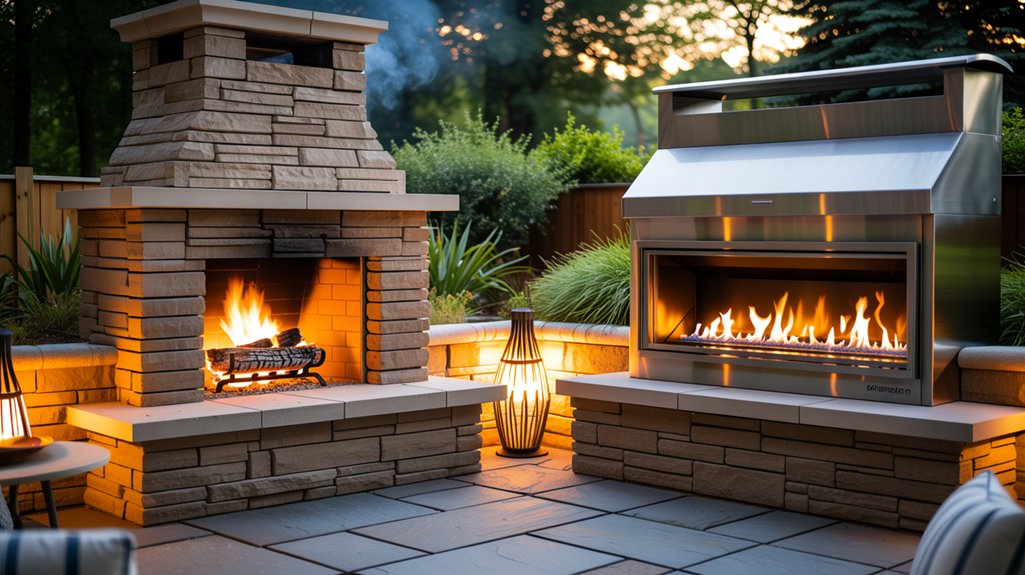
Three fuel types—wood, gas, and ethanol—each carry hidden trade-offs that could make or break your outdoor fireplace decision.
Fuel type selection precedes every aesthetic and structural decision because wood, gas, and ethanol each impose distinct venting, safety, and installation regimes that cannot be reconciled after siting. Gas-utility availability, desired heat output, annual use hours, and maintenance tolerance are the four variables that resolve the selection. An outdoor fireplace is a fixed or semi-fixed combustion appliance engineered to deliver radiant heat within an open-air environment under fuel-specific listing standards governing ignition, containment, and exhaust.
Each of the three fuel paths carries its own code regime, and conflating them as interchangeable finishes on a single product category is the kind of misreading that produces improper installations. Wood-burning appliances fall under NFPA 211 and IRC 2021 Chapter 10, which mandate a full solid-fuel flue assembly – clay-lined masonry or a listed Class A system – because combustion byproducts, including creosote accumulation, impose structural and fire-separation requirements that the other fuel types never trigger. Gas appliances are listed under ANSI Z21.97/CSA 2.41 with fuel supply governed by NFPA 54 or NFPA 58, while ethanol units answer to UL/ULC 1370, and each standard reflects a fundamentally different hazard profile rather than a variation on a shared baseline.
NFPA 211 requires that solid-fuel-burning fireplaces installed in residential applications be served by a chimney system constructed to withstand continuous flue gas temperatures and the intermittent creosote ignition events that wood combustion produces. That standard, read alongside IRC 2021 Chapter 10, mandates either a clay-lined masonry flue or a listed Class A chimney assembly – each rated for the sustained thermal cycling inherent to wood fires. Creosote accumulation is a direct byproduct of incomplete combustion and is not incidental; it is the primary driver of the annual inspection and cleaning schedule that wood-burning systems carry as a permanent maintenance obligation. Local air-quality authorities may impose seasonal or episodic burn restrictions that further constrain the annual use-hours available from a wood-burning installation, regardless of how the chimney is constructed.
Outdoor decorative gas appliances installed in open-air residential settings are listed under ANSI Z21.97/CSA 2.41, a standard that governs ignition systems, valve assemblies, and flame supervision for appliances operating without a dedicated venting system. Because combustion byproducts disperse into the open air rather than a confined flue, gas units under this listing carry no creosote obligation and no annual chimney inspection requirement – conditions that distinguish the gas path from the solid-fuel regime in both maintenance load and installation scope. Natural gas supply lines fall under NFPA 54, while propane installations are governed separately under NFPA 58, each imposing its own pressure, connection, and proximity requirements at the fuel source. Ethanol appliances occupy a third and independent code regime under UL/ULC 1370, which requires a cool-down period before refueling to address the thermal hazard that liquid bio-ethanol fuel presents when a burner has been in recent operation.
Once the three fuel paths are understood as distinct code and infrastructure regimes, the selection reduces to four variables that must be evaluated in sequence rather than simultaneously. Utility access is determinative first – if a natural gas line doesn’t reach the site and propane delivery isn’t viable, gas is eliminated before heat output or aesthetics enter the conversation. Siting constraint and maintenance appetite then govern the remaining choice, since an ethanol appliance’s installation flexibility comes at the direct cost of heat output, and a wood-burning system’s thermal performance comes with a creosote management obligation that compounds with every use-hour logged annually.
NFPA 54, the National Fuel Gas Code, requires that a natural gas supply line be present at or extensible to the installation site before any gas appliance can be specified – a condition that immediately eliminates one fuel path for a significant portion of rural and exurban properties where utility distribution does not reach. Propane can substitute where natural gas is absent, but its handling falls under the separate regulatory regime of NFPA 58, which governs tank siting, setback, and capacity. Heat demand and annual use-hours then govern the remaining candidates: wood delivers the highest peak radiant output and suits high-frequency, high-duration use, while ethanol, regulated under UL/ULC 1370 as a decorative appliance, serves low-frequency installations where siting flexibility outweighs thermal performance.
IRC 2021 Section R1001 establishes the masonry and clearance requirements that govern where a solid-fuel fireplace may be structurally placed – requirements that, on constrained lots or beneath aluminum-framed pergola structures, routinely eliminate wood as a viable candidate before fuel preference enters the conversation. Siting constraint and maintenance appetite then resolve the remaining decision jointly: ethanol appliances listed under UL/ULC 1370 carry no chimney requirement and no utility connection, making them the only fuel path available to a fully enclosed courtyard or a rooftop installation where neither a flue chase nor a gas supply line can be routed. Against that flexibility, the owner must weigh ethanol’s position as a decorative-primary heat source and its mandatory cool-down interval before refueling – an operational discipline that low-frequency users accept readily but that high-frequency households find restrictive.
Fuel type determines venting geometry, clearance envelopes, and structural backing before a single aesthetic preference enters the conversation. A wood-burning unit requires a full solid-fuel flue assembly and the masonry mass to carry it; a listed outdoor gas appliance operates without that infrastructure entirely; an ethanol unit needs neither a flue nor a fuel line, but that siting flexibility comes with a ceiling on heat output that may disqualify it for primary use. Each path establishes its own downstream maintenance rhythm and regulatory compliance load, which means reversing the sequence – selecting a design and then assigning it a fuel type – routinely produces installations that require structural or mechanical correction.
IRC 2021 Chapter 10 classifies solid-fuel appliances under a separate venting regime from gas and liquid-fuel appliances, establishing that flue type, clearance distances, and combustion air requirements are fuel-determined before any architectural envelope is drawn. A wood-burning outdoor fireplace requires a full Class A or clay-lined masonry flue compliant with NFPA 211, while a listed outdoor decorative gas appliance under ANSI Z21.97/CSA 2.41 operates unvented in open-air conditions and an ethanol unit governed by UL/ULC 1370 requires neither a flue nor a utility connection. Those three regulatory tracks are not interchangeable finishes – – they are distinct installation regimes, each with its own site survey, structural loading assumption, and clearance envelope. Selecting a stone facing before selecting a fuel type means designing toward the wrong code path.
NFPA 211 mandates annual inspection of solid-fuel venting systems, establishing a recurring maintenance obligation that has no equivalent under either ANSI Z21.97/CSA 2.41 or UL/ULC 1370. A wood-burning installation produces creosote accumulation requiring licensed sweep service and periodic flue relining, costs that compound over the service life of the structure. A listed outdoor decorative gas appliance eliminates ash removal and flue inspection while introducing a regulated fuel supply line governed by NFPA 54 or NFPA 58, the capital and permitting burden of which depends entirely on whether utility natural gas reaches the site. An ethanol unit governed by UL/ULC 1370 carries the lowest ongoing maintenance profile but the lowest recoverable heat output, making it a decorative-primary installation. The fuel decision, made before any masonry or structural drawing is produced, determines which of those downstream obligation regimes the owner accepts for the life of the fireplace.
Four questions surface consistently when clients begin evaluating outdoor fireplace options, and each one resolves to the fuel-path decision established in the preceding section. Wood produces the highest peak radiant output but carries the flue, creosote, and air-quality compliance requirements that come with it; gas offers adjustable, instant heat without ash management; and ethanol, governed by a cool-down refueling protocol under its listing standard, functions primarily as a decorative appliance rather than a thermal one. Siting constraints – gas-utility availability, overhead structure materials, and local burn ordinances – operate as hard limits that determine which fuels remain viable before any output or maintenance preference enters the comparison.
Wood combustion produces the highest peak radiant heat output among the three outdoor fireplace fuel types. That output, however, depends on species, moisture content, and sustained fire management rather than a simple valve adjustment. Sites where that thermal performance is the priority must also accommodate a listed Class A or clay-lined masonry flue under NFPA 211 requirements.
Gas presents a substantially lower maintenance burden than wood. Wood-burning installations produce creosote, requiring periodic flue inspection and cleaning under NFPA 211 protocols, while gas appliances listed under ANSI Z21.97/CSA 2.41 produce neither ash nor combustion residue. Sites where annual use hours are high and maintenance appetite is limited will find the gas path materially preferable.
Ethanol fireplaces function primarily as decorative appliances rather than primary heat sources, with heat output governed by UL/ULC 1370 listing parameters that fall well below wood or gas alternatives. Open-air dissipation compounds the limitation, making sustained ambient temperature gain unlikely on a fully exposed patio. Projects where meaningful radiant warmth is a program requirement are better served by a wood or gas fuel path from the outset.
Fuel choice is among the most consequential determinants of outdoor fireplace placement. Wood-burning units require a full solid-fuel flue clearance envelope, while ethanol appliances carry no chimney or gas-line dependency, granting the broadest siting flexibility. Gas installations are governed by approved supply-line routing, which constrains positioning relative to utility access points.
Southern California’s combination of seismic soil classification requirements, coastal air-quality management district burn-day restrictions, natural gas utility access variables across hillside parcels, and IRC 2021 Chapter 10 flue compliance for solid-fuel appliances creates a layered engineering context that shapes outdoor fireplace fuel-path decisions before any structural or aesthetic consideration enters the project. Backyard Paradiso works within these specific conditions across outdoor fireplace installations throughout the region, applying demonstrated familiarity with the venting, fuel-supply, and maintenance regimes that separate wood, gas, and ethanol systems at the specification stage. Consultations are available by appointment for properties in the Inland Empire, San Gabriel Valley, Orange County, and surrounding markets. An outdoor fireplace installed to the correct fuel-path specification for its site consistently registers as a functional extension of conditioned living area, and projects completed to that standard reflect durable value in Southern California’s outdoor-living resale profile.