Physical Address
304 North Cardinal St.
Dorchester Center, MA 02124
Physical Address
304 North Cardinal St.
Dorchester Center, MA 02124
Here is why interlocking pavers may outlast poured concrete patios in Colorado Springs—but the answer depends on factors most homeowners overlook.
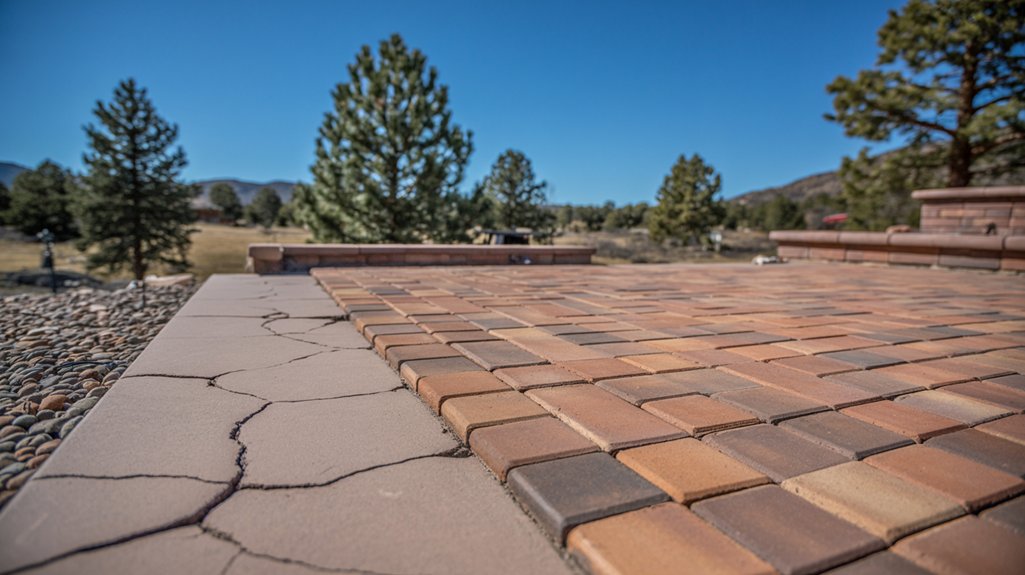
Interlocking pavers outperform poured concrete slabs for patio applications on Colorado Springs estate properties. Expansive clay soils, freeze-thaw cycling, and high-altitude ultraviolet exposure accelerate slab cracking while individual pavers accommodate movement and allow isolated unit replacement. A paver patio is an outdoor surface system of individually set interlocking units that distributes structural load flexibly across a prepared aggregate base.
Colorado Springs sits at an elevation where freeze-thaw cycles occur with unusual frequency and severity, subjecting patio surfaces to repeated volumetric stress that monolithic concrete slabs aren’t well-positioned to absorb without cracking. The expansive clay and decomposed granite soils common across the Front Range compound that stress by introducing differential movement beneath the slab—conditions that accelerate joint failure and surface fracture in ways that become structurally consequential rather than merely cosmetic. Modular paving systems, by contrast, distribute that movement across individual units and their sand-set joints, allowing the surface to flex and resettle without the propagating fractures that compromise a continuous pour.
Poured concrete slabs in Colorado Springs experience freeze-thaw cycling at rates exceeding 100 thermal crossings of the 32°F threshold per year, a frequency that progressively widens surface cracks and degrades structural integrity across the slab’s full monolithic plane. At elevations above 6,000 feet, ultraviolet intensity compounds this deterioration by accelerating the breakdown of surface sealers that would otherwise slow moisture intrusion. When expansive clay beneath a slab swells unevenly, differential heaving produces fault lines that a monolithic pour cannot redistribute — the crack migrates through the concrete rather than stopping at a joint. Interlocking pavers, by contrast, segment that stress across hundreds of independent units, each free to shift incrementally without transferring load damage to neighboring pieces.
Expansive clay soils in the Colorado Springs region can exert uplift pressures exceeding 5,000 pounds per square foot when saturated, a force sufficient to fracture a monolithic concrete slab along its weakest plane. The decomposed granite interbedded through that clay profile compounds the instability by creating zones of differential compressibility — some sections settle while adjacent sections heave, producing uneven vertical displacement across the patio footprint. Interlocking pavers accommodate this movement because each unit responds independently, absorbing minor shifts without propagating damage laterally. The high-altitude semi-arid climate accelerates moisture infiltration and evaporation cycles that drive repeated soil contraction and expansion, making a modular surface the structurally logical choice for estate-scale hardscape installed over Colorado Springs soils.
The performance gap between interlocking pavers and poured concrete becomes most apparent at the base preparation stage, where Front Range expansive clay demands compacted aggregate depths and geotextile separation layers that neither system can compromise without accelerating surface failure. Concrete slabs, once poured monolithically, have no mechanism to absorb differential movement in the substrate—a condition Colorado Springs soils impose seasonally and without uniformity across a patio’s footprint. Pavers distribute that movement across dozens of independent units and adjustable joint sand, which means a contractor can re-level isolated sections rather than saw-cut and repour entire panels when the ground shifts beneath them.
A structurally sound paver patio base on Colorado Springs’ expansive clay soils requires a minimum of 6 to 8 inches of compacted aggregate base to counteract the vertical movement that freeze-thaw cycling and clay expansion impose on finished hardscape. Poured concrete slabs demand comparable or greater base depth, but they distribute that movement across a monolithic panel that has no mechanical capacity to flex—cracking becomes the only available stress-relief mechanism. Interlocking pavers, by contrast, distribute load across individual units separated by jointing sand, allowing minor substrate shifts to be absorbed without surface fracture. On parcels where decomposed granite interbeds with clay, as is common across the Broadmoor and Black Forest corridors, base depth requirements can vary within a single project footprint, making the flexible-system tolerance of pavers a functional advantage over the rigid geometry a slab demands.
Replacing a cracked concrete slab requires demolition and full re-pour, while a damaged interlocking paver field requires only the extraction and substitution of the affected units. That distinction carries direct cost consequences on Colorado Springs estate parcels, where freeze-thaw cycling across the cold months and expansive clay movement routinely stress hardscape surfaces through repeated seasonal cycles. A poured slab that fractures across a high-traffic zone near an outdoor kitchen or fire feature cannot be selectively repaired; the structural integrity of the monolithic panel is compromised at the point of failure. Interlocking concrete or clay pavers, because each unit remains mechanically independent, allow targeted intervention without disturbing the surrounding field—a repair economy that compounds in value across a twenty-year service horizon on soils that will continue to move.
A patio surface doesn’t operate in isolation—it anchors pergola footings, defines kitchen equipment zones, and establishes the visual datum from which mountain sight lines are composed, so material choice carries consequences that extend well beyond the slab itself. Interlocking pavers accommodate those adjacencies more readily than poured concrete because individual units can be lifted and reset when post bases require adjustment or utility rough-ins need access without condemning the surrounding field. Colorado Springs’ Stage 1 drought restrictions add a parallel consideration: permeable paver systems reduce site runoff and align with municipal conservation conditions in ways that impervious concrete cannot match regardless of finish treatment.
Interlocking pavers allow a patio surface to terminate cleanly at a pergola post base or outdoor kitchen footing without requiring a continuous monolithic pour that would conflict with independent structural footings. On estate properties along the Broadmoor and Black Forest corridors, where pergolas and built-in kitchen structures often carry their own concrete piers, this decoupled relationship prevents differential settlement from telegraphing cracks across the patio field. The modular units can be cut and reset around post bases if footing depth is later adjusted. Mountain-facing sight lines also benefit from the directional flexibility of paver laying patterns, which can be oriented to draw the eye toward Pikes Peak without the arbitrary seam placement that governs formed concrete pours.
Permeable interlocking concrete pavers reduce stormwater runoff volume by retaining water in the aggregate base rather than directing it across an impervious surface toward drainage infrastructure. Under Colorado Springs Stage 1 drought restrictions, active through April 2027, this characteristic positions permeable paver systems as a functionally aligned choice rather than a purely aesthetic one, since municipalities under water stress read on-site infiltration favorably when evaluating hardscape projects. The aggregate-filled joints that enable permeability also allow minor resetting of individual units displaced by the expansive clay and decomposed granite soils common along the Front Range, addressing two site-specific constraints through a single material decision. Where a patio adjoins a pergola or built-in kitchen structure, the permeable field can terminate at those independent footings without disrupting the infiltration function of the surrounding field.
Homeowners weighing pavers against poured concrete for an estate patio in Colorado Springs tend to return to four practical questions: initial cost, expected service life, retrofitting options, and what maintenance altitude and climate actually demand. Cost comparisons depend heavily on paver material, base depth, and site complexity, so surface-level price comparisons rarely hold at the estate scale. The answers to the remaining three questions—longevity, replaceability, and maintenance—are shaped more directly by the region’s freeze-thaw frequency, UV intensity, and expansive soil conditions than by any single installation variable.
Pavers carry a higher installed cost than poured concrete at the estate scale, typically running 20 to 30 percent more per square foot once base preparation and jointing materials are included. Colorado Springs’ expansive clay soils and freeze-thaw cycling, however, compress that premium over time by eliminating the repeated crack-repair expenditures that plague monolithic slabs. Backyard Paradiso serves estate clients across the Broadmoor and Black Forest corridors where that long-term cost calculus regularly favors interlocking systems.
A properly installed interlocking paver patio in Colorado Springs should last 25 to 50 years under normal conditions. The pronounced freeze-thaw cycling and expansive clay soils of the Front Range can shorten that lifespan if base preparation is inadequate. Properties in the Broadmoor and Black Forest corridors with engineered aggregate bases consistently reach the upper range of that estimate.
A concrete patio can be replaced with pavers, though the existing slab typically remains in place as a sub-base rather than being removed. Slab thickness, surface condition, and drainage slope determine whether the concrete can support a paver overlay without creating height conflicts at thresholds or adjoining grade changes. Estate properties in the Broadmoor and Black Forest corridors frequently pursue this conversion when poured slabs develop the pronounced cracking common under Colorado Springs freeze-thaw and expansive clay conditions.
Paver patios at Colorado Springs elevations require periodic joint sand replenishment, surface cleaning to counter intense UV-driven efflorescence, and selective resealing every two to three years depending on exposure. Freeze-thaw cycling accelerates polymeric sand degradation in north-facing or shaded installations where moisture retention is highest. Replacing compromised jointing material remains a straightforward task that avoids the full-slab remediation expenses associated with cracked poured concrete.
Backyard Paradiso serves estate-scale residential clients across Colorado Springs, bringing working knowledge of the region’s expansive clay profiles, freeze-thaw cycling, and active drought restrictions to every paver patio engagement. The firm’s approach reflects an understanding that material selection, base preparation, and joint specification are interdependent decisions — not sequential ones — and that each choice carries long-term implications for maintenance economy and functional value recovery at resale.
For properties in the Broadmoor, Black Forest, and northern corridors, where sight lines and site conditions each add complexity, that technical grounding matters more than general installation experience. Backyard Paradiso operates by appointment from its office at 111 W Las Vegas St in Colorado Springs, where project scope and site-specific conditions are assessed before any recommendation is made.