Physical Address
304 North Cardinal St.
Dorchester Center, MA 02124
Physical Address
304 North Cardinal St.
Dorchester Center, MA 02124
Adding a paver patio may boost your home's value, but the real numbers depend on factors most homeowners never consider.
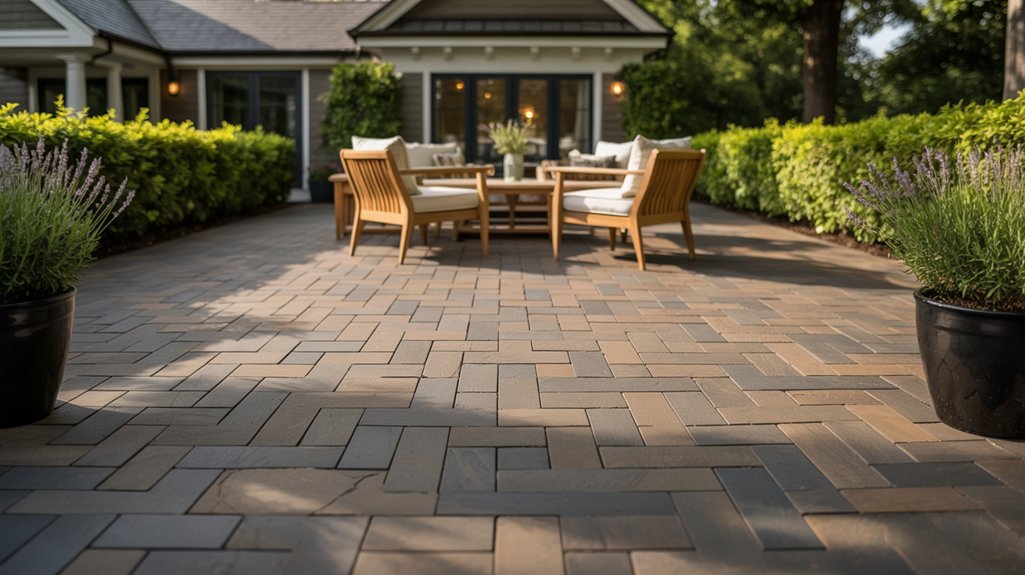
Paver patios measurably increase Hudson County property value by converting underutilized exterior space into functional, marketable living area. In Secaucus and surrounding Meadowlands corridors, that contribution depends on proper base preparation suited to high-groundwater fill soils and freeze-thaw cycling. A paver patio is a ground-level hardscape surface assembled from interlocking modular units that extends a home’s usable square footage outdoors year-round.
On dense Meadowlands lots where interior square footage commands a premium five miles from Midtown, a well-executed paver patio functions as an additional room rather than an amenity—extending the home’s usable envelope into space that would otherwise remain underutilized. Buyers in Hudson County’s constrained lot market recognize this distinction, and appraisers increasingly treat hardscape improvements as functional square footage equivalents when evaluating outdoor living continuity with interior spaces. That framing positions a paver installation not as a discretionary landscaping expense but as a recoverable capital improvement with measurable bearing on resale positioning.
Residential lots within the Hackensack Meadowlands District average among the smallest buildable parcels in Hudson County, where the New Jersey Sports and Exposition Authority exercises land-use authority over development footprint and impervious surface calculations. On lots of this scale, a paver patio does not merely extend the yard — it converts previously unstructured outdoor area into a defined, functional room with the spatial logic of interior living space. The IRC site-drainage standard requiring surface slope of one-quarter inch per foot away from structures guarantees the patio plane reads as a usable floor rather than a drainage afterthought. For households five miles west of Midtown Manhattan, where interior square footage commands outsized market attention, that functional equivalence carries direct relevance to how buyers evaluate and compare listings.
Remodeling industry tracking consistently classifies hardscape improvements among the outdoor project categories with measurable resale recovery rates in dense urban markets. Within the Hackensack Meadowlands District, where buildable lot sizes compress the relationship between interior and exterior square footage, a paver patio functions as a direct extension of livable area rather than a decorative addition. The New Jersey Sports and Exposition Authority’s oversight of impervious surface calculations means that every permitted square foot of structured outdoor surface carries documented value in the development record — a distinction buyers and appraisers can verify. On lots where interior expansion is constrained by NJSEA footprint limits, a patio effectively adds a room without adding to the building envelope, positioning the improvement as functional square footage in resale framing rather than landscaping expenditure.
Buyers in the Harmon Cove and Meadowlands District market read a paver surface the way an appraiser reads a foundation: unit consistency, edge restraint integrity, and joint stability signal whether the installation was built to last or built to look finished at listing. Conformance to ASTM C936 compressive standards isn’t visible to the eye, but its absence is — in cracked faces, settled borders, and polymeric sand that’s migrated or failed. Drainage slope held at the IRC-prescribed quarter-inch per foot, paired with NJDEP-compliant stormwater management at the perimeter, tells a buyer that the patio won’t become a liability the first time a nor’easter moves through.
Concrete pavers installed in pedestrian patio applications must meet ASTM C936, which sets a minimum compressive strength of 8,000 psi — a threshold that directly governs the unit’s resistance to freeze-thaw cycling and surface spalling under load. In the Hackensack Meadowlands, where seasonal freeze-thaw events are a consistent annual condition, a surface composed of compliant units reads to experienced buyers and inspectors as a system built to last rather than one likely to require near-term intervention. Clean, uniformly filled joints sealed with polymeric sand and continuous edge restraint at the perimeter eliminate the settlement gaps and border migration that signal deferred maintenance. Because individual units in a ASTM C936-compliant field can be extracted and reset without disturbing the surrounding surface, a well-maintained paver patio carries an invisible-repair advantage that poured concrete and natural stone slabs cannot replicate.
New Jersey Department of Environmental Protection stormwater rules at N.J.A.C. 7:8, effective March 2, 2021, require green-infrastructure best management practices for major developments, with the Inland Flood Protection Rule effective July 17, 2023 extending those requirements to stormwater systems designed for present and future climate-condition storms. In the Hackensack Meadowlands, where hydrologic soil group behavior ranges across classifications B through D depending on fill composition, a paver surface that demonstrably manages runoff through proper 1-to-2-percent slope and permeable-joint detailing signals regulatory awareness to buyers and inspectors alike. Permeable segmental systems tested under ASTM C1781 for surface infiltration carry documentation that reads as a compliance asset in a jurisdiction where Tier A MS4 permits govern Hudson and Bergen municipalities. That documented drainage performance repositions a patio from a cosmetic feature to a site-infrastructure improvement.
Beneath virtually every Secaucus-area paver surface lies a stratum of human-transported fill — construction debris, urban rubble, and legacy marsh material — that behaves nothing like native subgrade. That variability demands base compaction executed in controlled lifts and verified against modified Proctor density standards, because inconsistent bearing capacity translates directly into differential settlement visible at the surface. With a frost line reaching approximately 36 inches, installations that cut corners on base depth don’t survive the region’s freeze-thaw cycles intact, and a patio that heaves or separates within a few seasons reads as a liability to prospective buyers rather than an asset.
The USDA NRCS Secaucus soil series—loamy-skeletal Oxyaquic Udorthents formed in human-transported fill over historically tidal marsh—contains more than 35 percent coarse fragments and exhibits seasonal saturation below approximately 100 centimeters, creating base instability that standard compaction protocols alone cannot address. Because the fill matrix varies in composition across lots, bearing capacity is inconsistent at depth, and freeze-thaw cycling through Secaucus’s Zone 6b winters amplifies settlement risk wherever compaction is incomplete. ASTM D1557 Modified Proctor testing sets the benchmark at 95 percent maximum dry density, and base aggregate must be placed and compacted in lifts no greater than three to four inches to achieve that threshold reliably over fill soils. Skipping lift discipline on Secaucus-series ground produces differential settlement that fractures the paver plane and undermines the resale positioning the installation was meant to support.
Hudson and Bergen County municipalities typically adopt a minimum footing and base-penetration depth of 36 inches, aligned with the regional frost line established under New Jersey Uniform Construction Code standards for Zone 6b ground conditions. Secaucus’s Hackensack Meadowlands setting compounds that threshold: NOAA climate normals for the region document 25 to 35 inches of seasonal snowfall, nor’easter events, and sustained freeze-thaw cycling through winter and shoulder seasons that drive frost penetration into fill soils already compromised by variable bearing capacity. Where aggregate base preparation falls short of that depth standard, heave forces acting on the Secaucus-series fill matrix displace the paver plane unevenly across seasons. An installation engineered to the full frost-line depth, with base aggregate compacted in lifts to 95 percent of ASTM D1557 Modified Proctor density, distributes those forces without the differential movement that degrades surface integrity and resale positioning over time.
Homeowners in the Secaucus and Hudson County market frequently weigh paver patio projects against the same practical questions: whether buyers respond to finished outdoor space, how the material holds under New Jersey’s freeze-thaw conditions, what the permitting process involves, and how square footage constraints on Meadowlands lots shape design decisions. Each question carries distinct implications depending on the specific corridor, lot configuration, and intended use. The answers, taken together, form a clearer picture of where paver installations fit within the broader calculus of property investment in this market.
Buyers in Hudson County markets consistently signal stronger purchase interest in homes where outdoor living space is already established and finished. Willingness to pay a premium correlates most directly with patio condition, functional integration with interior living areas, and lot constraints that make retrofitting difficult post-purchase. Harmon Cove and Hackensack riverfront properties, where buildable outdoor area is limited, reflect this dynamic most sharply.
Properly installed paver patios in New Jersey regularly achieve service lives of 25 to 50 years when base preparation meets compaction standards suited to Secaucus-series fill soils and freeze-thaw conditions. Longevity depends heavily on aggregate base depth, edge restraint continuity, and polymeric sand maintenance across seasonal frost cycles. Projects within the Hackensack Meadowlands District face added durability demands given high groundwater and the NJSEA’s land-use oversight framework.
Most paver patio installations in Secaucus require a construction permit under the New Jersey Uniform Construction Code, administered through the local construction office. Projects within the Hackensack Meadowlands District face an additional layer of review, with the New Jersey Sports and Exposition Authority serving as land-use authority and plan-review coordinator. NJDEP stormwater compliance under N.J.A.C. 7:8 may also apply depending on site conditions and project scope.
Compact patio footprints of 120 to 200 square feet align well with the constrained lot configurations typical of Harmon Cove and Meadowlands District properties. Dense fill soils and high groundwater characteristic of the Secaucus series require careful base preparation regardless of patio scale. Even modest installations effectively convert unused side or rear yards into functional outdoor rooms, maximizing usable square footage on lots where interior expansion is rarely feasible.
Harmon Cove, the Hackensack riverfront corridor, and the Meadowlands District neighborhoods share a defining installation constraint: dense lot configurations over the Secaucus fill series, where high groundwater and freeze-thaw cycling at the frost line govern every base and drainage decision in a paver patio project. Backyard Paradiso designs and installs paver patios across these corridors, applying base preparation and edge-restraint practices calibrated to the soil and regulatory conditions that distinguish this market from conventional suburban sites. Consultations are available by appointment from the firm’s Secaucus office, with service extending through North Bergen, Lyndhurst, and the southern Bergen ridge. For properties on small Meadowlands lots where functional outdoor square footage carries direct resale weight, a properly engineered paver patio represents recoverable investment — effectively adding a room where lot constraints make traditional interior expansion impractical.