Physical Address
304 North Cardinal St.
Dorchester Center, MA 02124
Physical Address
304 North Cardinal St.
Dorchester Center, MA 02124
Surprising factors determine whether composite decking reaches 25-plus years—discover what most homeowners overlook before it's too late.
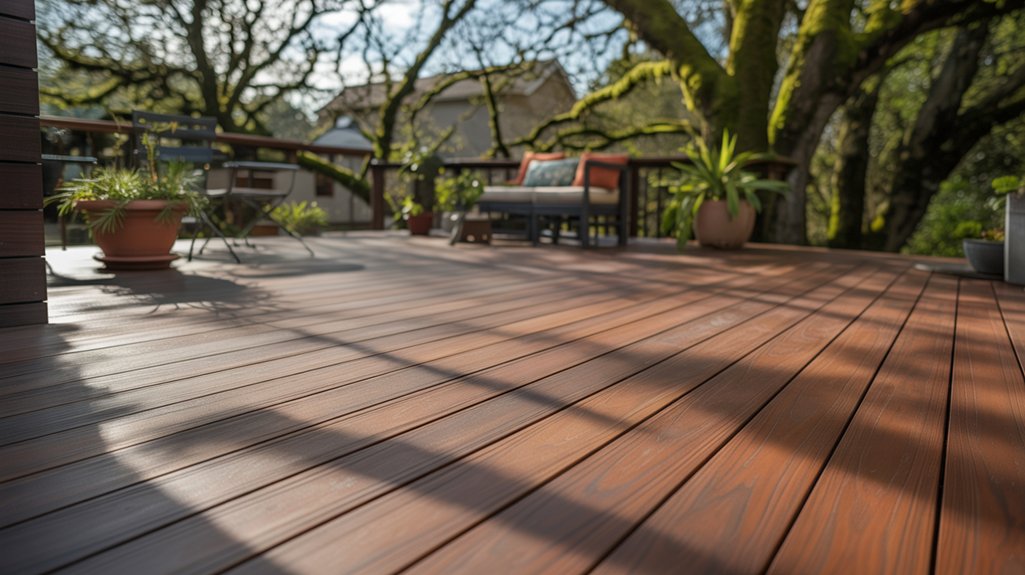
Co-extruded wood-plastic composite decking installed over properly engineered substructure routinely achieves a 25-plus year design life in Romeoville’s freeze-thaw climate. That performance depends on 42-inch frost-depth footings, correctly flashed ledger connections, and co-extruded board construction that seals the wood-fiber core against the region’s aggressive moisture cycles. Co-extruded WPC decking encases a wood-fiber composite core within a continuous polymer shell, protecting structural integrity across repeated freeze-thaw cycles while maintaining a stable walking surface year-round.
The 25-plus year design life assigned to co-extruded wood-plastic composite decking isn’t a marketing claim — it’s a performance threshold tied to ASTM D7032, the standard that governs flexural strength, creep resistance, and long-term weathering behavior under conditions that directly parallel what Romeoville’s freeze-thaw cycling imposes on exposed surfaces. What separates co-extruded boards from earlier composite generations is the continuous polymer shell encasing the wood-fiber core, which closes off the moisture pathways that otherwise allow repeated freeze-thaw cycles to degrade the material from within. That shell doesn’t merely slow moisture uptake; it changes the failure mechanism entirely, shifting the dominant durability variable away from the board surface and down into the substructure and footings.
ASTM D7032 governs the performance requirements for plastic composite deck boards, mandating that co-extruded wood-plastic composite products demonstrate resistance to moisture absorption, dimensional change, and mechanical degradation under cyclic loading conditions. The co-extruded construction differs fundamentally from first-generation capped or uncapped composites: a continuous polymer shell encases the wood-fiber core on all four sides during the extrusion process, blocking the moisture pathways that previously allowed freeze-thaw cycling to degrade board integrity from within. In the southwest Chicago corridor, where NOAA climate normals record approximately 29 inches of seasonal snowfall and freeze-thaw cycling recurs aggressively across USDA Hardiness Zones 5b–6a, that sealed core is the structural basis for the 25-plus year design life rating. The rating covers the decking surface itself — not the substructure, footings, or ledger connection, which operate under separate performance constraints.
ASTM D7032 requires plastic composite deck boards to demonstrate acceptable performance across three mechanical and environmental test protocols — flexure, accelerated weathering, and creep under sustained load — before carrying a compliant rating. The flexure requirement establishes minimum stiffness and load-bearing thresholds that correspond to residential structural live loads; the accelerated weathering protocol simulates UV degradation and moisture cycling that, in the southwest Chicago corridor’s Zone 5b–6a climate, occurs across genuine seasonal extremes rather than laboratory approximations alone. Creep testing addresses long-term deflection under continuous load, a condition relevant wherever boards span joists at standard spacing under snow accumulation. Collectively, these tests define what the 25-plus year design life rating actually certifies: surface material performance under load, UV, and moisture — not footing integrity, substructure durability, or ledger-connection behavior, which each carry independent performance constraints.
The composite surface that carries a 25-plus year rating performs only as well as the substructure beneath it, and in Romeoville’s freeze-thaw environment that substructure begins with footings sunk below the 42-inch frost line — the deepest threshold in Backyard Paradiso’s service footprint. Frost heave acting on a shallow footing transmits differential movement upward through posts and beams, compromising fastener integrity and board alignment long before the composite material itself shows wear. On attached decks, ledger flashing functions as the single most consequential detail, because water infiltrating the ledger-to-rim-joist connection initiates concealed wood decay that can render a structurally sound deck surface unrepairable.
Northeastern Illinois building practice sets the minimum footing depth for deck construction at 42 inches below finished grade, reflecting the frost line established for the greater Chicago region and codified in local amendments adopted by jurisdictions including the Village of Romeoville. That depth exceeds requirements in every other market Backyard Paradiso serves, a distinction rooted in the region’s humid continental climate, which subjects glacial till and clay loam soils to aggressive freeze-thaw cycling across extended winter seasons. When footings terminate above that threshold, frost heave generates vertical movement that racks post bases, distorts beam bearing points, and transmits cumulative stress upward through every framing connection to the decking surface above. The substructure, not the composite boards, determines whether a deck reaches its 25-year design horizon or fails a decade short of it.
The International Residential Code requires ledger connections on attached decks to be flashed against water infiltration, identifying moisture intrusion at the house-to-deck interface as the structural failure pathway that most commonly ends an attached deck’s service life before the framing reaches its design horizon. Where flashing is absent, improperly lapped, or installed without back-dam detailing, water migrates behind the ledger board, saturating the rim joist and band framing of the primary structure across successive wet-freeze cycles. In Romeoville’s climate — roughly 41 inches of annual precipitation distributed across late-spring convective storms and sustained winter snowpack — that infiltration pathway is active for most of the calendar year. Co-extruded composite decking extends surface life well past 25 years, but that performance is contingent entirely on a ledger assembly that excludes water at the attachment plane.
Winter on the southwest Chicago corridor doesn’t arrive as a single event; it compounds, cycling through freeze-thaw sequences that test every connection, joint, and footing in the substructure. Co-extruded WPC boards resist the moisture absorption that makes cellular materials vulnerable to that cycling, but surface protection still depends on how snow removal and de-icing are handled — plastic-blade tools and ice-melt products free of calcium or magnesium chloride preserve the polymer shell where metal and aggressive chemistry would degrade it. Beneath the boards, joist tape and deliberate substructure ventilation work against the glacial silt-loam and clay-loam soils characteristic of Romeoville, where seasonal moisture migration can sustain a damp framing environment long after the last snowmelt has cleared the surface.
Romeoville’s average seasonal snowfall of approximately 29 inches places composite deck surfaces under repeated mechanical and chemical stress that begins the moment temperatures drop below freezing. Co-extruded WPC boards, with their continuous polymer shell encasing the wood-fiber core, resist moisture absorption more effectively than earlier-generation composites, reducing the surface degradation that freeze-thaw cycling accelerates in porous materials. Plastic or composite snow shovels with no metal edges preserve the board surface during clearing; metal-bladed tools risk gouging the polymer shell and creating entry points for moisture. Calcium chloride and magnesium chloride ice-melt products are generally compatible with WPC surfaces, while sodium chloride accelerates corrosion in the fasteners and substructure framing below, making product selection a structural consideration, not merely a surface one.
Joist tape applied to the top surface of pressure-treated framing members creates a continuous moisture barrier between the substructure and the composite deck boards above, preventing the wood-fiber contact that accelerates rot in Romeoville’s glacially derived clay-loam and silt-loam soils. Seasonal high water tables near the Des Plaines River floodplain and preserved open spaces such as Romeoville Prairie elevate ambient soil moisture throughout the substructure zone, making vapor management a structural priority rather than a finishing detail. Adequate bay spacing between joists and between the decking surface and grade maintains the air circulation that allows the framing to dry between precipitation and snowmelt events. Together, joist tape and substructure ventilation extend the service life of the pressure-treated framing that ultimately determines whether co-extruded WPC boards reach their 25-plus year design potential.
Homeowners planning or maintaining a composite deck in Romeoville’s climate tend to circle the same practical questions: whether snow accumulation harms the surface, whether composite boards can go down over an existing wood frame, what actually shortens a deck’s service life, and whether the Village requires a permit. Each question carries a different weight. The answers, taken together, reveal that material performance is rarely the limiting variable — structural integrity, code compliance, and installation discipline are.
Snow resting on co-extruded composite decking does not cause structural or surface damage under normal seasonal accumulation. The continuous polymer shell that encases the wood-fiber core resists moisture infiltration during the freeze-thaw cycling common to Romeoville’s Zone 5b–6a winters. Substructure ventilation and properly pitched framing remain the critical factors in preventing ice-load stress from concentrating at ledger connections.
Composite boards can be installed over an existing wood frame when the framing meets current structural standards, is free of rot, and carries appropriate joist spacing for the chosen board profile. Romeoville’s aggressive freeze-thaw cycling accelerates hidden framing deterioration, making thorough inspection of each joist bay a prerequisite. Ledger connections and any substructure near the Des Plaines River floodplain or Gateway Wetlands soils warrant particular scrutiny before resurfacing proceeds.
Ledger connection failure—driven by water infiltration behind improperly flashed attachments—ends attached decks earlier than any other single factor in Romeoville’s freeze-thaw climate. Seasonal moisture cycling accelerates rot and fastener corrosion at the house connection faster than it degrades properly specified co-extruded decking surfaces. Substructure ventilation and code-compliant flashing at every ledger attachment represent the margin between a 25-year service life and premature structural failure.
Most deck construction in Romeoville requires a building permit issued by the Village of Romeoville Building Department under adopted ICC model codes with local amendments. Permit requirements typically apply based on structure size, attachment method, and proximity to property lines or regulated areas such as wetlands and floodplain corridors. Projects near Des Plaines River floodplain or Gateway Wetlands may trigger additional review from the U.S. Army Corps of Engineers or Illinois regulatory agencies.
Composite deck construction in Romeoville operates under IRC Section R507 and R312 guard requirements, a 42-inch frost-line footing standard enforced by the Village of Romeoville Building Department, and Will County stormwater ordinances that govern impervious surface additions across the region’s glacial till and hydric soil profiles. Backyard Paradiso brings demonstrated command of these layered requirements to composite deck installation, translating code compliance and substructure engineering into decks designed for a 25-plus year service life in one of the most demanding freeze-thaw markets in the greater Chicago corridor. Consultations are available by appointment at the firm’s Romeoville office. The investment is framed through resale recovery and functional square footage equivalence, giving homeowners along the Weber Road corridor, the Des Plaines River edge, and the Gateway Wetlands and Bolingbrook preserve boundaries a durable outdoor addition that extends livable space across more seasons of the year.