Physical Address
304 North Cardinal St.
Dorchester Center, MA 02124
Physical Address
304 North Cardinal St.
Dorchester Center, MA 02124
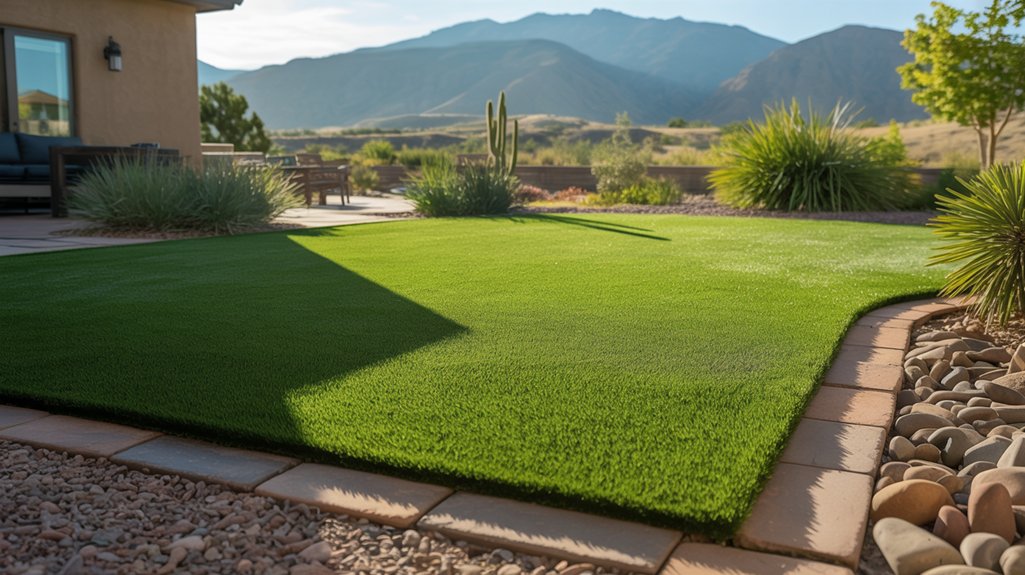
Knowing why Colorado Springs homeowners are ditching real grass for synthetic turf reveals surprising climate-driven reasons you haven't considered yet.
Artificial grass has gained meaningful traction in Colorado Springs, driven by recurring Front Range drought and the region’s semi-arid climate receiving only 15.91 inches of annual precipitation. Adoption is conditioned on UV-stable polymer specifications and permeable base construction suited to altitude and freeze-thaw cycles. Artificial grass is a synthetic multi-layer surface system designed to replace irrigated turf while maintaining functional outdoor living space year-round.
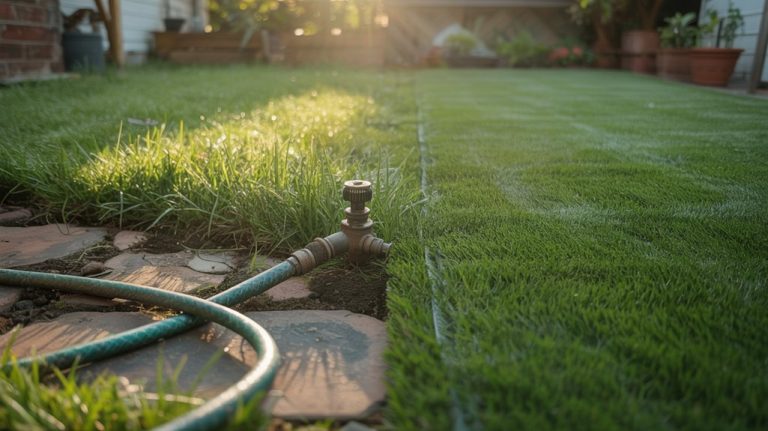
Colorado Springs receives roughly 15.91 inches of annual precipitation, a figure that frames nearly every landscaping decision across the region. That scarcity has accelerated adoption of the xeriscape ethic promoted throughout Colorado, shifting homeowner priorities toward eliminating irrigation demand rather than managing it. Synthetic lawn fits directly within that framework, removing turf water consumption entirely in a climate where recurring Front Range drought makes the trade-off functionally straightforward.
Colorado Springs receives an annual average of 15.91 inches of precipitation, placing it firmly within the semi-arid high-desert steppe classification (Köppen BSk) that defines much of the Colorado Front Range. That constrained water budget intensifies under recurring regional drought cycles, making irrigation-dependent bluegrass or fescue lawns a significant draw on a limited municipal supply. The xeriscape movement, actively promoted across Colorado municipalities, has normalized grass-free and low-water landscaping as a practical response to these conditions rather than an aesthetic preference. Synthetic lawn installations eliminate landscape irrigation demand entirely, a consequence that carries measurable weight in a climate where afternoon relative humidity regularly falls below 20 to 25 percent and evapotranspiration rates outpace natural precipitation for most of the growing season.
Colorado’s Water Plan, adopted by the Colorado Water Conservation Board, identifies the Arkansas River Basin—which supplies Colorado Springs Utilities—as among the state’s most water-stressed systems under continued drought and growth pressure. That structural scarcity has made irrigation elimination a functional objective rather than a lifestyle preference across Front Range municipalities, with xeriscape ordinances and tiered water-rate structures reinforcing the shift. Synthetic lawn installations address this directly by removing turf irrigation from a household’s water demand entirely, a consequence of particular weight in a climate where, based on NOAA climate normals for the Colorado Springs Municipal Airport station, annual precipitation averages 15.91 inches while evapotranspiration deficits persist across the full growing season.
Altitude introduces two conditions that determine whether a synthetic lawn remains structurally and aesthetically intact over time. At 6,035 feet, ultraviolet intensity accelerates polymer degradation measurably faster than at sea level, making fiber-level UV stabilization a functional requirement rather than a product tier distinction. The semi-arid freeze-thaw regime compounds that exposure by cycling snowmelt through the base layer repeatedly each season, so base permeability and compaction density govern whether the surface holds its grade or begins to shift.
At 6,035 feet above sea level, Colorado Springs receives measurably higher ultraviolet radiation intensity than lower-elevation Front Range cities, accelerating polymer chain breakdown in synthetic turf fibers that lack UV stabilization additives. Polyethylene pile manufactured without UV inhibitors degrades faster under high-altitude solar exposure, losing tensile integrity and color stability within years rather than decades. The Synthetic Turf Council specifies UV-stable polyethylene or polypropylene fiber as a functional performance requirement for installations in high-radiation environments, not an optional upgrade. In a semi-arid steppe climate averaging roughly 300 sunny days annually, according to NOAA climate normals for the Colorado Springs station, cumulative solar loading compounds the altitude effect, making fiber stabilization specification the single most consequential material decision in a Colorado Springs synthetic turf installation.
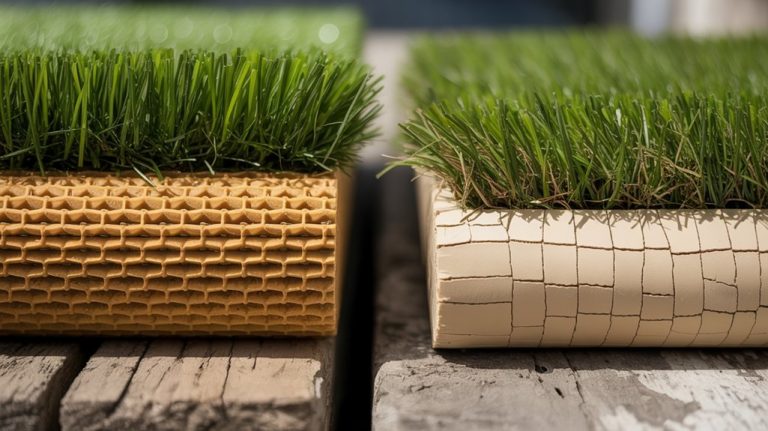
ASTM D1557 governs the compaction standard for synthetic turf base layers, requiring crushed stone or decomposed granite to reach 90 to 95 percent of modified Proctor density before pile installation begins. In Colorado Springs, that specification carries additional consequence because the semi-arid freeze-thaw regime produces mean diurnal temperature swings exceeding 25 degrees Fahrenheit, and the region receives approximately 32.5 inches of annual snowfall, according to NOAA climate normals for the Colorado Springs station. Inadequately compacted base material absorbs snowmelt rather than shedding it, creating subsurface saturation that expands during freeze cycles and progressively heaves the turf surface. A properly engineered permeable base drains snowmelt laterally before freeze events can act on retained moisture, preserving surface planarity across seasonal cycles.
The Front Range’s position as one of North America’s most active Chinook corridors subjects Colorado Springs installations to sustained gusts reaching 50 to 80 miles per hour in exposed foothill neighborhoods, making perimeter anchoring a structural concern rather than a finishing detail. The Pikes Peak Regional Building Department applies ASCE 7 ultimate design wind speeds of 130 miles per hour under Exposure C, a condition that determines anchoring frequency and fastener specification before a single roll of turf is cut. Synthetic Turf Council base standards govern the compacted stone sublayer and drainage geometry that prevent the surface from lifting or shifting when wind load combines with freeze-thaw cycling.
The Pikes Peak Regional Building Department enforces ASCE 7 ultimate design wind speeds of 130 miles per hour under Exposure C classification for Colorado Springs installations. This threshold reflects the Front Range’s position as one of North America’s most active downslope Chinook corridors, where recorded gusts of 50 to 80 miles per hour occur regularly across exposed foothill neighborhoods. Synthetic turf perimeter anchoring must be specified to perform within that load environment, as edge failure under Chinook-driven uplift can compromise seam integrity and base stability across the full installation. The Synthetic Turf Council’s installation guidance addresses seaming and perimeter fastening practice as structural considerations rather than finishing details in high-wind regional contexts.
The Synthetic Turf Council specifies a compacted aggregate base of 3 to 4 inches of crushed stone or decomposed granite, brought to 90 to 95 percent of modified Proctor density per ASTM D1557, as the foundational requirement for synthetic turf installations. In Colorado Springs, that specification carries structural consequence beyond simple surface stability: the semi-arid freeze-thaw regime, combined with approximately 32.5 inches of annual snowfall, creates repeated thermal cycling that can destabilize an under-compacted base and transmit heave forces upward through the turf assembly. A geotextile separation layer between native soil and aggregate prevents fines migration, preserving drainage rates across seasonal changes. Perimeter anchoring systems must function in coordination with base integrity, since Chinook-driven uplift loads that breach the edge transfer stress into the base plane directly beneath the seam.
Homeowners across Colorado Springs ask predictable questions about artificial grass, and the answers tend to cluster around water conservation, UV durability, and HOA compliance. Artificial grass is increasingly common here, particularly in estate neighborhoods where water-wise landscaping has become a standard design consideration rather than an exception. High-altitude UV exposure at 6,035 feet does accelerate fiber degradation in lower-grade products, making polymer stability a practical prerequisite, while HOA approval varies by community and typically requires a formal submittal before installation begins.
Artificial grass has grown increasingly common across Colorado Springs as the region’s semi-arid climate and recurring Front Range drought have pushed homeowners toward low-water landscaping alternatives. Annual precipitation averaging just 15.91 inches makes irrigation-dependent turf a significant burden. The xeriscape movement promoted throughout Colorado has further normalized synthetic and grass-free installations across estate neighborhoods including Broadmoor, Flying Horse, and Wolf Ranch.
Artificial grass eliminates landscape irrigation demand entirely, a meaningful advantage in Colorado Springs’ semi-arid climate where annual precipitation averages only 15.91 inches. Water savings depend on the size of the replaced lawn and local El Paso County watering restrictions in effect during drought declarations. The xeriscape movement normalized across Colorado has made water-wise, grass-free landscapes a recognized standard rather than an exception.
High-altitude UV exposure at 6,035 feet accelerates synthetic fiber breakdown faster than at sea level, making UV-stable polyethylene or polypropylene a functional specification rather than an optional upgrade. Colorado Springs receives approximately 300 sunny days annually, compounding cumulative radiation load on pile fibers. Specifying UV-inhibited resin at installation directly addresses this degradation risk.
HOA policies on artificial grass in Colorado Springs vary considerably by community, with some associations permitting it outright and others imposing restrictions on pile height, color, or visible perimeter edging. The xeriscape movement normalized across Colorado has prompted many boards to revisit outdated turf mandates. Estate communities like Flying Horse and Kissing Camels typically maintain architectural review processes governing installation approval.
Artificial grass installation in Colorado Springs is governed by Pikes Peak Regional Building Department jurisdiction applying ASCE 7 ultimate design wind speeds of 130 mph in Exposure C, Synthetic Turf Council base and drainage standards, and ASTM D1557 compaction requirements of 90 to 95 percent modified Proctor density — specifications that collectively define whether a synthetic lawn performs or fails at 6,035 feet. Backyard Paradiso brings demonstrated command of these requirements to every artificial grass installation it undertakes across the Front Range, treating UV-stable polymer selection, permeable base engineering, and perimeter wind anchoring as baseline practice rather than optional upgrades. Consultations are available by appointment for properties across estate neighborhoods including Broadmoor, Flying Horse, Kissing Camels, Wolf Ranch, and Pine Creek. Investment is framed through water savings relative to Colorado Springs’ 15.91-inch annual precipitation budget, usable functional square footage, and long-term performance value suited to the semi-arid high-desert steppe climate.