Physical Address
304 North Cardinal St.
Dorchester Center, MA 02124
Physical Address
304 North Cardinal St.
Dorchester Center, MA 02124
Nighttime curb appeal and home value may hinge on one often-overlooked investment—but does landscape lighting truly deliver the returns homeowners expect?
Landscape lighting functions as a legitimate property investment when evaluated across three dimensions: resale positioning, extended time-in-use, and conversion of dark exterior space into functional living area. San Antonio’s 250-plus sunny days and long warm season make the time-in-use argument especially compelling, as evening hours represent the most comfortable and actively used portion of the outdoor day. Landscape lighting is a permanently installed, low-voltage exterior illumination system designed to extend the functional availability of outdoor environments beyond daylight hours while reinforcing architectural character and site safety.
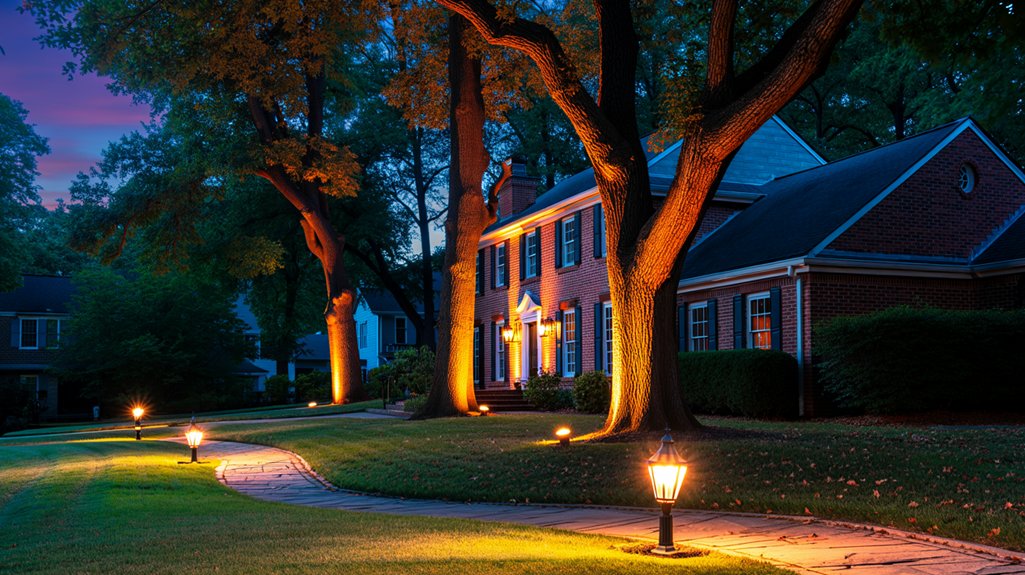
A composed lighting scheme—facade grazing, tree uplighting, and path lighting working in concert—determines whether a residence presents at night or simply disappears into it. Discipline governs the result: full-cutoff shielding, warm color temperatures, and BUG-rating-informed fixture selection per IES TM-15 keep the effect architectural rather than commercial, limiting light trespass onto adjacent properties. Glare left unchecked overwhelms the composition, so ANSI/IES RP-43 informs fixture placement and aiming as practical controls rather than aesthetic preferences.
ANSI/IES RP-43, the recommended practice governing exterior lighting, establishes that facade grazing, tree uplighting, and pathway illumination function as a compositional system rather than a collection of independent fixtures. When these three elements are designed in coordination, the optical relationship between vertical surfaces, canopy planes, and ground-level changes creates architectural depth that remains legible after sunset. A house without this composition does not simply appear darker — it loses the dimensional reading that defines its presence from the street. Discipline in execution is what separates architectural effect from visual noise: full-cutoff shielding, warm color temperature selection, and glare control as directed under RP-43 keep the composition coherent, while BUG-rating-informed fixture selection per IES TM-15 prevents light trespass from compromising neighboring properties.
ANSI/IES RP-43 classifies glare as a direct impairment to visual comfort and identifies it as a measurable failure condition in exterior lighting design, not merely an aesthetic preference. Uncontrolled glare from landscape fixtures draws the eye to the light source itself rather than to the illuminated surface, collapsing the compositional depth that curb appeal depends on. Full-cutoff shielding redirects output onto intended targets — facade planes, canopy structures, grade changes — while eliminating the spill that flattens a night scene into competing bright points. The discipline required is optical and geometric: fixture aiming angles, mounting positions, and lumen output must be calibrated as a system, because a single over-bright or misdirected source disrupts the tonal hierarchy of the entire composition.
Landscape lighting’s return doesn’t resolve into a single metric. Resale recovery is real but properly belongs to a licensed appraiser’s analysis rather than a contractor’s claim, given that valuation depends on comparable sales, market conditions, and the specific improvements made. Where the argument is most defensible on its own terms is in time-in-use and functional square footage — two dimensions that convert installed cost into measurable living utility rather than speculative appreciation.
Landscape lighting qualifies as a capital improvement under generally accepted accounting principles, meaning its installed value enters the cost-basis record of the property rather than being treated as a consumable expense. That classification matters when resale occurs, because a licensed real estate appraiser evaluates permanent improvements against comparable sales data specific to the subject market — a discipline that renders any generic percentage-recovery claim unreliable and potentially misleading. The honest framework has three dimensions: resale recovery, best assessed by a licensed appraiser familiar with the San Antonio market; time-in-use, which converts after-dark hours into functional outdoor living time; and functional square footage, which transforms an illuminated patio or garden into usable space rather than dark yard.
NOAA climate normals recorded at San Antonio International Airport document more than 250 days of annual sunshine and a warm season that extends well into October, making evening hours — rather than midday — the most livable portion of the outdoor day during peak summer months. Landscape lighting converts that after-dark window from an inaccessible interval into functional time, effectively expanding the operating calendar of any outdoor room. A patio, garden terrace, or outdoor kitchen that is dark at eight o’clock in the evening is, by practical measure, unusable square footage; the same space under a composed lighting design becomes an extension of interior living area. In a market where Hill Country-edge lots in The Dominion, shaded canopies in Shavano Park, and garden properties in Alamo Heights are built around outdoor living, that functional recovery is not incidental — it is the primary return on the investment.
Safety and security aren’t incidental benefits of landscape lighting — they’re discrete, measurable utilities. Grade shifts, exposed root zones, and changes in paving material create predictable trip-and-fall hazard zones that path lighting and step lighting address directly, reducing the conditions under which injuries occur. Shadow concealment near primary entries, garage approaches, and dense foundation plantings represents an invitation to unauthorized access that well-placed, glare-controlled perimeter lighting systematically removes.
ANSI/IES RP-43, the recommended practice governing exterior lighting, explicitly identifies grade alterations, steps, and changes in walking surface elevation as priority hazard zones requiring dedicated illumination.
Where pathways shift in plane — at stair nosings, ramp changes, or uneven pavers — shadow accumulation under low ambient light conditions creates the precise circumstances that produce trip-and-fall incidents. San Antonio compounds this exposure through a behavioral pattern that makes clear: the most comfortable and thus most trafficked outdoor hours occur after sunset, when summer heat recedes and residents move through exterior spaces in earnest. Properly positioned low-voltage step lighting and path fixtures, selected with BUG ratings per IES TM-15 that constrain backlight and glare, resolve these hazard zones without producing the disorienting brightness that itself compromises safe pedestrian movement.
ANSI/IES RP-43 identifies shadow concealment near entry points and perimeter plantings as a documented security vulnerability that dedicated exterior illumination is designed to eliminate. Unlit recesses adjacent to doors, dense foundation shrubs, and dark side-yard corridors create low-visibility conditions that reduce natural surveillance and provide concealment opportunity near access points. In San Antonio, where NOAA climate normals confirm more than 250 days of annual sunshine and outdoor activity concentrates in post-sunset hours during the extended warm season, residential exteriors remain occupied environments well into the evening — making perimeter lighting a functional security layer rather than an aesthetic addition. Fixture placement informed by IES TM-15 BUG ratings guarantees that glare is controlled, that light reaches intended concealment zones without spilling onto neighboring properties, and that the result meets the functional intent of RP-43 rather than simply adding ambient brightness.
Landscape lighting functions as a capital improvement that contributes to perceived and market value, though specific valuation outcomes belong to a licensed real-estate appraiser rather than a contractor or manufacturer. The strength of that contribution depends on design discipline, fixture quality, and how meaningfully the installation extends the property’s functional outdoor environment. In San Antonio’s climate, where evening hours represent the most comfortable and usable portion of the day across much of the year, that functional argument carries particular weight.
Landscape lighting meaningfully reduces unauthorized-access risk by eliminating shadow concealment near entries, perimeter plantings, and changeover zones where intruders rely on darkness. The deterrent effect depends on fixture placement discipline rather than raw output — glare-heavy installations can obscure rather than reveal. ANSI/IES RP-43 addresses both security-oriented illumination criteria and the glare-control standards that distinguish effective from counterproductive exterior lighting.
Low-voltage landscape lighting systems governed by NEC Article 411 and listed to UL 1838 operate at voltages that present minimal shock hazard in typical family yard conditions. Proper installation with direct-burial-rated components and listed transformers remains the conditioning factor that separates safe systems from improvised ones. Homeowners should confirm all components carry appropriate listings before installation proceeds.
Warm color temperatures in the 2700K–3000K range produce the most architecturally appropriate results for residential landscape lighting. Cooler temperatures render plant material harshly and impart a commercial character inconsistent with estate-grade exterior environments. ANSI/IES RP-43 affirms warm-spectrum sources as the recommended practice for controlling glare and preserving the intended character of illuminated facades and planted compositions.
San Antonio’s combination of more than 250 sunny days annually, a long warm season, and the evening-use patterns characteristic of Hill Country-edge and established neighborhood lots creates market conditions where low-voltage landscape lighting under NEC Article 411 delivers time-in-use value that few other exterior improvements can match. Backyard Paradiso’s landscape lighting installation work reflects direct familiarity with these conditions, including the fixture selection discipline — full-cutoff shielding, warm color temperature, and BUG-rating-informed specification per IES TM-15 — that separates architectural results from commercial-looking installations. Consultations are available by appointment for properties across The Dominion, Shavano Park, Alamo Heights, and surrounding San Antonio markets. Investment in a properly designed system is most accurately framed through the lens of functional square footage equivalence — illuminated outdoor rooms that perform as usable living environments after dark — and resale recovery assessed in consultation with a licensed real-estate appraiser.