Physical Address
304 North Cardinal St.
Dorchester Center, MA 02124
Physical Address
304 North Cardinal St.
Dorchester Center, MA 02124
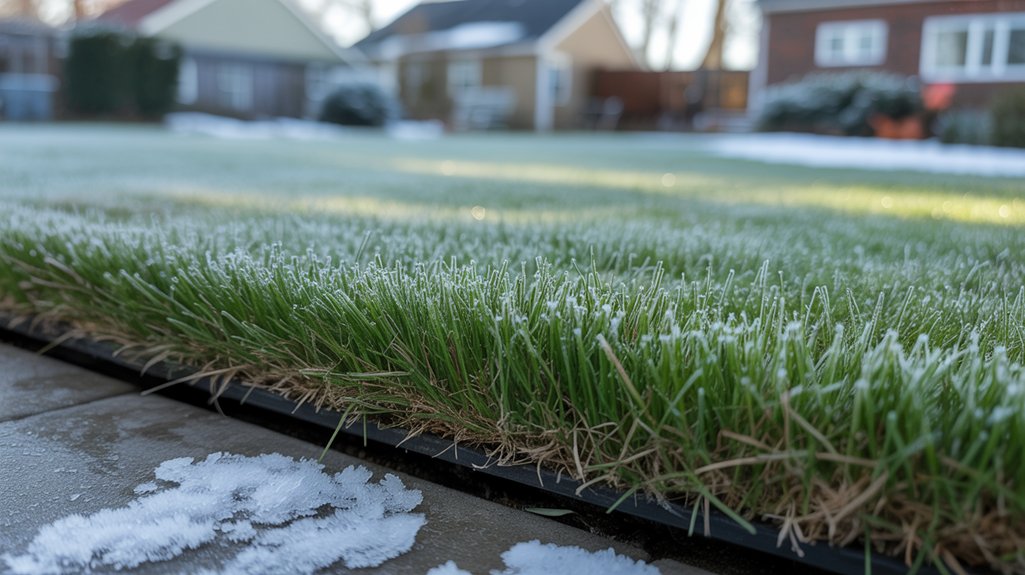
Artificial grass performance in New Jersey's freeze-thaw season depends on base compaction at 90–95% Modified Proctor density and compliance with Bergen County regulations.
Artificial grass maintains structural integrity through Bergen County’s freeze-thaw season when the base layer is properly compacted to 90–95% Modified Proctor density and drainage geometry accounts for the 36-inch frost line. Performance degrades rapidly on HSG C Boonton series soils where poorly drained bases heave across 70-plus annual freeze-thaw cycles. Artificial grass is a synthetic turf system engineered to replace natural turf with polyethylene fiber installed over a compacted aggregate base, delivering consistent surface performance regardless of seasonal ground movement or precipitation.
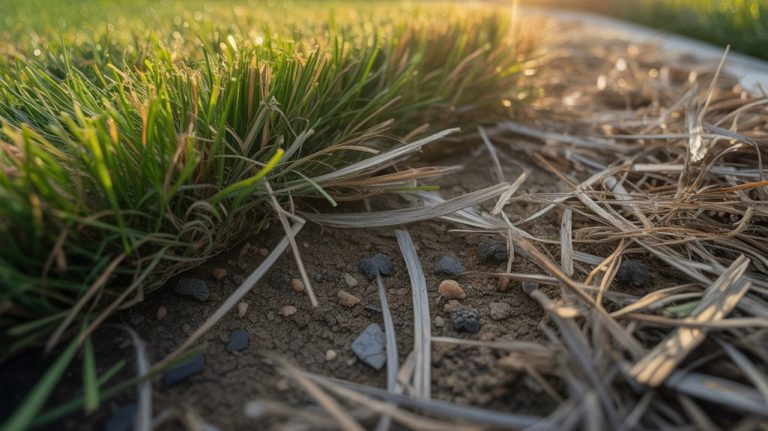
Bergen County’s dominant Boonton series soil — an HSG C glacial till with infiltration rates as low as 0.05 inches per hour — creates conditions where subsurface water accumulates rather than disperses, particularly during the wet-spring saturation periods common above dense diabase substrata. Where perched water tables develop, freeze-thaw cycling acts directly on retained moisture within the base layer, generating heave pressures that compromise compaction integrity over successive winters. Base construction that achieves 90–95% of Modified Proctor density per ASTM D1557, staged in compacted lifts and engineered with drainage geometry calibrated to the 36-inch frost line, determines whether the installation maintains dimensional stability across Bergen County’s 70-plus annual freeze-thaw cycles or progressively degrades from within.
Bergen County’s dominant residential soil — the Boonton series, classified as Hydrologic Soil Group C under NRCS standards — exhibits a saturated hydraulic conductivity of 0.05 to 0.15 inches per hour, a rate insufficient to accommodate concentrated surface drainage without engineered intervention beneath an artificial grass base. Glacial till compaction beneath this series creates perched water table conditions during wet-spring saturation events, trapping moisture within the base profile precisely when freeze-thaw cycling is most frequent. Bergen County logs more than 70 annual freeze-thaw cycles, and repeated volumetric expansion of retained pore water degrades compacted aggregate bases over successive seasons, producing surface displacement and infill redistribution. Base lifts compacted to 90–95% of Modified Proctor density per ASTM D1557 reduce void space and limit water retention capacity, directly extending installation service life under these conditions.
The 2021 New Jersey Residential Code, Section R403.1.4, establishes a 36-inch frost line depth across Bergen County — a structural threshold that directly governs the drainage geometry beneath artificial grass base installations where freeze-thaw cycling drives the primary mechanical degradation pathway. Bergen County logs more than 70 annual freeze-thaw cycles based on NOAA 1991–2020 climate normals recorded at Teterboro Airport (KTEB), and each cycle subjects compacted base material to repeated volumetric stress as retained pore water expands and contracts. Base lifts compacted to 90–95% of Modified Proctor density per ASTM D1557 reduce interstitial void space, limiting the moisture retention that accelerates frost heave. Without base depth and compaction geometry calibrated against the frost line, surface displacement and infill redistribution accumulate progressively across successive seasonal cycles.
Bergen County’s seasonal de-icing regimen introduces chloride compounds to artificial grass installations through runoff migration from adjacent drives and walkways, a condition that ASTM F1551 testing protocols specifically characterize through accelerated exposure sequences to predict long-term fiber integrity. Polyethylene fiber resists chloride penetration more effectively than nylon or polypropylene alternatives, but sustained salt concentration at the infill layer can degrade binder chemistry and accelerate UV-induced fiber brittleness when the two stressors act concurrently. Synthetic Turf Council installation standards address this compounded exposure by specifying fiber and infill combinations that maintain tensile and colorfast performance under conditions Bergen County’s estate corridor consistently produces.
Polyethylene fiber used in residential artificial grass installations is susceptible to surface embrittlement and tensile-strength loss when exposed to chloride ion concentrations characteristic of sodium chloride and magnesium chloride de-icing compounds applied to adjacent driveways and walkways. Along the Bergen County estate corridor, where nor’easter events averaging 18–24 inches generate repeated de-icing applications across winter seasons, chloride migration onto turf perimeters is a recurring seasonal condition rather than an isolated exposure event. UV degradation compounds this effect: prolonged ultraviolet exposure degrades the polymer chain structure in unprotected polyethylene fiber, accelerating the brittleness already initiated by chloride contact. Fiber and infill selection for installations near hardscape edges must account for both degradation mechanisms acting in combination across the corridor’s 70-plus annual freeze-thaw cycles.
ASTM F1551 establishes the thorough performance characterization framework against which synthetic turf fiber systems are evaluated for tensile strength retention, UV resistance, and dimensional stability under cyclic loading and environmental exposure. Along the Bergen County estate corridor, where NOAA 1991–2020 climate normals recorded at Teterboro Airport document annual precipitation averaging approximately 48 inches and snowfall averaging 26–28 inches, fiber systems face compounding stressors that a single-parameter specification cannot adequately capture. Installations near driveways and walks subject to repeated sodium chloride or magnesium chloride application must demonstrate chloride-resistant fiber performance across the corridor’s 70-plus annual freeze-thaw cycles, conditions that accelerate tensile degradation beyond what UV exposure alone would produce. Synthetic Turf Council installation standards align with ASTM F1551 evaluation criteria to define base preparation, seam integrity, and infill compaction requirements that support fiber longevity under these combined mechanical and chemical stressors.
Large-scale artificial grass installations across Bergen County’s estate corridor trigger regulatory review that reaches well beyond municipal permitting. Projects disturbing 5,000 square feet or more require certification from the Bergen County Soil Conservation District under the NJ Soil Erosion and Sediment Control Act — a threshold that estate-scale installations in Alpine, Franklin Lakes, and Saddle River routinely meet. Where installations approach the Saddle River, the Category One designation under N.J.A.C. 7:9B imposes a 300-foot riparian buffer, and any qualifying disturbance within that zone simultaneously engages NJDEP’s post-construction stormwater management requirements under N.J.A.C. 7:8, compounding both the design constraints and the approval sequence.
The Bergen County Soil Conservation District requires certification for any land disturbance of 5,000 square feet or more under the New Jersey Soil Erosion and Sediment Control Act. Artificial grass installations approaching this threshold on Bergen County estate properties — particularly the expansive lot configurations common in Alpine, Saddle River, and Franklin Lakes — must account for this requirement during project scoping. Projects that also qualify as major development under N.J.A.C. 7:8, the NJDEP Stormwater Management Rule effective March 2, 2021, carry additional post-construction stormwater control obligations. Where installations occur near the Saddle River, a Category One designated waterway under N.J.A.C. 7:9B, a 300-foot riparian buffer restricts disturbance scope and conditions site access for base preparation equipment.
The Saddle River carries Category One designation under N.J.A.C. 7:9B, New Jersey’s Surface Water Quality Standards, imposing a 300-foot riparian buffer along most of its corridor length that restricts land disturbance and conditions site access for base preparation equipment. Artificial grass installations within this buffer zone face constrained excavation logistics, limiting the heavy compaction equipment used to achieve the 90–95% Modified Proctor density specified under ASTM D1557 for a properly performing base layer. Projects that independently qualify as major development under the NJDEP Stormwater Management Rule, N.J.A.C. 7:8 — effective March 2, 2021 — carry post-construction stormwater control obligations that intersect with base drainage design decisions, particularly on Saddle River valley floor soils classified as Dunellen series HSG B, where infiltration rates influence compliant outflow management.
Bergen County homeowners considering artificial grass installations consistently raise four questions that cut to the core of long-term system performance: how Bergen County’s 70-plus annual freeze-thaw cycles affect base integrity, whether de-icing salts compromise fiber and infill near paved surfaces, when BCSCD approval becomes a regulatory obligation, and what base depth adequately counters the slow-infiltrating glacial till that dominates corridor soils. Each question carries practical consequence — an undersized base in HSG C Boonton series soil fails differently than one exposed to repeated salt infiltration, and a project crossing the 5,000-square-foot disturbance threshold without BCSCD certification carries legal exposure, not merely technical risk. The answers aren’t interchangeable, because site conditions in Alpine, Saddle River, and Ridgewood each introduce variables that shift the calculus on installation depth, material selection, and permitting obligations.
Bergen County artificial grass base installations endure more than 70 freeze-thaw cycles annually, representing the primary mechanical degradation driver for any compacted aggregate base layer. Proper compaction to 90–95% of Modified Proctor density per ASTM D1557 is essential to resist heave and settlement under repeated thermal cycling. Base geometry must also account for the NJ Residential Code’s 36-inch frost line requirement.
De-icing salt migrates into artificial grass systems through snowmelt runoff, accelerating fiber degradation and disrupting infill performance over time. Polyethylene fiber demonstrates moderate salt tolerance, but repeated seasonal exposure common along Bergen County driveways compounds ultraviolet weathering stress cumulatively. Fiber and infill selection must specifically account for salt exposure on installations adjacent to treated paved surfaces.
Bergen County Soil Conservation District approval is required when an artificial grass installation disturbs 5,000 square feet or more of land, as established under the NJ Soil Erosion and Sediment Control Act. Projects falling below that threshold do not trigger BCSCD certification requirements. The District office is located at 700 Kinderkamack Road in Oradell.
Bergen County glacial till installations require 3–4 inches of compacted aggregate base, installed in lifts to 90–95% of Modified Proctor density per ASTM D1557. Dominant Boonton series soils, classified as HSG C with infiltration rates of only 0.05–0.15 inches per hour, make proper compaction and drainage geometry critical. Seventy-plus annual freeze-thaw cycles amplify base failure risk on underprepared subgrades across the corridor.
Freeze-thaw cycling exceeding 70 annual events, HSG C Boonton series soils with infiltration rates as low as 0.05 inches per hour, and a 36-inch frost line under the 2021 NJ Residential Code collectively define the performance envelope that any artificial grass installation must be engineered to meet across Bergen County’s estate corridor. Backyard Paradiso has accumulated direct field experience with these conditions through artificial grass installations across Alpine, Tenafly, Englewood Cliffs, Franklin Lakes, Wyckoff, Ridgewood, Saddle River, and Upper Saddle River. The firm operates by appointment, allowing site-specific consultation that accounts for variables including perched water tables over dense glacial till, Palisades diabase outcrops along the bluff-line communities, and de-icing salt exposure adjacent to drives and walks. Investment in a correctly engineered base system — compacted to 90–95% of Modified Proctor density and designed for the site’s actual drainage constraints — tends to recover value through functional outdoor square footage that performs across the full four-season range Bergen County demands.