Physical Address
304 North Cardinal St.
Dorchester Center, MA 02124
Physical Address
304 North Cardinal St.
Dorchester Center, MA 02124
Uncover why Colorado Springs' harsh climate and shifting soils may make pavers the smarter patio choice over concrete for your property.
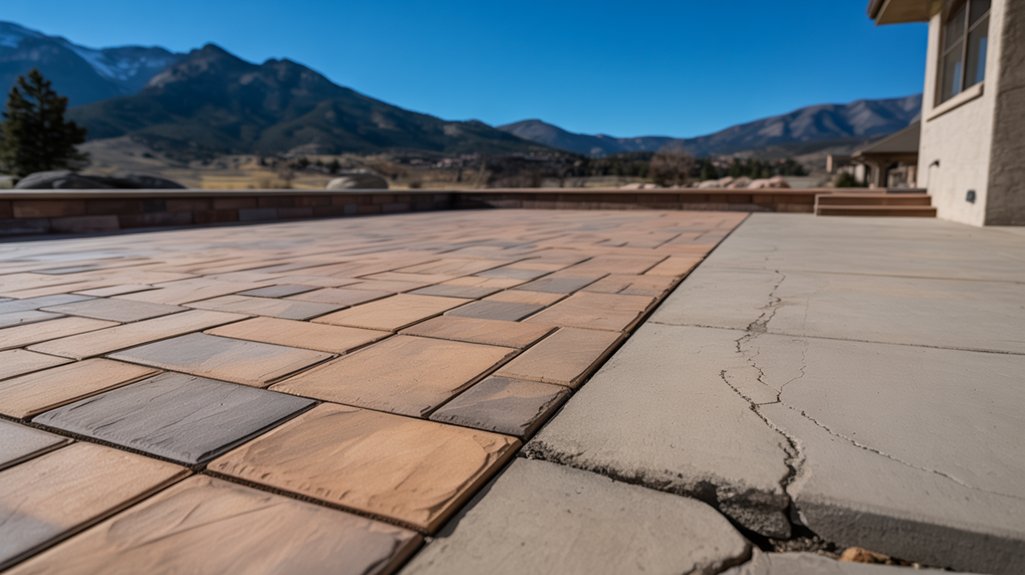
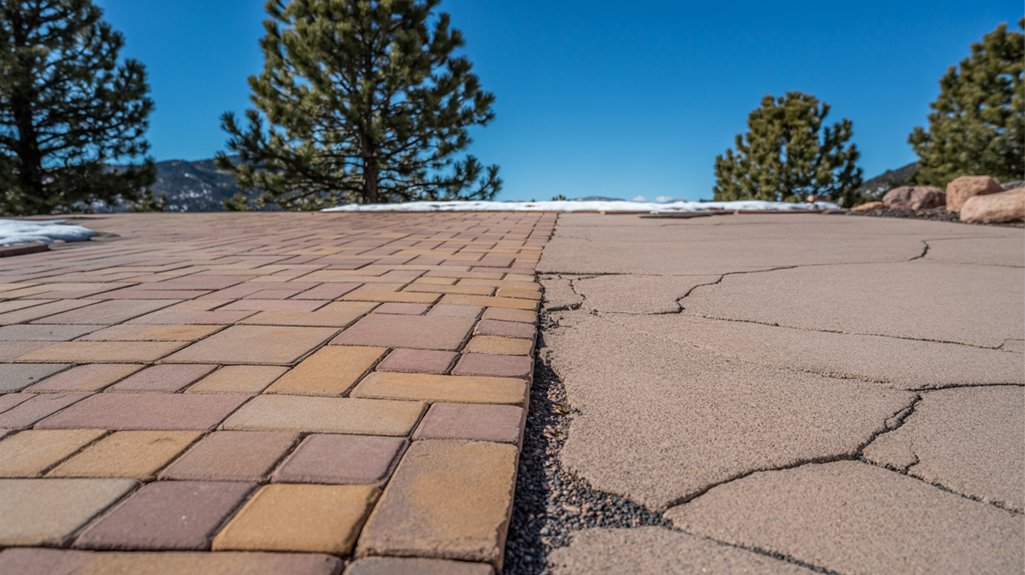
For patio construction at estate scale in Colorado Springs, interlocking pavers outperform poured concrete slabs under the site conditions that define the Front Range — expansive clay soils, pronounced freeze-thaw cycling, and high-altitude UV exposure that accelerates surface degradation in monolithic materials. The pavers vs concrete patio comparison isn’t genuinely close here. Poured concrete behaves as a single rigid plane; soil movement and thermal contraction fracture it. Pavers distribute that same stress across discrete joints, preserving structural integrity where a slab would fail. Repair follows the same logic — individual units replace without disturbing adjacent material. On properties where hardscape integrates with mountain sight lines and outdoor living features, that long-term dimensional stability carries meaningful design and economic consequence.
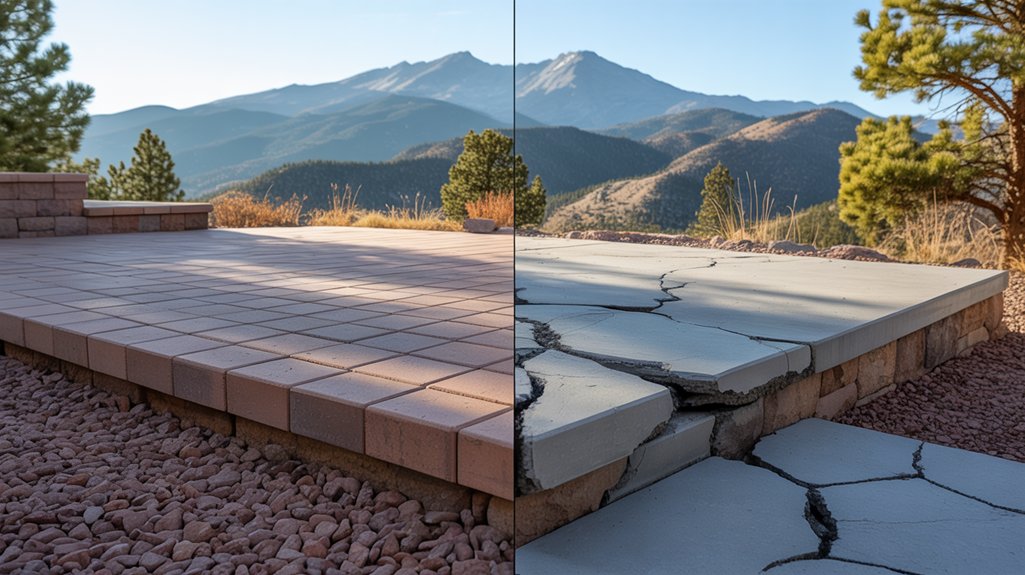
Colorado Springs’ high-altitude semi-arid climate—characterized by intense ultraviolet radiation, low annual precipitation, and pronounced freeze-thaw cycling through the cold months—creates material stress conditions that distinguish this market from lower-elevation Front Range sites. The soil profile compounds that challenge: expansive clay interbedded with decomposed granite generates subsurface movement that rigid, monolithic surfaces can’t accommodate without cracking. Stage 1 drought restrictions currently in effect through April 2027 add a third variable, favoring permeable hardscape configurations that manage stormwater on-site rather than routing it to municipal infrastructure.
Sitting at roughly 6,000 feet on the Front Range, Colorado Springs subjects hardscape materials to a freeze-thaw patio conditions that’s more consequential than moisture alone would suggest. Ultraviolet intensity at elevation accelerates surface degradation in cementitious materials faster than comparable installations at lower altitudes. The soil compounds this. Expansive clay contracts and heaves with seasonal moisture variation, while decomposed granite shifts under load. Poured concrete, which behaves as a monolithic unit, has no capacity to absorb differential movement without cracking. Interlocking pavers distribute that movement across joints rather than concentrating stress at fixed points. The result isn’t merely aesthetic—it’s structural resilience built into the installation method itself. Both variables, climate and soil, argue against rigid slabs before a single material cost is calculated.
Climate and soil set the conditions; material selection determines how well a patio survives them. Interlocking concrete pavers manufactured to a higher compressive density than standard cast concrete resist surface spalling under repeated freeze-thaw cycling—a direct consequence of reduced water absorption at the unit level. Clay pavers carry comparable durability credentials, though regional availability narrows the field. Poured concrete slabs, by contrast, absorb moisture, and cracking under expansive clay movement isn’t incidental; it’s predictable. Paver patio service life in Colorado Springs routinely extends beyond two decades when base preparation accounts for soil displacement. Individual units can be lifted, substrate corrected, and pavers reset without visible scarring. A concrete slab offers no equivalent repair economy; damage compounds rather than resolves.
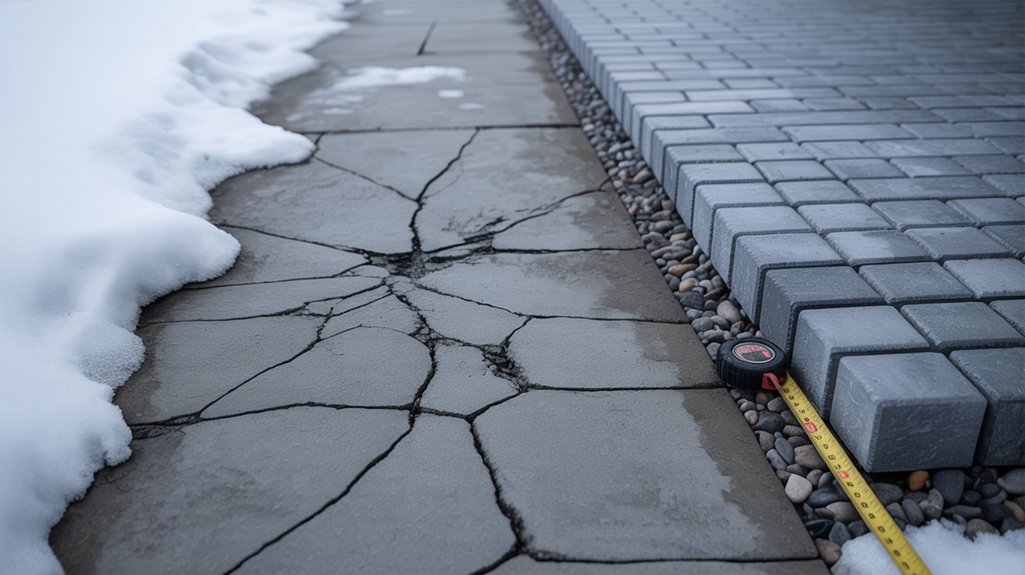
Substrate composition and installation engineering govern patio longevity far more decisively than material selection alone. Colorado Springs’ expansive clay and decomposed granite profiles shift laterally and vertically across seasonal cycles, and any surface assembly that can’t redistribute that movement into its joints will eventually crack, heave, or delaminate. Whether the chosen system accommodates or resists that movement determines whether maintenance stays routine or becomes structural.
Where a patio must perform across decades rather than merely seasons, the substrate and surrounding environment become the primary determinants of material selection—not aesthetics, not cost. Colorado Springs presents a compound challenge: expansive clay that shifts with moisture cycling, decomposed granite that drains rapidly but offers inconsistent bearing capacity, and freeze-thaw oscillations that test any rigid assembly. Paver base preparation addresses these variables directly. A properly graded aggregate base accommodates differential movement without transferring stress to the surface layer. Poured concrete lacks that flexibility; substrate displacement produces cracks rather than isolated unit failures. At elevation, ultraviolet intensity accelerates surface degradation in concrete, while interlocking units remain individually replaceable. The environment here doesn’t merely influence material performance—it actively determines which systems remain structurally coherent long-term.
Substrate behavior sets the constraint; installation engineering determines whether a patio system respects it or fights it. A paver patio in Colorado Springs demands a compacted aggregate base deep enough to account for frost depth and expansive clay displacement—conditions that a monolithic concrete slab addresses through thickness and reinforcement rather than flexibility. When soil shifts, the slab transmits stress as cracking; pavers redistribute it through joint movement. Base preparation quality governs which system performs as intended. Improperly compacted base material undermines both, but the failure modes differ: a compromised slab fractures irrecoverably, while a compromised paver field settles unevenly yet remains correctable. Edge restraint selection, bedding sand consistency, and drainage slope all carry measurable consequence at the estate scale, where finished area and loading conditions amplify installation tolerances markedly.
A paver patio doesn’t function in isolation; it anchors a broader hardscape system that typically includes retaining walls, outdoor kitchens, fire features, pergola footings, and drainage infrastructure, all of which must coordinate dimensionally and materially from the earliest design phase. Poured concrete complicates this coordination because changes to the slab boundary or surface plane after installation require demolition rather than adjustment, limiting adaptive response when adjacent features evolve or when grade corrections become necessary. Pavers, by contrast, allow contractors to lift, regrade, and relay discrete sections without disturbing the surrounding field, a recovery characteristic that carries particular consequence on expansive-clay sites where phased construction and post-settlement correction are practical realities rather than contingencies.
Paver patios don’t function in isolation—they’re typically one component within a coordinated outdoor living program that includes pergolas, fire features, outdoor kitchens, water features, and planted borders, all of which impose their own structural, drainage, and access requirements on the hardscape beneath and around them. Utility rough-ins for gas, electrical, and irrigation must be mapped before installation, since pavers allow future access without demolition costs that erode paver patio cost recovery. Pergola footings and kitchen pad elevations must be resolved at the design stage, not retrofitted. Where these elements converge, Backyard Paradiso coordinates scope across categories rather than treating each feature as an independent contract. That coordination directly affects how joints align, how drainage grades resolve, and whether the finished system performs as a unified composition.
When the full outdoor living program is considered—pergolas, fire features, kitchens, water features, planted borders—paver systems justify their higher installation cost through a service-life model that concrete slabs can’t replicate under Colorado Springs conditions. A poured concrete slab patio reaches an inflection point after one sustained freeze-thaw cycle causes a significant crack; repair options narrow to patching or full demolition. Pavers don’t share that constraint. Individual units lift, reset, or replace without disturbing the field. Utility penetrations added years after installation leave no permanent scar. On expansive clay soils characteristic of the Front Range, differential settlement is probable, not theoretical. Paver systems absorb that movement and remain serviceable; slabs record it permanently. Long-term maintenance cost and functional continuity both favor the interlocking system.
Homeowners weighing pavers against poured concrete for estate-scale patios tend to surface the same practical concerns once the design conversation advances: how each surface behaves under repeated freeze-thaw cycling, what soil movement does to long-term integrity, and whether repair costs accrue differently over a ten- or twenty-year horizon. The answers shift meaningfully depending on property type—a Broadmoor estate with a formal entertaining terrace carries different performance priorities than a Black Forest property where decomposed granite subsoil and expansive clay create more aggressive substrate movement. Maintenance considerations, drainage compatibility, and the way each material integrates with adjacent features like fire structures, water elements, and covered outdoor rooms all factor into a decision that extends well beyond initial installation cost.
After working through the core comparison between pavers and poured concrete, most clients arrive at a predictable cluster of follow-up questions—each one grounded in a specific concern about long-term performance, cost structure, or design integration rather than abstract curiosity. Paver patios generate the most sustained inquiry, particularly around maintenance intervals, freeze-thaw repair expectations, and base preparation standards specific to Colorado Springs’ expansive clay soils. Cost questions tend to surface next, typically framed around initial installation versus long-term repair economics rather than material price alone. Design integration follows—specifically how paver selections align with mountain-facing sight lines and adjacent outdoor living structures common to estate-scale properties. Each question reflects a distinct decision point. Addressing them individually allows for the conditional, site-specific answers these properties actually require.
Property type shapes the pavers-versus-concrete decision more than almost any other variable, because the performance requirements, budget structures, and aesthetic expectations that govern a 12,000-square-foot Black Forest estate differ materially from those of a mid-range suburban lot in the northern corridors. Estate properties typically integrate paver patios with outdoor kitchens, fire features, and grade changes that demand modular flexibility — conditions where monolithic concrete accumulates repair liabilities over time. Smaller residential lots present a different calculus: tighter budgets sometimes favor an initial concrete pour, though long-term replacement costs frequently offset that advantage. Commercial and semi-public properties introduce load and maintenance cycles that further separate the two materials. Soil type, lot scale, and intended use each function as independent variables, and their intersection determines which material performs with acceptable durability.
Maintenance for paver patios and poured concrete slabs diverges across five distinct categories: joint stabilization, surface sealing, freeze-thaw remediation, drainage management, and long-term structural correction. Paver patios require periodic polymeric sand replenishment as joint material migrates under Colorado Springs’ pronounced freeze-thaw cycling. Sealing extends color retention and limits moisture infiltration, though reapplication intervals depend on UV exposure intensity at elevation. Concrete demands crack monitoring; unaddressed fissures admit water that expands during freeze cycles, accelerating deterioration. Drainage management remains material-agnostic but critical given expansive clay soils beneath both systems. Where structural correction becomes necessary, pavers permit selective unit removal and replacement without disrupting adjacent surfaces. Concrete correction typically requires sectional demolition. Cumulative maintenance costs favor pavers across extended ownership periods on estate-scale properties.
How hardscape materials perform alongside other outdoor living features matters as much as how they perform in isolation. Interlocking pavers accommodate the varied geometries that outdoor kitchens, fire pit surrounds, pergola footings, and water features typically require. Each element can shift cleanly into the paver field without demanding saw cuts or cold joints that introduce failure points under freeze-thaw cycling. Concrete slabs, by contrast, impose fixed dimensional constraints that complicate phased additions. When a property incorporates mountain-facing sight lines, as many Broadmoor and Black Forest estates do, the material pattern can be adjusted directionally without disrupting structural continuity. Grade shifts between lawn zones and built structures resolve more predictably in a modular system. That adaptability compounds in value as outdoor living programs expand over time.
Homeowners maneuvering the paver-versus-concrete decision benefit from working with a contractor who understands both the material science and the site-specific variables that define Front Range installations. Backyard Paradiso operates from Colorado Springs and specializes in paver patios scaled to estate properties across the Broadmoor, Black Forest, and northern corridors. Their process accounts for expansive clay behavior, freeze-thaw cycling, and drought-sensitive site planning from the outset, rather than as afterthoughts. Material selection, base engineering, and drainage routing are coordinated before installation begins. Consultations are available by appointment at 111 W Las Vegas St, Colorado Springs, CO 80903. Homeowners considering a patio investment at this scale benefit from early engagement, when site conditions can still inform design decisions rather than constrain them.